Iehuiah: The Angel of Sovereignty and Faithful Power
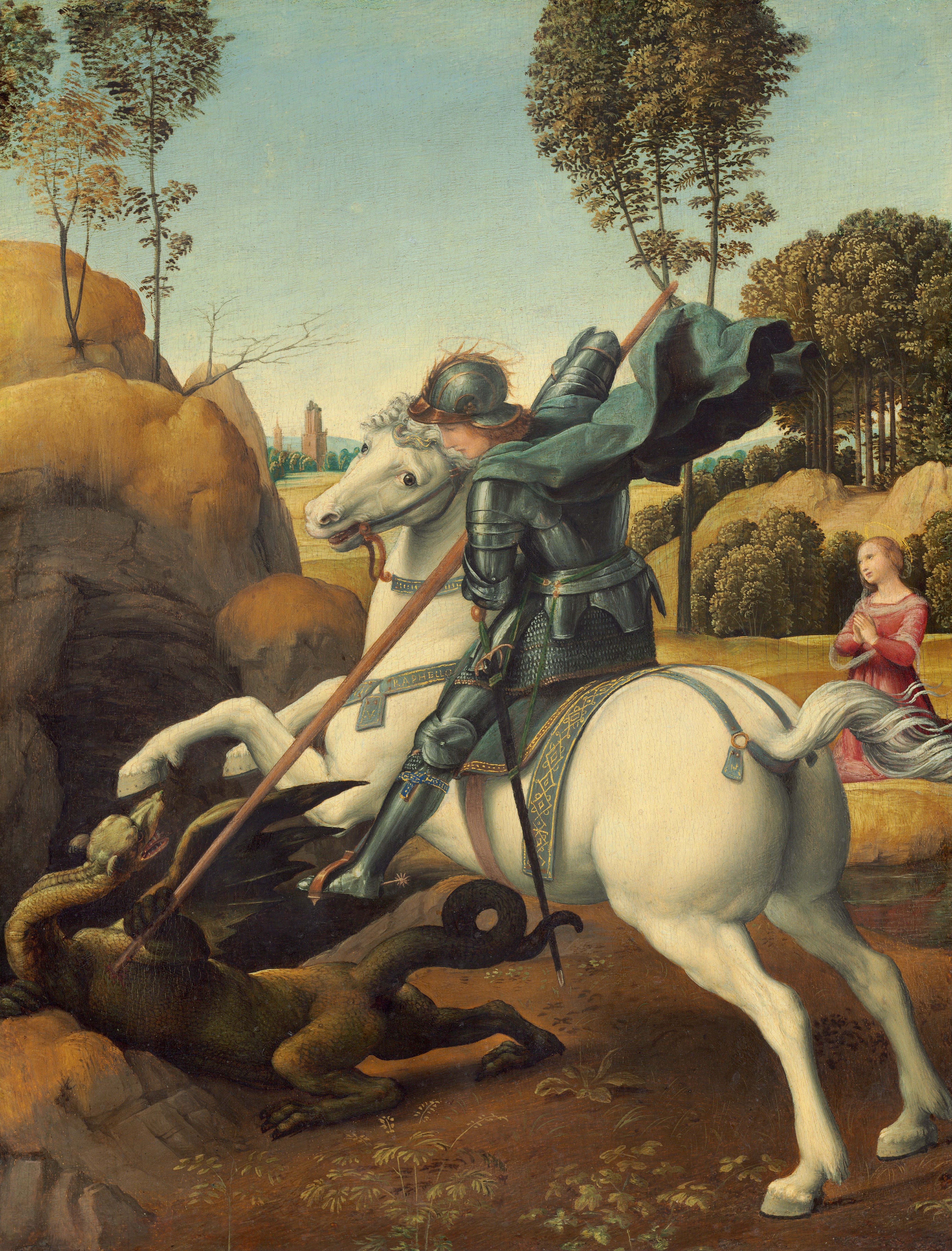
In Raphael's small, brilliant panel of Saint George, the knight rides a white horse straight at a dragon, lance lowered, cloak streaming behind him. The princess kneels in the distance, hands joined in prayer. There is no cruelty in the picture, only concentration.
The knight does not rage at the beast; he does what must be done, with a calm that comes from knowing whom he serves. In the Kabbalistic tradition of the seventy-two angels, this steady, faithful strength belongs to Iehuiah, the angel of rightful authority.
Iehuiah is invoked by those who must lead, by those who have been betrayed and by anyone who needs to master their own unruly impulses. He is the angel of order that rests on loyalty rather than on fear.
The Thirty-Third Name
The Shem HaMephorash, the "explicit name" of God, is a Kabbalistic teaching that draws seventy-two names of three letters from three verses of the Book of Exodus (14:19–21). Each name came to be associated with an angel who expresses one aspect of the divine power.
Iehuiah is the thirty-third of these names. It is formed from the Hebrew letters Yod, Chet and Vav, followed by the divine suffix "-iah." In later angelic tradition, the seventy-two angels are arranged in nine choirs of eight, and Iehuiah opens the fifth choir, the Powers, the angels who guard the boundary between order and chaos and restrain the forces that threaten the world.
In the system popularized by later French occultists, each angel rules five degrees of the zodiac, counting from the beginning of Aries. Following that scheme, Iehuiah governs the degrees from 10° to 15° of Virgo, a sign associated with discernment, service and the careful sorting of the true from the false.
The Just Commander
Tradition calls Iehuiah the angel of order and subordination. He is asked to help a leader earn the loyalty of those who follow, and to bring to light any hidden enemy or false friend who works against a good cause. Because he belongs to the Powers, his gift is not the authority of the tyrant but that of the guardian, a power that exists to protect.
The old teachers saw a close link between outer and inner command. A person who cannot govern their own appetites will not govern others for long. Iehuiah therefore teaches the discipline that begins at home, inside the self, where passions, fears and ambitions must be placed in their right order.
The Inner Hierarchy
In the path of theurgy, Iehuiah is sometimes called the master of the inner hierarchy. The idea is ancient. Plato pictured the soul as a charioteer guiding two horses, one noble and one wild. Medieval writers described the mind as a kingdom in which reason should rule the will and the will should rule the senses.
Iehuiah is invoked so that this inner kingdom may be well governed. He does not suppress the lower instincts but gives them a rightful place, like a good king who respects every part of his realm and allows none of them to seize the throne.
His Esoteric Gifts
According to the angelic tradition, Iehuiah is invoked above all for victory over betrayal and for the establishment of legitimate authority. Those who work with him seek these gifts:
- Discernment: perceiving the true intentions of friends, colleagues and followers.
- Mastery over disorder: bringing calm and structure to a confused or rebellious situation.
- Earned loyalty: inspiring deep trust by acting with honesty and consistency.
- Self-discipline: ruling one's own habits and impulses with firmness and kindness.
Authority Built, Not Taken
Our age is suspicious of authority, and often with good reason, because it has been abused so many times. Iehuiah represents a different model. In his teaching, authority is not seized by force. It grows slowly from faithful service, clear words and a record of keeping promises.
A leader who is respected only out of fear loses everything when fear passes. A leader who has proved faithful to the truth, in small things and in great ones, holds a power that cannot be taken away. Saint George did not win the people of the city by boasting; he won them by facing the beast.
Meditation: The Silver Gavel
To connect with Iehuiah, the tradition suggests a simple meditation. Find a quiet place where you will not be disturbed.
- Visualization: Imagine yourself holding a heavy silver gavel with a red gem glowing at its center.
- The sound: See yourself striking it once and hear a deep silence spread through the room.
- Invocation: Say silently, "Iehuiah, establish the order. Grant me the authority of the just and the loyalty of the true. Reveal what is hidden and strengthen the faithful bond. Let my word be honest and my rule be love."
- Action: Look honestly at one relationship in which the boundaries are unclear, and state a respectful but firm limit today.
For further study, readers often turn to The 72 Angels of Magick by Damon Brand, the medieval Sefer Raziel HaMalakh, and The Qabalistic Tarot by Robert Wang.
Closing
Iehuiah is the angel of the steady hand and the faithful word. Like the knight in Raphael's panel, who faces the dragon without hatred and without doubt, he teaches that true power is a service and that order begins in the heart that has learned to govern itself.
Those who call on him ask for the strength to lead justly, the clarity to see through deceit and the loyalty that no storm can shake.
Related Esoteric Inquiries
- Ieiazel: The Angel of Expression and Creative Liberation
- Haamiah: The Angel of Sacred Ritual and Protection
- Menadel: The Angel of Purpose and Hidden Truths
Lux Esoterica.
2026.


Comments