African Sacred Art: Masks, Bronzes, and the Ancestors
The sacred art traditions of sub-Saharan Africa constitute some of the most sophisticated sculptural achievements in human history — and some of the most systematically misrepresented. When Picasso and the Paris avant-garde encountered African masks in the early 20th century, they saw in them a formal boldness and psychological intensity that European academic art had lost, and they borrowed from them the stylistic revolution that became Cubism. What they did not fully understand was that these objects were not aesthetic artifacts in any modern sense: they were sacred objects, each with a specific ritual function, each the product of specialized artistic lineages whose makers were initiates as much as craftsmen, each encoding a theological and cosmological worldview of extraordinary sophistication. The bronze heads of Ife, the brass plaques of Benin, the terracotta figures of the Nok culture, the ivory masks of the Oba's court — these are not primitive art. They are the mature expression of civilizations that took the sacred seriously enough to commit their best technical achievements to its service.
 [Unavailable: ❌ https://upload.wikimedia.org/wikipedia/commons/thumb/9/9a/Arte_yoruba%2C_nigeria%2C_testa_da_ife%2C_12-15mo_secolo.JPG/250px-Arte_yoruba%2C_nigeria%2C_testa_da_ife%2C_12-15mo_secolo.JPG ❌]
Head from Ife, Yoruba, Nigeria (12th-15th century CE) — cast in naturalistic bronze with extraordinary technical mastery, these heads of Yoruba kings (oni) are among the finest portrait sculptures produced anywhere in the world at this period; the striations on the face represent scarification marks of royalty
 [Unavailable: ❌ https://upload.wikimedia.org/wikipedia/commons/thumb/d/d3/Queen_Mother_Pendant_Mask-_Iyoba_MET_DP231460.jpg/250px-Queen_Mother_Pendant_Mask-_Iyoba_MET_DP231460.jpg ❌]
Queen Mother Pendant Mask (Iyoba), Kingdom of Benin (early 16th century) — carved in ivory, one of a pair worn at the waist by the Oba during state ceremonies; the face is identified as Queen Mother Idia, the first Iyoba of Benin, whose power and counsel were crucial to the Oba's military victories
 [Unavailable: ❌ https://upload.wikimedia.org/wikipedia/commons/thumb/e/ef/Plaque-_Warrior_and_Attendants_MET_DT1231.jpg/250px-Plaque-_Warrior_and_Attendants_MET_DT1231.jpg ❌]
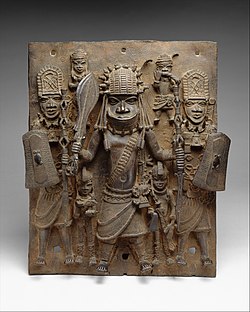
Benin Plaque — Warrior and Attendants (16th-17th century) — one of hundreds of brass relief plaques that covered the pillars of the Benin royal palace; they constitute a visual history of the kingdom and a theological statement of royal power; when British forces looted Benin City in 1897, they removed over 1,000 such objects
 [Unavailable: ❌ https://upload.wikimedia.org/wikipedia/commons/thumb/5/5b/Benin_plaque_in_the_Ethnological_Museum%2C_Berlin_-_026.JPG/250px-Benin_plaque_in_the_Ethnological_Museum%2C_Berlin_-_026.JPG ❌]
Benin bronze plaque, Ethnological Museum, Berlin — the Benin Bronzes are among the most contested objects in the international debate on cultural restitution; over 1,000 pieces are distributed across 160 institutions worldwide; Nigeria and Benin City have requested their return since independence
 [Unavailable: ❌ https://upload.wikimedia.org/wikipedia/commons/thumb/e/e2/Nok_sculpture_Louvre_70-1998-11-1.jpg/250px-Nok_sculpture_Louvre_70-1998-11-1.jpg ❌]
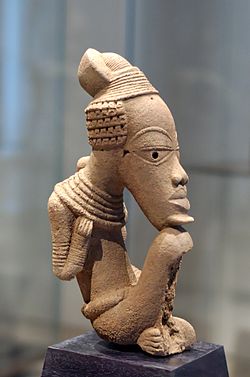
Nok terracotta figure, Louvre Museum (5th century BCE-5th century CE) — the Nok civilization of central Nigeria produced the oldest known sub-Saharan sculptural tradition; their terracotta figures, with their characteristic triangular eyes and elaborate hairstyles, precede the Ife and Benin traditions by over a millennium
 [Unavailable: ❌ https://upload.wikimedia.org/wikipedia/commons/thumb/2/27/Africa_Nok_Male_Figure_Kimbell.jpg/250px-Africa_Nok_Male_Figure_Kimbell.jpg ❌]
Nok male figure, Kimbell Art Museum (500 BCE-500 CE) — the Nok figures depict human beings with the same confident naturalism as the Greek Classical tradition, developed entirely independently; the similarity poses fundamental questions about the nature of artistic development in different cultures
 [Unavailable: ❌ https://upload.wikimedia.org/wikipedia/commons/thumb/b/b4/Brooklyn_Museum_61.33_Ndop_Portrait_of_King_Mishe_miShyaang_maMbul_%285%29.jpg/250px-Brooklyn_Museum_61.33_Ndop_Portrait_of_King_Mishe_miShyaang_maMbul_%285%29.jpg ❌]
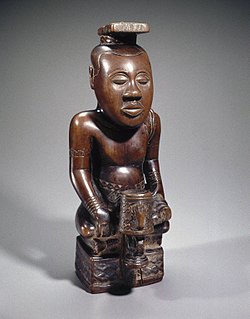
Ndop portrait of King Mishe miShyaang maMbul, Kuba Kingdom (18th century) — the Kuba ndop figures are portrait statues of kings, each identified by a specific emblem carved at the base; they were believed to contain the king's spirit and served as the locus of royal ritual during the king's absence
 [Unavailable: ❌ https://upload.wikimedia.org/wikipedia/commons/thumb/0/02/Brooklyn_Museum_78.118.6_Maiden_Spirit_Mask.jpg/250px-Brooklyn_Museum_78.118.6_Maiden_Spirit_Mask.jpg ❌]
Maiden Spirit Mask (Agbogho Mmuo), Igbo people (early 20th century) — the white-faced maiden spirit masks of the Igbo represent the spirits of deceased young women, returning to the community in celebration; the mask is not a disguise but a vehicle of presence — the spirit inhabits the mask and acts through it
 [Unavailable: ❌ https://upload.wikimedia.org/wikipedia/commons/thumb/d/de/Afrikaabteilung_in_Ethnological_Museum_Berlin_29.JPG/250px-Afrikaabteilung_in_Ethnological_Museum_Berlin_29.JPG ❌]
Ife bronze head, Ethnological Museum, Berlin — the naturalism of Ife portraiture (14th-15th century) was so unexpected when it reached Europe in the early 20th century that Leo Frobenius initially attributed it to ancient Greece or a lost civilization; he could not believe that Africans had produced art of this sophistication, revealing the limits of his own understanding
 [Unavailable: ❌ https://upload.wikimedia.org/wikipedia/commons/thumb/0/06/Leopard_aquamanile%2C_Nigeria%2C_Benin_Kingdom%2C_17th_century_AD%2C_brass_-_Ethnological_Museum%2C_Berlin_-_DSC02208.JPG/250px-Leopard_aquamanile%2C_Nigeria%2C_Benin_Kingdom%2C_17th_century_AD%2C_brass_-_Ethnological_Museum%2C_Berlin_-_DSC02208.JPG ❌]
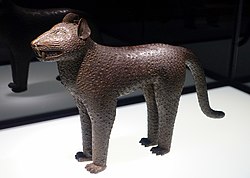
Leopard aquamanile, Kingdom of Benin (17th century) — a water vessel in the form of a leopard, the royal animal of the Oba; the leopard in Benin royal iconography represents the divine power of the king, his capacity to move between the human and spirit worlds; only the Oba could own real leopards
Related Esoteric Inquiries:
- The Bronze Guardians of Benin: Alchemical Sovereignty and Ancestral Power
- Chinese Ritual Bronzes: The Sacred Vessels of the Shang and Zhou
- Vodou: The Living Religion of the African Diaspora — Lwa, Ceremony, and Sacred Resilience
Lux Esoterica.
2026.


Comments