Ajanta and Ellora: Buddhist Cave Temples of Ancient India
Cut directly into basalt cliffs by monks and artists over a period of nearly seven centuries (2nd century BCE to 6th century CE), the Ajanta Caves constitute the most complete surviving example of ancient Indian Buddhist art — 30 cave temples whose walls and ceilings preserve paintings of extraordinary quality depicting the Jataka tales (stories of the Buddha's previous lives), scenes from the life of the historical Buddha, and celestial beings of such expressive power that they have never been surpassed in the history of Indian painting. The nearby Ellora Caves (extending the tradition through Hinduism and Jainism) add the greatest rock-cut temple in the world: the Kailasa temple, carved from the top down from a single basalt outcrop, its 30-meter height achieved by removing 200,000 tons of rock. These are not buildings constructed from assembled materials. They are existing mountains, revealing the sacred within them.
 [Unavailable: ❌ https://upload.wikimedia.org/wikipedia/commons/thumb/e/e0/AJANTA_CAVES_-_C.SHELARE_%282%29.jpg/330px-AJANTA_CAVES_-_C.SHELARE_%282%29.jpg ❌]
Cave 19, Ajanta — the chaitya (prayer hall) façade with its horseshoe-arch window and elaborate sculptural program; the 30 caves of Ajanta were carved in two distinct phases separated by four centuries; the later Mahayana phase (5th-6th century CE) produced the most elaborate painted programs and the most sophisticated sculptural work
 [Unavailable: ❌ https://upload.wikimedia.org/wikipedia/commons/thumb/4/4d/Life_circle_of_Lord_Buddha_-_A_marvel_of_painting_inside_Ajanta_Cave.jpg/250px-Life_circle_of_Lord_Buddha_-_A_marvel_of_painting_inside_Ajanta_Cave.jpg ❌]
Life cycle of the Buddha, Ajanta — the narrative paintings of Ajanta are the oldest surviving large-scale paintings in Asia; painted with mineral pigments on a mud-plaster base, they depict scenes from the Jataka tales with a naturalism, emotional range, and compositional sophistication that anticipates Italian Renaissance fresco painting by a millennium
 [Unavailable: ❌ https://upload.wikimedia.org/wikipedia/commons/thumb/0/0b/Hamsa_j%C3%A2taka%2C_Ajanta%2C_India.jpg/250px-Hamsa_j%C3%A2taka%2C_Ajanta%2C_India.jpg ❌]
Hamsa Jataka, Cave 17 — the Buddha as a golden goose (hamsa) in a previous life, teaching the king's wives; the Jataka tales depict the Buddha's previous lives as animals, commoners, and kings — the entire range of sentient experience — building compassion through narrative; the goose's golden light fills the composition with the quality of the teaching itself
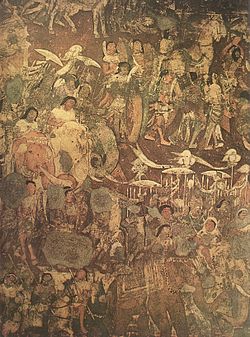 [Unavailable: ❌ https://upload.wikimedia.org/wikipedia/commons/thumb/9/96/Coming_Of_Sinhala_%28Mural_At_Ajanta_In_Cave_No_17%29.jpg/250px-Coming_Of_Sinhala_%28Mural_At_Ajanta_In_Cave_No_17%29.jpg ❌]
Coming of Sinhala, Cave 17 — the narrative painting shows a prince's arrival by ship; the Ajanta painters depicted clothing, hairstyles, architecture, and social customs of 5th-century India with documentary precision alongside their sacred content, making these caves simultaneously a religious monument and an anthropological archive
 [Unavailable: ❌ https://upload.wikimedia.org/wikipedia/commons/thumb/d/d3/Meister_des_Mah%C3%A2janaka_J%C3%A2taka_001.jpg/250px-Meister_des_Mah%C3%A2janaka_J%C3%A2taka_001.jpg ❌]
Mahajanaka Jataka, Cave 1 — King Mahajanaka (the Buddha in a previous life) renouncing his kingdom; the king's composed expression as he prepares to abandon worldly power is one of the great portrait achievements of ancient Indian art; the women lamenting around him embody attachment — the very thing the king is demonstrating how to release
 [Unavailable: ❌ https://upload.wikimedia.org/wikipedia/commons/thumb/e/ee/Ajanta_Cave_2_Birth_of_the_Buddha.jpg/250px-Ajanta_Cave_2_Birth_of_the_Buddha.jpg ❌]
Birth of the Buddha, Cave 2 — the infant Siddhartha taking his first seven steps at birth, declaring his final incarnation; each step produces a lotus; the scene is rendered with the architectural precision and figural grace that characterizes the finest Ajanta work; the cave's original lamp-lit environment would have made the gilded figures appear to move in the flickering light
 [Unavailable: ❌ https://upload.wikimedia.org/wikipedia/commons/thumb/1/14/Ajanta_Cave_26_Dagoba_with_praying_monks.jpg/250px-Ajanta_Cave_26_Dagoba_with_praying_monks.jpg ❌]
Dagoba with praying monks, Cave 26, Ajanta — the stupa at the heart of the chaitya hall, the axis of devotion around which monks circumambulated in meditation; the combination of sculptural program and architectural space at Ajanta creates environments designed to produce specific psychological and spiritual states in those who inhabit them
 [Unavailable: ❌ https://upload.wikimedia.org/wikipedia/commons/thumb/f/f7/067_Cave_4%2C_Buddhas%2C_Sitting_and_Standing_%2834123205802%29.jpg/250px-067_Cave_4%2C_Buddhas%2C_Sitting_and_Standing_%2834123205802%29.jpg ❌]
Seated and standing Buddhas, Cave 4, Ajanta — the seated Buddha in the dhyana (meditation) mudra flanked by standing Bodhisattvas; the scale and serenity of these figures, carved directly from the living rock of the cliff, creates the impression that they were always there — that the cliff itself was always a Buddha, waiting to be revealed by the sculptor's chisel
Related Esoteric Inquiries:
- The Ajanta and Ellora Caves: Temples of the Mind
- The Vimanas of Ancient India: Mercury Vortices and the Aetheric Chariots
- Thangka: Sacred Paintings of the Tibetan Buddhist World
Lux Esoterica.
2026.


Comments