Alchemy: The Great Work and Opus Magnum — Inner and Spiritual Transformation
Alchemy is perhaps the most misunderstood esoteric tradition in history. For centuries it was seen as nothing more than primitive proto-chemistry: long-bearded men surrounded by smoking alembics, trying to turn lead into gold. However, that simplistic image conceals a philosophical and spiritual discipline of extraordinary depth. Alchemy was, before anything else, a path of transformation: of the soul, of matter, and of the cosmos.
In this article we explore the Great Work — the Opus Magnum — from its roots in ancient Egypt to its influence on modern psychology, passing through the great masters who dedicated their entire lives to deciphering its secrets.

Hermes Trismegistus, the mythical figure fusing the Greek god Hermes with the Egyptian Thoth, considered the founding father of alchemy and hermeticism.
Physical Alchemy and Spiritual Alchemy: Two Sides of the Same Coin
There is a fundamental distinction within the alchemical tradition that many are unaware of: the difference between exoteric alchemy (physical) and esoteric alchemy (spiritual).
Exoteric alchemy seeks to manipulate matter: transmuting base metals into gold, distilling the Elixir of Life to prolong existence, or manufacturing the legendary Philosopher's Stone. This strand has a clearly practical dimension and directly nurtured the first European laboratories, directly preceding modern chemistry.
Esoteric alchemy, on the other hand, uses the language of metals and fires as a metaphor for an internal process. Lead is the ignorant soul, weighed down by attachments; gold is the purified spirit. The great fire of the athanor — the alchemical furnace — is the ardor of consciousness that consumes the useless. In this reading, no one seeks to enrich themselves: the goal is enlightenment.
Many historical alchemists practiced both strands simultaneously, convinced that external laboratory work and internal soul work were, at their core, the same process.
Historical Roots: Egypt, Islam, and the European Renaissance
Egyptian Origins and the Hermetic Corpus
Alchemy did not originate in Europe. Its oldest roots are found in Hellenistic Egypt, in the city of Alexandria, around the 1st and 2nd centuries CE. There, Greek philosophy, Egyptian magic, and Jewish mysticism coexisted, creating a unique melting pot for syncretic ideas.
The term "alchemy" likely derives from the Arabic al-kīmiyā, which in turn comes from the Greek Khēmia or Khumeia, possibly related to the ancient name of Egypt: Kemet ("the black land"). The connection with the black earth of the Nile is not coincidental: alchemy always revolved around the transformation of darkness into light.
The tutelary figure of this entire tradition is Hermes Trismegistus ("Thrice Great"), a syncretic deity fusing the Greek Hermes with the Egyptian Thoth. To him is attributed the Corpus Hermeticum, a collection of philosophical-spiritual texts, and the legendary Emerald Tablet (Tabula Smaragdina), whose most famous phrase summarizes the entire alchemical worldview: "That which is above is like that which is below, and that which is below is like that which is above, to perform the miracle of the one thing."
Medieval Islamic Alchemy
When the Roman Empire fell, Greek alchemical knowledge traveled to the Arab East. It was in the medieval Islamic world that alchemy made an enormous qualitative leap, thanks to figures like Jabir ibn Hayyan (known in the West as Geber), who lived in the 8th century and is considered the father of experimental chemistry.
Another Islamic giant was Al-Razi (Rhazes), a 9th century physician and philosopher who applied alchemical methods to medicine and classified substances by their experimental behavior.
The Renaissance Flowering in Europe
During the Crusades and the Spanish Reconquista, Arabic alchemical texts reached Europe and were translated into Latin. During the 14th to 17th centuries, alchemy flourished in European courts. This was also the period when the spiritual dimension of alchemy deepened enormously, especially with the rise of Rosicrucianism and the integration of Kabbalah into alchemical thought.

"The Alchemist Discovering Phosphorus" (1771) by Joseph Wright of Derby. The painting captures the drama of the alchemical laboratory and its obsessive search for light from matter.
The 4 Elements and the 3 Principles: The Philosophical Foundation
The Four Elements
Following Aristotle and the pre-Socratic philosophers, alchemy considered all matter to be composed of four elemental principles:
- Fire: hot and dry. Principle of transformation and energy.
- Water: cold and moist. Principle of fluidity and dissolution.
- Earth: cold and dry. Principle of solidity and manifestation.
- Air: hot and moist. Principle of movement and intelligence.
Each metal corresponded to a particular combination of these elements, and the Great Work consisted precisely in rebalancing those proportions to bring any metal to the perfection of gold.
Paracelsus's Three Principles: Sulfur, Mercury, and Salt
In the 16th century, Swiss physician Paracelsus revolutionized alchemy by proposing that matter was composed not of four elements but three fundamental principles:
- Sulfur (Sulfur): the principle of the soul — what burns, energy, will, and the character of a substance.
- Mercury (Mercurius): the principle of spirit — volatility, capacity for change, intelligence, and mediation between high and low.
- Salt (Sal): the principle of the body — solidity, what remains after combustion, the physical form of things.
In spiritual terms, these three principles correspond to the body, soul, and spirit of the human being. The Great Work seeks to purify and balance these three aspects in both matter and the practitioner.
The Stages of the Great Work: The Path of Transformation

The "Squared Circle" or *quadratura circuli*, one of alchemy's most enigmatic symbols, represents the union of the four elements and the perfection of the Philosopher's Stone.
Nigredo: The Dark Night of the Soul
The first stage is called Nigredo (from Latin nigrum, black) — the phase of putrefaction, dissolution, and symbolic death. In the laboratory, it corresponds to calcination and decomposition of the prima materia. Spiritually, it is the confrontation with the shadow: that moment of crisis, of falling to the bottom, when everything we believed ourselves to be crumbles.
Nigredo is the dark night of the soul described by St. John of the Cross, the necessary sinking before any true rebirth. The alchemists associated it with the raven, putrefaction, and Saturn's melancholy. Without Nigredo, no Great Work is possible: first you must die to the old.
Albedo: Purification and the Moon
After complete darkness, light emerges. Albedo (white) is the stage of washing and purification. In the laboratory, it corresponds to the ablution and distillation of Nigredo's black ashes until a white, pure substance is obtained. Spiritually, it is the moment of clarity, reconciliation with denied aspects of oneself, the inner peace that follows the storm.
Albedo is associated with the Moon, silver, and the White Queen. It is a state of pure potential, of total openness, of innocence recovered after the hard work of Nigredo.
Citrinitas: The Dawn of Gold
The third stage, Citrinitas (yellow), was for a long time considered an intermediate phase, sometimes omitted in later texts. It corresponds to dawn, to the transition between moon and sun, between silver and gold. Spiritually, it is the moment when consciousness begins to illuminate, when discernment sharpens and wisdom begins to mature.
It is associated with saffron, the rising sun, and the beginning of integration — the prelude to perfection, not perfection itself.
Rubedo: The Red King and Consummation
The final stage is Rubedo (red), the coronation of the Great Work. It is the complete fusion of opposites: masculine and feminine, sun and moon, spiritual and material. In the laboratory, it is the production of the Philosopher's Stone, red as ruby, capable of transmuting any metal into gold.
Spiritually, Rubedo is individuation — in Carl Jung's terms — the total integration of the psyche, the state in which the human being becomes the "Red King," sovereign of their own depths.

Emblem 21 of the *Atalanta Fugiens* (1617) by Michael Maier, one of the most beautiful alchemical texts of the Renaissance. It represents the symbolic process of creating the Philosopher's Stone.
The Philosopher's Stone and the Elixir of Life
The Philosopher's Stone (Lapis Philosophorum) is the ultimate goal of the Great Work. It is not necessarily a stone in the literal sense, though texts describe it as a solid substance of bright red color. Its attributed powers are two:
- Transmutation of metals: Upon contact with the Stone, any base metal becomes pure gold.
- The Elixir of Life: Dissolved in some liquid (often wine), the powder of the Philosopher's Stone produces the Elixir, capable of curing diseases, rejuvenating the body, and prolonging life indefinitely.
In its spiritual dimension, the Philosopher's Stone represents transformed consciousness: one who has completed the Great Work within themselves possesses something equivalent to the Stone.
The Great Alchemists
Paracelsus (1493–1541)
Philippus Aureolus Theophrastus Bombastus von Hohenheim, known as Paracelsus, was the most revolutionary figure in Western alchemy. A Swiss physician with an explosive temperament and brilliant mind, he rejected the Galenic medicine of his era and proposed that disease was an imbalance of the three principles in the body. He developed the use of minerals and metals as medical remedies — founding iatrochemistry, precursor to pharmacology — and wrote extensively on magic, astrology, and Hermetic philosophy.
Nicolas Flamel (1330–1418)
Nicolas Flamel is probably the most legendary alchemist in history, a figure halfway between historical document and myth. A Parisian scrivener and copyist, legend holds that he acquired a mysterious book — the Book of Abraham the Jew — whose decoding, after years of study, allowed him to perform the Great Work and fabricate the Philosopher's Stone in 1382. Historically, Flamel did exist and was a notable philanthropist: he financed hospitals and churches in Paris.
John Dee (1527–1608)
John Dee, mathematician, astrologer, and advisor to Queen Elizabeth I of England, was one of the most extraordinary intellectuals of his era. He combined the study of mathematics, navigation, astronomy, and Hermetic philosophy. Dee practiced skrying (crystal gazing) with his controversial companion Edward Kelley, with whom he claimed to receive messages from angels in the Enochian language, supposedly revealing the secrets of the cosmos.
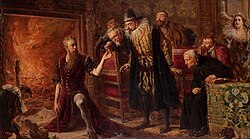
"The Alchemist Sendivogius" (1867), painting by Jan Matejko. The Polish alchemist Michal Sedziwoj (Sendivogius) was one of the most celebrated of his era, famous in 17th century European courts.
Alchemy as a Metaphor for Inner Transformation
It was Swiss psychologist Carl Gustav Jung who restored alchemy's philosophical dignity in the 20th century, discovering that alchemical symbols were expressions of the collective unconscious. In works such as Psychology and Alchemy (1944) and Mysterium Coniunctionis (1955), Jung demonstrated that images appearing in his patients' dreams corresponded surprisingly with medieval alchemical symbols, and that the Great Work process was a perfect description of the individuation process: the path toward total psychic integration.
From this perspective:
- Nigredo is the existential crisis, depression, the collapse of the superficial identity.
- Albedo is the clarity that emerges after shadow work.
- Rubedo is the realization of the Self, the person who manages to be authentically who they are.
Alchemy, in its deepest dimension, is not about turning lead into gold literally. It is about turning gold from what we are: taking the raw material of our life — with its shadows, its fears, its contradictions — and submitting it to the sacred fire of consciousness until the accidental dissolves and the essential shines through.
The gold is not in any crucible. It is in you.
— Lux Esoterica


Comentarios