Dream Interpretation: The Esoteric Language of the Sleeping Mind

*The Nightmare* (1781) by Henry Fuseli — one of the most iconic representations of the dream world in Western art.
Every night, we cross a threshold. The body stills, the senses withdraw, and consciousness dissolves into a realm where time bends, the impossible becomes ordinary, and messages arrive clothed in the strangest symbols. Dreams have fascinated humanity since the first cave dwellers watched the stars and asked why the sleeping mind conjured worlds of its own.
From ancient Egypt to modern neuroscience, from shamanic traditions to the analyst's couch, dream interpretation has been one of the most persistent and earnest attempts to decode the hidden language of the psyche. In esoteric traditions, dreams are not mere neurological noise — they are windows into dimensions of being that waking consciousness cannot easily reach. They carry warnings, revelations, and invitations to know ourselves more deeply.
This guide explores the esoteric meaning of dreams: their history, their symbolic grammar, the giants who shaped our understanding of them, and practical tools to begin reading their messages in your own life.
The Ancient World and Prophetic Dreams
Long before Freud or Jung, prophetic dreams occupied a central place in the spiritual life of civilizations. In ancient Mesopotamia, specialized priests called maš.šu.gíd.gíd ("dream interpreters") worked in temples, consulting elaborate manuals that catalogued thousands of dream scenarios and their meanings. The Assyrian Dream Book from the library of Ashurbanipal (7th century BCE) listed dreams alphabetically by their dominant image — fish, serpents, the sky, a king's face — and prescribed their significance.
In Egypt, dreams were considered direct communications from the gods. The symbolism of a dream had to be decoded by priests, and the temples of Serapis functioned partly as dream incubation centers — places where the sick and the troubled would sleep on sacred ground, hoping the god would appear with healing guidance. The Bible is full of prophetic dreams: Joseph's visions of sheaves bowing, Pharaoh's seven fat and seven lean cows, Daniel's interpretation of Nebuchadnezzar's night terrors. For the Hebrews, as for most ancient peoples, prophetic dreams were one of the primary channels through which the divine spoke to mortals.
Ancient Greece developed the practice of enkoimesis — ritual sleep in the sanctuary of Asclepius, god of healing. Petitioners would undergo purification rituals, fast, and sleep on the temple floor, waiting for the god to appear in a dream and prescribe a cure. Thousands of inscriptions at Epidaurus record these miraculous dream healings. Aristotle, ever the empiricist, was skeptical — but even he admitted that some dreams seemed to predict illness before symptoms appeared, as if the body's own intelligence communicated through sleep.
In indigenous and shamanic traditions around the world, dreams serve as the primary space of contact with the spirit world. The dreamer is not passive: trained shamans learn to navigate the dream landscape with intention, meeting guides, diagnosing illness, retrieving lost soul fragments, and carrying back knowledge to the waking community. The consciousness that moves through the dream, in these frameworks, is the true self — more awake, in a sense, than the ego that drives the car to work.
Freud and the Royal Road
The modern era of dream interpretation begins — at least in the Western intellectual tradition — with Sigmund Freud and his landmark 1899 work, The Interpretation of Dreams. Freud famously called the dream "the royal road to the unconscious," and his system, while since revised and contested, was genuinely revolutionary: it insisted that dreams are meaningful, that their bizarre imagery is not random, and that beneath the surface narrative (the "manifest content") lies a hidden layer of desires, fears, and memories (the "latent content").
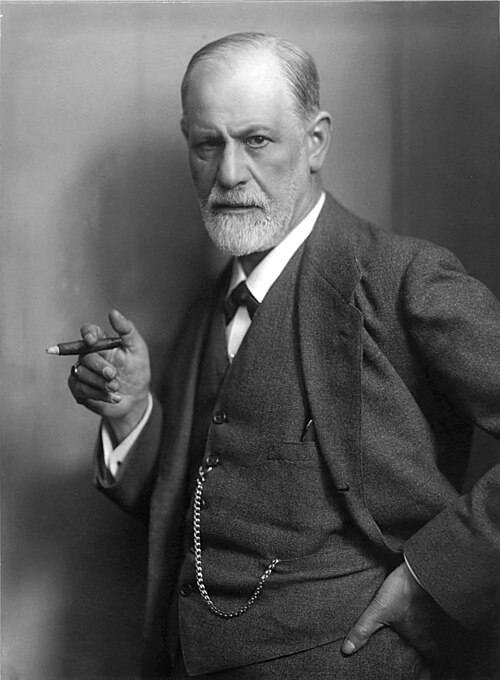
Sigmund Freud, whose *Interpretation of Dreams* (1899) established the unconscious as the ground of dream life.
For Freud, the dream was primarily a fulfillment of repressed wishes — material the waking ego would not allow into conscious awareness was disguised through "dream work" and expressed symbolically. The symbolism in dreams, he argued, often followed patterns: houses represented the self, water represented birth, flying represented sexual liberation. This systematization was both Freud's great contribution and his greatest limitation — the reduction of the dream's vast symbolic vocabulary to a handful of drives.
What Freud gave us, however, was something transformative: the idea that consciousness has layers, that the waking mind sits atop an enormous unconscious structure that exerts constant pressure on thought, feeling, and behavior — and that dreams are one of the few places where that deeper level reveals itself. Even those who reject his specific interpretive framework owe him the basic premise that the dream is worth paying attention to.
Jung and the Collective Unconscious
Where Freud looked downward — into the personal biography of the dreamer, the childhood wounds, the repressed desires — Carl Jung looked outward and upward, toward something vast and transpersonal. For Jung, the unconscious was not just the storehouse of personal material. Beneath the personal unconscious lay what he called the collective unconscious: a layer of psychic reality shared by all of humanity, populated not by personal memories but by archetypes — primordial patterns of experience that have shaped the human psyche across millennia.

Carl Jung, whose concept of the collective unconscious opened dream interpretation to the transpersonal and the mythic.
Jungian archetypes are not fixed images but dynamic patterns — the Hero, the Shadow, the Anima/Animus, the Wise Old Man, the Great Mother, the Trickster. These patterns appear spontaneously in dreams across cultures that have had no historical contact, which Jung took as evidence of their universality. A person raised in contemporary Buenos Aires may dream of a wise old figure delivering cryptic counsel — the same archetypal energy that appears in the myths of Greece, Japan, and West Africa.
For Jung, dream interpretation was not a matter of consulting a symbol dictionary. Each dream needed to be understood in relation to the dreamer's specific life situation (the personal layer) and in relation to the great patterns of human experience (the archetypal layer). Dreams compensate: if the waking personality is inflated and arrogant, the dream may bring a humbling image. If the ego is overly rational, the dream overflows with irrational, oceanic imagery. The unconscious, in Jungian thought, is not the enemy of the self but its collaborator — endlessly working to restore wholeness.
The Shadow and the Work of Integration
One of Jung's most enduring contributions is the concept of the Shadow — everything we have rejected, denied, or never developed in ourselves. The Shadow is not evil per se; it is simply the unlived life, the qualities we decided (or were taught) were unacceptable. In dreams, the Shadow often appears as a threatening figure of the same gender as the dreamer: a pursuer in a dark alley, a sinister stranger, a monstrous animal.
Shadow work — the deliberate effort to recognize, engage, and integrate the contents of the Shadow — is one of the central practices of Jungian psychology and has been embraced widely in contemporary spiritual communities. When we refuse to acknowledge the Shadow, it does not disappear; it operates from behind the scenes, projecting itself onto other people, sabotaging relationships, erupting in moments of disproportionate anger or fear. Dreams are among the most reliable maps of our Shadow material — the images we encounter in nightmares are often precisely the energies we have refused to claim.
The esoteric insight here is ancient: what we resist persists. The path to wholeness runs through the dark, not around it. Shadow work requires courage — the willingness to look at the parts of ourselves we find most shameful or frightening — but the reward is a more integrated, more authentic, more powerful self.
Common Dream Symbols and Their Esoteric Meanings
While no symbol dictionary can replace the work of relating a dream to the dreamer's specific life, certain images carry recurring symbolism across traditions:
Water — the unconscious itself; emotions, the flow of life, the depths of the psyche. Calm water suggests emotional clarity; turbulent water, inner chaos or transformation; deep, dark water, the encounter with the unknown or the collective unconscious.
Houses — the self, the psyche. Different rooms represent different aspects of personality or life. Attics are associated with the higher mind or spiritual aspiration; basements with the unconscious and ancestral material; the roof with the ego's constructed identity.
Flying — liberation, expanded perspective, transcendence of ordinary limits, or sometimes the desire to escape. In shamanic traditions, flying dreams are considered a form of soul travel.
Teeth falling out — one of the most universal dream experiences, associated cross-culturally with anxiety about loss: of power, of appearance, of control, of a significant relationship or life phase.
Death — in esoteric dream interpretation, death rarely means literal death. It signifies transformation, the end of an identity or life chapter, the making way for something new. The death of a dream character often signals the integration of that quality into the self.
Snakes — deeply ambivalent symbols: healing (the caduceus), wisdom (the serpent of Eden offering knowledge), transformation (they shed their skin), the kundalini energy of the spine in yogic traditions. Context and the dreamer's felt sense determine the meaning.
Pursuit — something avoided in waking life that demands attention. The pursuer is worth engaging: what does it want? What would happen if we turned and faced it?
Light — consciousness, revelation, the divine, insight arriving from beyond the ego's constructs.
Prophetic Dreams and the Question of Time
Perhaps the most mysterious dimension of dreams is their occasional apparent knowledge of future events. Prophetic dreams appear in virtually every culture's historical record and continue to be reported by ordinary people today: dreams of accidents before they happen, of deaths before they are announced, of events that unfold the following day with uncanny precision.
From an esoteric standpoint, time in the dream state may not be organized the same way as in waking consciousness. Consciousness, when freed from the body's anchoring in the present moment, may access information that does not yet "exist" in linear time — or rather, that exists in a different register of reality where the distinction between past, present, and future is less absolute.
Jung developed the concept of synchronicity — meaningful coincidence, events connected by significance rather than causality — partly to account for these experiences. The dreaming mind may be sensitive to patterns and fields of meaning that waking rationality filters out. Whether one calls this faculty intuition, precognition, or simply the processing of subtle cues the waking mind ignores, the phenomenon of the prophetic dream remains one of the most compelling reasons to take the dream state seriously as a mode of knowing.
Practical Approaches to Dream Interpretation
Working with your own dreams requires a few simple but powerful practices:
Keep a dream journal. The moment you wake, before checking your phone or speaking a word, write down everything you remember: images, emotions, fragments of dialogue, colors, bodily sensations. Dreams fade within minutes; the habit of immediate recording builds a relationship with the dreaming mind that deepens over time.
Look for the emotional tone first. Before analyzing symbolism, notice how the dream felt. Fear, joy, grief, wonder — the emotional charge is often the most direct message. A dream full of frightening imagery but a feeling of exhilaration carries a very different meaning than the same imagery accompanied by dread.
Ask what each figure or element represents to you personally. A lion means something different to a Kenyan child who grew up hearing lions at night and a suburban adult who knows lions only from documentaries. Your associations are the primary data.
Consider the compensatory function. What has your waking life been overemphasizing? The dream often brings its opposite. If you have been relentlessly active and productive, a dream of stillness and water may be asking you to rest. If you have been living in your head, a dream of primal, bodily vitality may be calling you back to the body.
Engage with the figures. Jungian active imagination invites you to close your eyes after waking and re-enter the dream, turning to face the threatening figure, asking it what it wants, allowing a dialogue. The unconscious responds to genuine attention and curiosity.
Sit with the dream rather than resolving it. The best dreams do not yield to quick interpretation. They unfold over days or weeks, their meaning emerging as life presents the context for understanding. Resist the urge to close them down too quickly.
Dreams as Spiritual Practice
In Tibetan Buddhism, dream yoga is a formal practice: the practitioner learns to recognize the dream state as a dream while dreaming (lucid dreaming), and then to use that awareness to pursue enlightenment. The teaching is that the state between falling asleep and waking is structurally similar to the state between death and rebirth — mastering the dream state is thus preparation for navigating the bardos, the transitional realms after death.
In the Sufi tradition, dreams in which the Prophet appears are considered authentic visitations, not mere products of the sleeper's mind. The mystic Ibn Arabi received much of his spiritual teaching in the dream state and described entire cosmological systems apprehended during sleep. For the Sufi, the boundary between dream and reality is permeable: both are "imaginative" worlds, one generated by the individual psyche, the other by the divine creative imagination (al-khayal).
The common thread across traditions is that dreams are not simply entertainment or biological noise — they are a mode of participation in a larger reality. To honor the dream is to honor the depths of one's own consciousness and, through that, something that exceeds the individual self entirely.
We spend roughly a third of our lives asleep. The esoteric traditions suggest that this is not time lost — it is time spent in another school, where different teachers speak in a different language. The invitation is to learn that language, one night at a time.
— Lux Esoterica
Related Esoteric Inquiries:
- Dreams as Spiritual Messages: How Different Traditions Understand the Dreaming Mind
- Carl Jung and the Journey into the Unconscious: Archetypes, Shadow, and Individuation
- The 12th House of Astrology: The House of Sacrifice, the Power of the Subconscious, and the Dissolution into the Divine
Lux Esoterica.
2026.


Comments