Flemish Masters: The Sacred Image and the World Made Holy
In the early 15th century, in the cities of Bruges, Ghent, and Brussels, a group of painters made a discovery that changed the history of Western art: that oil, used as a medium for pigment, produced a depth, luminosity, and precision impossible in tempera. The invention of oil painting — associated above all with Jan van Eyck (c. 1390–1441), though the technique had precedents — enabled the Early Netherlandish masters to achieve something unprecedented: the complete visual equation of the sacred and the material. In their altarpieces, the Virgin sits in a room with tiled floors and Persian carpets and Flemish windows opening onto Flemish landscapes. The angel of the Annunciation casts a shadow. The Lamb of God bleeds into a golden chalice in a landscape that could be the Flemish countryside on a clear summer morning. The theology was precise: if God had become incarnate in the material world, then the material world — painted with total fidelity, every detail rendered with reverence — was the appropriate vehicle for sacred imagery. The Ghent Altarpiece of 1432, the greatest single work of Early Netherlandish painting, is the fullest expression of this theology: a painting in which the divine and the human, the celestial and the terrestrial, the symbolic and the specific all exist simultaneously in perfect, luminous harmony.
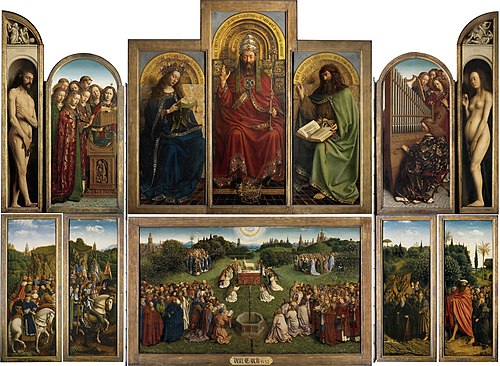
Ghent Altarpiece (completed 1432), Hubert and Jan van Eyck, St. Bavo Cathedral, Ghent — the most complex altarpiece in the history of Western art; 12 panels showing God the Father enthroned, the Virgin and John the Baptist, angels singing and playing music, Adam and Eve, and the central lower panel of the Adoration of the Mystic Lamb; the painting was described by Dürer as 'the most precious painting in the world'

Annunciation, Jan van Eyck (1434-1436), National Gallery, Washington — the archangel Gabriel and the Virgin in a Gothic church interior of extraordinary detail; the floor tiles depict Old Testament scenes that typologically prefigure the Annunciation; Van Eyck's theology is embedded in every detail — nothing in the painting is merely decorative
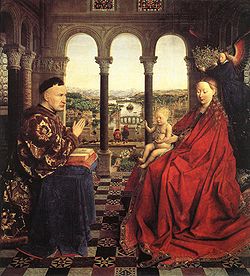
Madonna of Chancellor Rolin, Jan van Eyck (c. 1435), Louvre — the Chancellor of Burgundy kneels before the Virgin and Child in a palace loggia opening onto a Flemish city and river; the landscape in the background is rendered with the same precision as the figures — hundreds of figures visible in the middle distance, the river winding to a horizon of blue mountains; the sacred and the worldly occupy the same continuous space
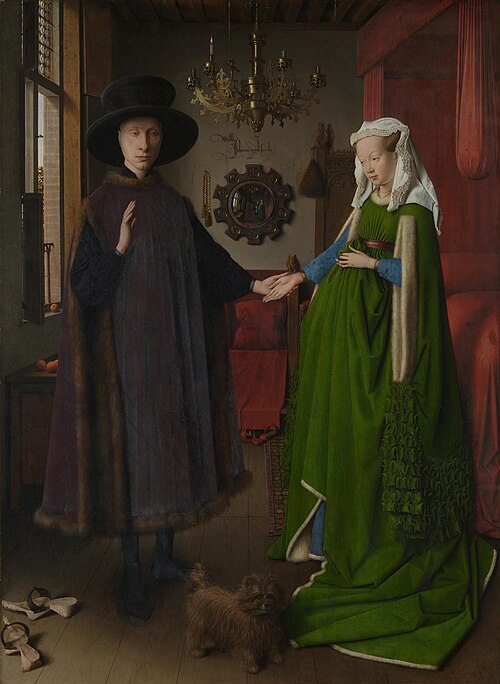
Arnolfini Portrait, Jan van Eyck (1434), National Gallery, London — the merchant Giovanni Arnolfini and his wife in their Bruges bedchamber; the convex mirror on the back wall reflects two figures entering the room (one possibly Van Eyck himself) and is inscribed 'Johannes de Eyck fuit hic' (Jan van Eyck was here); the painting raises questions about the sacred status of the ordinary that have occupied scholars for five centuries

The Descent from the Cross, Rogier van der Weyden (c. 1435), Prado Museum — ten life-size figures in a shallow golden space; the swooning Virgin's body exactly echoes the dead Christ's, her hand dropping at the same angle as his, her pain identical to his death; Rogier's formal mastery (the figures filling the picture plane like a carved relief) serves an emotional directness that has never been surpassed

The Magdalen Reading, Rogier van der Weyden (before 1438), National Gallery, London — Mary Magdalene absorbed in a book, her elaborate headdress, her white hands, the jar of ointment beside her; a fragment of what was once a larger altarpiece; the intimacy of the image — the private act of reading as a form of devotion — is characteristic of the Flemish tradition's domestication of the sacred

Braque Triptych, Rogier van der Weyden (c. 1452), Louvre — Christ between the Virgin and Saint John the Baptist, flanked on the wings by the patron saints of the Braque family; the reverse of the wings (visible when the triptych is closed) shows skulls — the private devotional object reminding the owner of mortality every time the altarpiece is folded; Flemish devotional objects worked on both sides of closure

The Entombment, Dieric Bouts (c. 1440-1455), National Gallery, London — Christ's body lowered into the tomb by mourning figures in a landscape of extraordinary quiet; Bouts developed the integration of figures and landscape that Van Eyck had pioneered into a consistent emotional register: the grief of the figures and the stillness of the landscape are the same quality of feeling

The Garden of Earthly Delights, Hieronymus Bosch (c. 1490-1510), Prado Museum — the most enigmatic painting in Western art: a triptych whose left panel shows Paradise, whose central panel shows a world of pleasure and sin, and whose right panel shows Hell; the imagery is a visual encyclopedia of moral theology, folklore, alchemical symbolism, and what can only be called private vision; five centuries of scholarship has not agreed on what it means
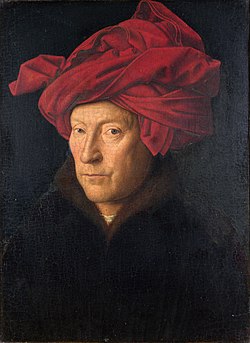
Portrait of a Man in a Red Turban, Jan van Eyck (1433), National Gallery, London — possibly a self-portrait; the eyes meet the viewer with a directness unprecedented in Western portraiture; inscribed at the top 'Als ich can' (As I can) — Van Eyck's motto, a statement of maximum aspiration within human limitation; at the bottom, the date and a signature that established the convention of the signed artwork


Comentarios