Gnosticism: The Hidden Knowledge and the Secret Gospel of the Divine Spark

A lion-faced deity from a Gnostic gem — likely representing Yaldabaoth, the Demiurge, the false creator-god of Gnostic cosmology.
At the edges of the great religious traditions of antiquity, there existed a current of thought so radical, so subversive, and so spiritually urgent that it was systematically persecuted, its texts burned, its teachers exiled, and its name turned into a slur. This was Gnosticism — not a single religion but a constellation of spiritual movements united by one electrifying conviction: that the material world is not the creation of the highest God, that something has gone profoundly wrong in the cosmos, and that within every human being there glows a divine spark — a fragment of original, uncreated light — waiting to be recognized, awakened, and returned to its true home.
The path of that return is Gnosis — from the Greek gnōsis, meaning knowledge. Not knowledge as information or belief, but knowledge as direct, unmediated, transformative encounter with the divine reality within oneself. Where orthodox Christianity offered salvation through faith and the Church, Gnosticism offered liberation through knowing: knowing who you truly are, where you truly come from, and how to find your way back.
A Hidden Current in the Ancient World
Gnosticism flourished primarily in the first four centuries of the Common Era, in the same Alexandrian and Syrian milieu that produced early Christianity, Neoplatonism, and Hermeticism. Scholars debate whether it preceded Christianity, arose alongside it, or emerged from within it — but what is clear is that Gnostic teachers moved freely in the intellectual world of late antiquity, drawing from Jewish mysticism, Platonic philosophy, Zoroastrian dualism, Egyptian religion, and early Christian texts to build their elaborate and visionary systems.
Its practitioners included some of the most brilliant theological minds of the ancient world. Valentinus (c. 100–180 CE), who nearly became Bishop of Rome, developed a system of such philosophical sophistication that his opponents — including Irenaeus of Lyon, whose Against Heresies is our main source for Gnostic teachings — struggled to refute it on intellectual grounds and instead resorted to institutional condemnation. Basilides of Alexandria, Marcion of Sinope, and the mysterious Simon Magus (whom later tradition called the father of all heresy) were among the other towering figures of this movement.
What all these teachers shared was a burning dissatisfaction with the official answer to the question of evil. If God is all-good and all-powerful, why does the world contain so much suffering, injustice, and darkness? The Gnostic answer was shattering in its boldness: because the God who created this world is not the highest God. He is a lesser being — ignorant, perhaps malevolent — and the true God, the God of light and love, is elsewhere, in a realm utterly beyond this one.
The Demiurge: The False Creator
At the center of most Gnostic systems stands the figure of the Demiurge (from the Greek dēmiourgos, meaning "craftsman" or "artisan") — the being who fashioned the material world. In Plato's Timaeus, the Demiurge is a benevolent craftsman who models the world on eternal forms. The Gnostics inverted this: their Demiurge is a being of limited intelligence and inflated ego, who creates the material cosmos not out of love but out of ignorance, and who then mistakes himself for the supreme God.
In Sethian Gnosticism, this figure is named Yaldabaoth — a name combining Hebrew and Aramaic elements suggesting "child of chaos." He is depicted as lion-faced and serpent-bodied, surrounded by the Archons (archontes, rulers) — lesser powers who collectively administer the cosmic prison, ensuring that the divine sparks trapped in human bodies remain unaware of their true nature and origin.
The Demiurge declares, "I am a jealous God, and there is no other God beside me" — the Gnostic reading of the same declaration in Exodus. For the Gnostics, this very jealousy proves his limitation: a truly supreme being has no competitors to be jealous of. His ignorant boast is simultaneously a self-indictment and a clue to the truth he cannot see: there is another God, infinitely greater, whose light flickers in the hearts of human beings.

A page from the Codex Tchacos, containing the Gospel of Judas — a Gnostic text rediscovered in the 1970s and published in 2006, which portrays Judas not as traitor but as the only apostle who truly understood Jesus.
The Pleroma and Sophia's Fall
Beyond the Demiurge and his Archons, the Gnostic universe extends upward (or inward) into the Pleroma — the "Fullness," the realm of the true God, which is pure light, pure consciousness, pure love, overflowing and self-sufficient. The Pleroma is populated by Aeons — divine emanations, aspects of the infinite divine nature, arranged in conjugal pairs (syzygies). In Valentinian Gnosticism, there are thirty Aeons in all, constituting a heavenly community of wisdom and love.
The last of the Aeons is Sophia — divine Wisdom. In a moment of cosmic tragedy, Sophia acts without the consent of her divine partner: she desires to know and produce from herself alone, without the fullness of the divine will. The result is a misbegotten creation — the Demiurge, who falls into the void outside the Pleroma and, not knowing his origin, sets about creating the material world.
But Sophia's act, though it caused the catastrophe of material existence, also planted within that world the seed of its redemption: divine sparks (pneuma, spirit) — fragments of Sophia's own light, now trapped in the matter the Demiurge fashioned. These sparks are the essence of human beings: the immortal, luminous, divine self hidden beneath layers of material body and soul-nature. The whole drama of creation and redemption, in Gnostic thought, is the story of these sparks finding their way home.
The Nag Hammadi Library: Lost Voices Recovered
For centuries, our knowledge of Gnosticism came almost entirely from its enemies — from the heresiologists like Irenaeus, Hippolytus, and Epiphanius, who quoted Gnostic texts only to refute them. Then, in December 1945, a momentous discovery was made near the Egyptian town of Nag Hammadi: an Arab farmer digging for fertilizer unearthed a sealed clay jar containing thirteen leather-bound papyrus books — fifty-two texts in Coptic translation, the largest collection of Gnostic writings ever found.
The Nag Hammadi Library transformed our understanding of early Christianity and the ancient world. Among its treasures:
- The Gospel of Thomas: 114 sayings attributed to Jesus, many paralleling the canonical Gospels but in a distinctly Gnostic register. Its most famous saying: "The Kingdom of God is inside you and outside you. When you know yourselves, then you will be known, and you will understand that you are children of the living Father."
- The Gospel of Philip: a meditation on sacraments, marriage, and spiritual transformation that treats the bridal chamber as the supreme Gnostic sacrament — the inner union of the soul with its divine counterpart.
- The Apocryphon of John: the fullest account of the Gnostic creation myth, presenting a cosmic drama of fall, entrapment, and redemption.
- The Gospel of Truth: attributed to Valentinus himself, a sublime meditation on the nature of error, ignorance, and the redemptive knowledge that dispels them.
The Gospel of Judas, part of the Codex Tchacos (a separate find, rediscovered in the 1970s and published in 2006), caused a sensation: in this text, Judas is not the traitor of orthodox tradition but the only apostle who truly understood Jesus — the one chosen to liberate the divine spark within Jesus by facilitating the death of his material body.
The Gnostic Schools
Gnosticism was never a single movement but a family of related systems. Among the most significant:
Valentinianism, founded by Valentinus in Rome (c. 136–165 CE), was the most philosophically sophisticated school. Valentinians developed an elaborate cosmological mythology and practiced a series of sacraments including baptism, anointing, Eucharist, and the bridal chamber. They spread throughout the Mediterranean and were the dominant form of Gnosticism for two centuries.
Sethian Gnosticism centered on Seth, the third son of Adam, as the earthly ancestor of the pneumatic race — the spiritual humans who carry the divine spark. Sethian texts include the Apocryphon of John, the Gospel of the Egyptians, and Allogenes. They placed particular emphasis on visionary ascent through the heavenly realms.
Manichaeism, founded by the Persian prophet Mani (216–274 CE), was a full-blown world religion that spread from Spain to China, surviving for over a millennium. Mani synthesized Zoroastrian, Buddhist, and Christian Gnostic elements into a universal system of radical dualism: light versus darkness, spirit versus matter, trapped particles of light awaiting liberation through the elect.
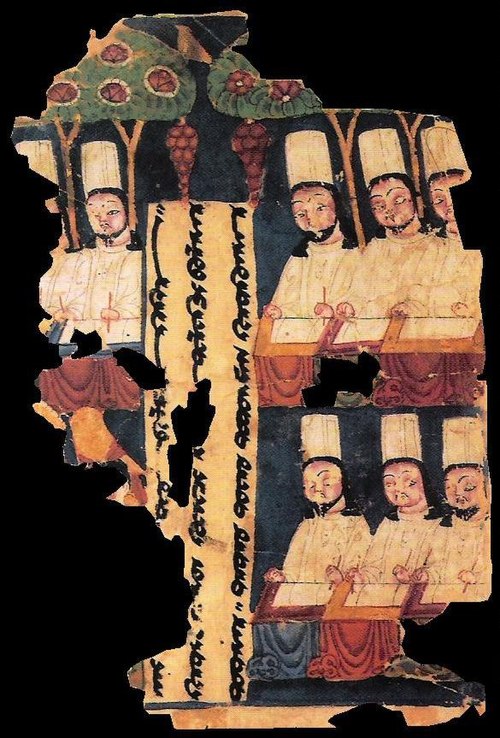
An illuminated Manichaean manuscript from Khocho (Central Asia, c. 10th century) — Manichaeism was a Gnostic world religion that spread from Persia to China.
The Living Gnostic Tradition: the Mandaeans
Most Gnostic movements were eventually suppressed — by Roman emperors, by the Christian Church, by Islamic conquerors. But one ancient Gnostic community has survived continuously into the present day: the Mandaeans, an ethno-religious group centered in southern Iraq and Iran, with diaspora communities around the world.
The Mandaeans trace their origins to John the Baptist (whom they revere as their greatest prophet) and have preserved an extraordinary body of sacred texts — the Ginza Rba (Great Treasure), the Book of the Zodiac, and the Canonical Prayerbook — in a dialect of Aramaic closely related to the language of Jesus. Their central ritual is repeated baptism (masbuta) in flowing "living water" — a sacrament of purification and connection with the world of light.

A Mandaean mandi (ritual meeting house) in Nasiriya, Iraq — the Mandaeans are the only surviving ancient Gnostic community, maintaining an unbroken tradition for nearly two millennia.
Gnosis as Liberation: The Inner Path
At its heart, Gnosticism is not a theology to be believed but an experience to be had. Gnosis is the moment of recognition — sudden and total — in which the individual soul remembers what it is: not a creature of the material world, not the product of the Demiurge's limited craftsmanship, but a spark of the infinite divine light, temporarily estranged, now awakening to its true nature and true home.
This recognition is not merely intellectual. It is transformative in the way that a dream dissolves upon waking — suddenly and completely. The Gnostic who achieves gnosis does not become different; they become what they always were. As the Gospel of Philip teaches: "You saw the Spirit, you became Spirit. You saw Christ, you became Christ. You saw the Father, you shall become the Father."
The Gnostic tradition thus anticipates — or parallels — many mystical traditions in both East and West: the Advaita Vedanta insight that the individual self (atman) is identical with the universal Self (Brahman); the Sufi teaching of fana (annihilation of the ego in the divine); the Buddhist recognition of Buddha-nature as the ground of all beings. In every case, the spiritual path is not the acquisition of something external, but the recognition of something eternally present and eternally one's own.
Gnosticism Today
Suppressed by the Church for over fifteen centuries, Gnosticism returned dramatically in the 20th century — not only through the Nag Hammadi discovery, but through the work of scholars like Gilles Quispel, Elaine Pagels, and Stephan Hoeller, and through the work of Carl Gustav Jung, who recognized in Gnostic mythology a profound symbolic map of the unconscious psyche. Jung saw in the Demiurge an image of the ego's inflation; in Sophia's fall, an image of the disconnection between consciousness and its deeper source; in the divine spark, the Jungian Self — the total personality that transcends and includes the ego.
Today, Gnostic communities exist in many countries. The Ecclesia Gnostica, Apostolic Johannite Church, and other contemporary Gnostic churches offer initiatic sacramental paths rooted in the ancient tradition. Meanwhile, the influence of Gnostic ideas on literature, cinema, and popular culture — from Philip K. Dick's visionary novels to The Matrix trilogy — demonstrates that the Gnostic question has lost none of its urgency.
Are we trapped? Is the world we see the whole of reality, or a construct that conceals a deeper truth? And within us — underneath the noise of ordinary consciousness — does something know, and has always known, the answer?
— Lux Esoterica
Related Esoteric Inquiries:
- The Gospel of Philip: The Mystery of the Bridal Chamber
- The Valentinian Exposition: The Systematic Blueprint of the Pleroma
- Valentinus and the Gospel of Truth: The Gnostic Anatomy of the Unmanifested
Lux Esoterica.
2026.


Comments