Helena Blavatsky and Theosophy: The Architect of Modern Occultism
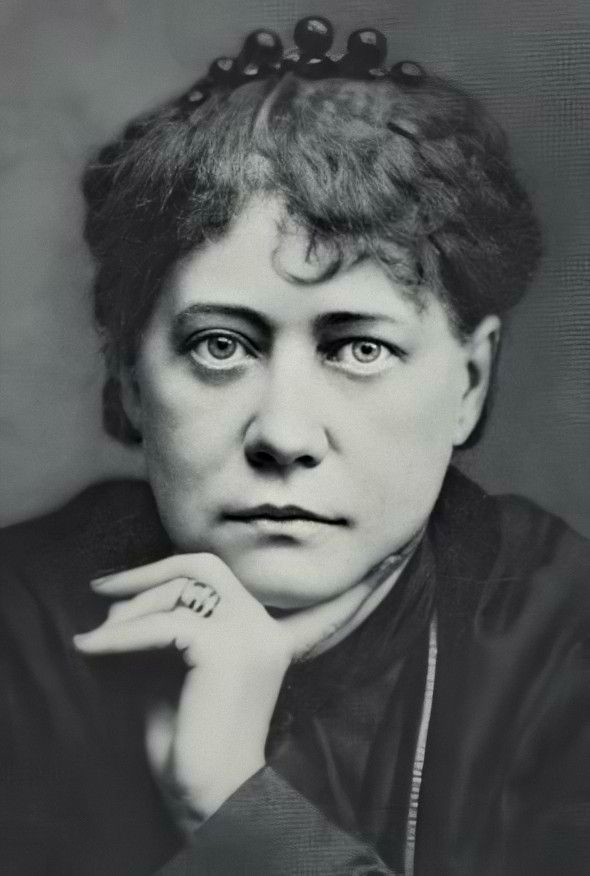
Few figures in the history of spirituality have provoked as much admiration and controversy as Helena Petrovna Blavatsky. To her critics, she was a charlatan. To her followers, she was a messenger of ancient wisdom. To historians, she is one of the most influential founders of modern esotericism.
Through the Theosophical Society, she helped bring ideas such as karma and reincarnation to a wide Western audience and shaped spiritual movements that continue today.
Her life was as extraordinary as her teachings: full of travel, mystery, books of immense length and fierce debates.
A Restless Life
Helena von Hahn was born in 1831 in Yekaterinoslav, in the Russian Empire, today the city of Dnipro in Ukraine. Her family belonged to the aristocracy. As a young woman, she married Nikifor Blavatsky, a much older official, but soon left him and began years of wandering.
According to her own accounts, she traveled widely through Europe, the Middle East, India and the Americas, and spent time in Tibet studying with spiritual masters. Many of these travels cannot be confirmed, and some historians doubt parts of her story. What is certain is that she was a bold, independent woman in an age that rarely allowed women such freedom.
The Theosophical Society
In 1875, in New York, Blavatsky founded the Theosophical Society together with Henry Steel Olcott, a lawyer and journalist, and William Quan Judge. The word theosophy means divine wisdom. The society set out three aims: to form a nucleus of universal brotherhood without distinction of race, creed, sex, caste or color; to encourage the study of comparative religion, philosophy and science; and to investigate unexplained laws of nature and the latent powers of humanity.
In 1882, the society established its international headquarters at Adyar, near Madras, now Chennai, in India, where it remains today.
Isis Unveiled and The Secret Doctrine
Blavatsky's first major work, Isis Unveiled, published in 1877, criticized both materialist science and dogmatic religion and argued for the existence of an ancient wisdom underlying all traditions. In 1888 she published The Secret Doctrine, a vast work in two volumes on the origin of the cosmos and the evolution of humanity, built around verses she called the Stanzas of Dzyan.
She also wrote The Key to Theosophy, a clear introduction in question-and-answer form, and The Voice of the Silence, a short book of spiritual aphorisms that many readers still treasure.
The Masters
Blavatsky claimed that her teachings came from a brotherhood of spiritual adepts, whom she called Mahatmas or Masters, living in seclusion in the Himalayas. Letters said to come from two of them, known as Koot Hoomi and Morya, were received by members of the society. These letters are now kept at the British Library.
Whether the Masters existed as real persons, as spiritual beings or as figures of her imagination remains a matter of belief and debate.
Controversy
In 1885, the Society for Psychical Research in London published a report by Richard Hodgson accusing Blavatsky of fraud in connection with phenomena at Adyar. The report damaged her reputation for many years. In 1986, a member of the same society, Vernon Harrison, published a critical review of Hodgson's methods, arguing that the original investigation had been flawed.
Her ideas also drew criticism. Her theory of root races, a series of ancient human epochs, was later misused by racist movements, although Theosophy's first aim proclaimed universal brotherhood.
Bridging East and West
One of Blavatsky's greatest legacies was her role in bringing Eastern thought to the West. Theosophists promoted the study of Hinduism and Buddhism, and Olcott became one of the first Westerners to formally embrace Buddhism in Sri Lanka, where he supported the revival of Buddhist education.
The young Mohandas Gandhi, while studying in London, met Theosophists who encouraged him to read the Bhagavad Gita, a book that would become central to his life.
Influence on Art and Thought
Theosophy influenced artists such as Wassily Kandinsky and Piet Mondrian, who sought to express spiritual realities through abstract art. The poet W. B. Yeats was a member of the society for a time. Later spiritual teachers, including Rudolf Steiner and Alice Bailey, began within Theosophical circles before developing their own paths.
The Burden of the Pioneer
Blavatsky's final years were marked by illness and hard work. She died in London in 1891. Her followers commemorate the date as White Lotus Day.
Closing
Helena Blavatsky remains a puzzle: brilliant and difficult, inspiring and controversial. Through the Theosophical Society, she opened a door between East and West and helped shape the spiritual landscape of the modern world. Whatever one thinks of her claims, her call for universal brotherhood and for the free search for truth still resonates with seekers everywhere.
Related Esoteric Inquiries
- Theosophy and Helena Blavatsky: The Secret Doctrine and the Roots of Modern Esotericism
- Helena Blavatsky and Theosophy: The Woman Behind the Movement
- Esoteric Freemasonry: Building the Inner Temple Through Sacred Geometry
Lux Esoterica.
2026.


Comments