Insular Art: The Book of Kells, Lindisfarne, and the Sacred Manuscripts of the Celtic North

On the windswept islands and rocky headlands of the northwestern edge of the known world — in Ireland, in the Scottish islands, in the kingdom of Northumbria in northern England — between roughly the sixth and ninth centuries CE, a group of monastic communities produced some of the most extraordinary objects in the history of human art. Their manuscripts — the Book of Kells, the Lindisfarne Gospels, the Book of Durrow, the Cathach of Saint Columba — are among the supreme achievements of medieval art anywhere in the world. Their metalwork — the Ardagh Chalice, the Tara Brooch, the Derrynaflan Paten — represents a peak of goldsmithing skill that has rarely been equaled. Their stone crosses — towering monuments carved with biblical narrative and interlace ornament — still stand in Irish churchyards and on Scottish moorlands, weathered but intact, fifteen centuries after they were erected. This body of work is called Insular art ("insular" from the Latin insula, island), because it was produced on the islands and island-influenced coastlands of the British Isles, in communities that had developed in partial isolation from the Mediterranean world and had fused the ancient traditions of Celtic and Germanic visual art with the demands of Christian sacred content into something entirely new.
The historical context from which Insular art emerged is one of the most remarkable episodes in the history of Christianity. While the Western Roman Empire disintegrated in the fifth century and the Mediterranean world descended into a long period of political fragmentation and cultural contraction, the Christian faith was spreading in the opposite direction — northward and westward, into the Atlantic fringe of Europe that Rome had never fully controlled. The Christianization of Ireland, accomplished without martyrdom or imperial pressure in the fifth century (the traditional credit going to Saint Patrick, though the historical reality is considerably more complex), produced a church of a distinctive character: intensely monastic, deeply learned, passionately devoted to Scripture and to the books that contained it, and organizing itself around great abbeys — Iona, Lindisfarne, Clonmacnoise, Armagh — rather than the diocesan episcopal structure of the Mediterranean church. These monasteries were simultaneously centers of prayer, scholarship, agricultural production, and artistic creation; the monks who copied manuscripts, cast chalices, and carved crosses were not specialists but members of communities in which all of these activities were understood as forms of prayer.
The manuscript tradition of Insular art centers on the production of elaborately decorated Gospel books — copies of the four Gospels used in the liturgy of the Mass, elevated by their content (the Word of God) and their liturgical function into objects of the highest possible spiritual significance. The production of a great Gospel book was a sacred act: the scribe who copied the text was understood to be reproducing the Word of God letter by letter, and the illuminator who decorated the pages was adding visual commentary on the divine content. The great Insular Gospel books are distinguished by several characteristic features: carpet pages (full-page abstract compositions of interlace and geometric ornament, placed before the opening of each Gospel), incipit pages (dramatically decorated pages marking the beginning of each Gospel text, in which the opening words are built up into extraordinary compositions of calligraphy and ornament), evangelist portraits (depictions of the four evangelists, drawn from Byzantine models but transformed beyond recognition by the Insular decorative sensibility), and marginal decoration of bewildering variety, in which birds, beasts, human figures, and abstract forms twist and interweave in the borders of almost every page.
The Book of Kells — produced around 800 CE, probably on the island of Iona before being moved to the monastery of Kells in Ireland during the Viking raids — is the supreme achievement of the Insular manuscript tradition and one of the supreme achievements of medieval art anywhere. Its 340 surviving vellum pages contain the four Gospels in the Vulgate Latin translation, surrounded by decoration of such density and complexity that scholars have spent lifetimes studying its imagery without exhausting it. The Chi-Rho page — which decorates the opening of Matthew's account of the nativity with a monogram of Christ's name (the Greek letters chi and rho superimposed) developed into a vast swirling composition of interlace, spirals, and tiny figures — is generally considered the greatest single page of decorative art in the Western manuscript tradition. Hidden within its patterns are angels, otters catching fish, cats watching mice steal the Eucharistic host — images so small they require a magnifying glass to see, placed there for the eye of God rather than the eye of any human reader.
The Lindisfarne Gospels — produced around 715–720 CE by the monk Eadfrith on the tidal island of Lindisfarne off the Northumbrian coast — represent the other great peak of Insular manuscript art. Where the Book of Kells is exuberant and overwhelming in its complexity, the Lindisfarne Gospels are more controlled, more austere, their carpet pages organized with a mathematical precision that reveals the deep connections between Insular ornament and geometric thought. Eadfrith's carpet pages for the Matthew Gospel — a cross-form composition of interlaced birds and beasts within a framework of geometric borders — have been analyzed by modern mathematicians who found that the interlace patterns follow rules of combinatorial regularity that anticipate formal mathematical discoveries of the modern era. The Lindisfarne Gospels are now housed in the British Library in London, where they are one of the most studied and most reproduced objects in the collection.
The interlace patterns that dominate Insular manuscript decoration — the endless knotwork of interlocked lines, the zoomorphic interlace of beasts whose bodies extend into ribbons and double back on themselves — are not merely decorative. In the theological imagination of the Insular monastic world, the endless interlace without beginning or end was a visual meditation on divine eternity: a line that has no start and no finish represents a reality that transcends time. The zoomorphic interlace — animals transformed into pure pattern — was read as a visual enactment of the transformation of the created world through divine grace: natural things drawn into the order of divine beauty. The spiral patterns inherited from pre-Christian Celtic art — the triskele, the double spiral, the La Tène curvilinear vocabulary that had decorated Celtic metalwork for a thousand years before Christ — were reinterpreted in the Christian context as symbols of the Trinity, of resurrection, of the cyclical movement of the divine energy through creation. The entire visual language of Insular art is a sustained meditation on the relationship between the created order and the eternal ground from which it emerges and to which it returns.
The metalwork tradition of Insular art reached its peak in the seventh, eighth, and ninth centuries, producing objects of technical sophistication that remain unmatched. The Ardagh Chalice — discovered in 1868 in a field in County Limerick and dating to the eighth century — is a two-handled silver chalice of extraordinary elegance, its surfaces decorated with filigree gold panels, glass studs, amber settings, and enamel work in a combination of materials and techniques that demonstrates the full range of the Insular metalsmith's skill. The Derrynaflan Chalice, Paten, and Strainer — a liturgical set discovered in 1980 in a peat bog in County Tipperary — represent another peak of this tradition. These objects were not merely functional; they were theological statements in precious metal, their elaborate surfaces encoding the same symbolic language — interlace, spirals, zoomorphic ornament — that filled the manuscript pages.
The Insular tradition extended into Anglo-Saxon England, where it encountered and fused with the Germanic artistic traditions of the Anglo-Saxon settlers. The Sutton Hoo treasure — a ship burial from around 625 CE discovered in Suffolk in 1939 — includes a helmet, shoulder clasps, purse lid, and drinking horns decorated in a Germanic-influenced Insular style of extraordinary refinement. The shoulder clasps in particular — paired gold plaques decorated with interlocking boars in cloisonné garnet and millefiori glass — are among the most beautiful small objects in the history of European art. Sutton Hoo predates the Christian conversion of the East Anglian kingdom and represents the pagan Germanic substrate into which Christianity — and Insular Christian art — would be received; the encounter between these traditions produced the distinctive Anglo-Saxon Christian visual culture of the Northumbrian golden age.
The high crosses of Ireland and Scotland — standing stone monuments, typically over three meters tall, carved with intricate interlace ornament and biblical narrative scenes — represent the monumental expression of the same visual language found in the manuscripts and metalwork. Muiredach's Cross at Monasterboice in County Louth — dating to the early tenth century and among the finest surviving examples — depicts on its faces the Last Judgment, the arrest of Christ, the adoration of the Magi, and other biblical scenes in a dense narrative carving of extraordinary quality. The crosses served simultaneously as prayer stations, preaching points, territorial markers, and permanent statements of Christian presence carved into the Irish landscape. Many still stand in their original locations, weathered by fifteen centuries of Atlantic rain but still legible in their main outlines, still surrounded by the graveyards of the communities that built them.
The Insular tradition was also a missionary tradition. The monks of Iona and Lindisfarne — following the model established by Saint Columba, who sailed from Ireland to found Iona around 563 CE, and Saint Aidan, who brought the faith to Northumbria from Iona in 635 CE — carried their books, their liturgical objects, and their visual culture across the British Isles and into the European continent. Irish missionaries evangelized large parts of what is now France, Switzerland, Germany, and northern Italy, founding monasteries at Luxeuil, St. Gallen, and Bobbio that became major centers of learning and manuscript production. The visual style they carried with them — the interlace, the spiral, the zoomorphic ornament — was absorbed into the Carolingian manuscript tradition and through it into the broader stream of medieval European art. What began on the Atlantic edge of the world became, through this missionary diffusion, one of the major formative influences on the visual culture of medieval Europe.
The images in this gallery move through the full range of Insular artistic production: the carpet pages and decorated initials of the great Gospel books; the evangelists' portraits that transform Byzantine conventions into something entirely Celtic; the liturgical metalwork that brought the same visual language into three-dimensional form in silver and gold; the Sutton Hoo treasure at the Germanic-Celtic interface; the high crosses standing against Irish skies; and the Pictish carved stones of Scotland that represent yet another regional variant of the tradition. Together they constitute the visual record of a civilization that flourished on the edge of the known world and produced, in its brief golden age, some of the most concentrated and most beautiful sacred objects ever made by human hands.
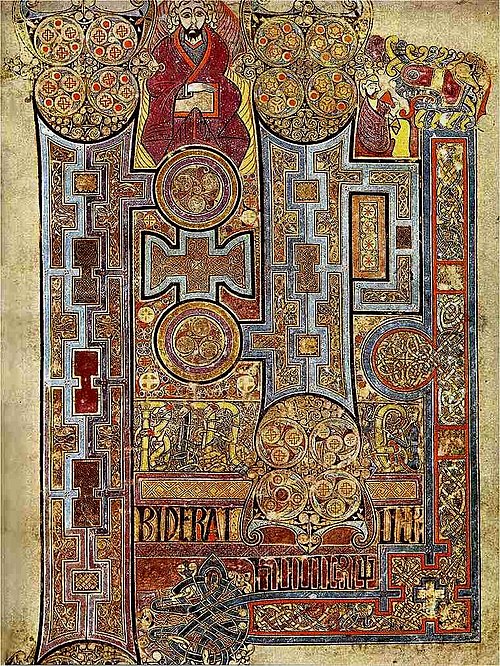
Book of Kells — Gospel of John incipit page, c. 800 CE, Trinity College Dublin; the opening words of John's Gospel ('In principio erat verbum' — In the beginning was the Word) are built up into a composition of calligraphy and ornament of extraordinary complexity; the Insular tradition of the decorated incipit page treats the written word itself as sacred material, its letters expanded and elaborated into visual meditation on the divine content they carry

Book of Kells — decorated initial; the marginal and initial decoration of the Book of Kells is famous for the density and inventiveness of its ornament; hidden within the interlace of this initial are cats, mice, birds, and human figures so small they require magnification to see — images placed for the eye of God rather than of any human reader, expressing the monastic conviction that the act of manuscript decoration was itself a form of prayer
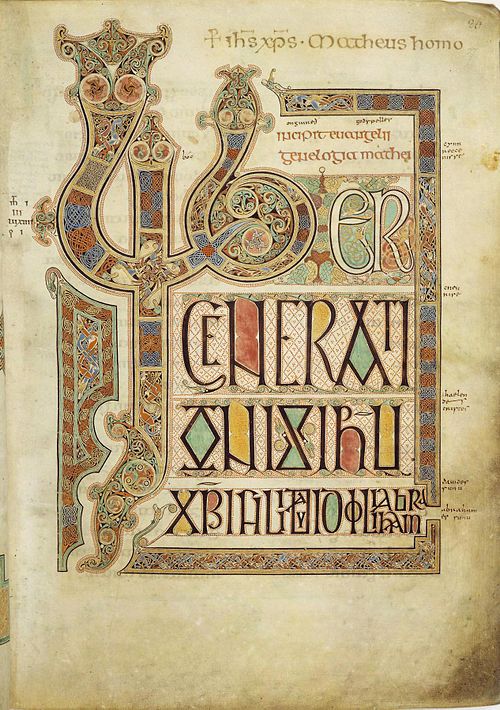
Lindisfarne Gospels — Matthew incipit page, c. 715-720 CE, British Library; produced by the monk Eadfrith on the tidal island of Lindisfarne, the Lindisfarne Gospels represent a more austere and geometrically precise counterpart to the exuberance of the Book of Kells; modern mathematicians have found that its carpet page interlace patterns follow combinatorial rules of mathematical regularity, anticipating formal discoveries of the modern era

Lindisfarne Gospels — evangelist portrait; the Insular tradition transformed the Byzantine evangelist portrait — a seated philosopher-figure with book and writing implements — into something almost unrecognizable through its application of the Celtic decorative sensibility; the figure is present but abstracted, its drapery rendered in patterns of interlace, its space filled with knotwork rather than architectural recession

Book of Durrow — beginning of Mark's Gospel, c. 680 CE, Trinity College Dublin; the Book of Durrow is the earliest fully decorated Insular Gospel book, predating the Book of Kells by more than a century; its carpet pages already show the mature Insular vocabulary of interlace, animal ornament, and spiral patterns that would be elaborated with increasing complexity over the following two centuries

Cathach of Saint Columba — the oldest surviving Irish manuscript, c. 560-600 CE, Royal Irish Academy; traditionally attributed to Saint Columba himself (the founder of Iona), the Cathach (Battle Book) contains a Psalter in an early Insular hand; it was carried into battle as a protective talisman by the O'Donnell clan for centuries, encased in a silver shrine; the decorated initials, while far simpler than later Insular work, already show the characteristic spiral and trumpet patterns of the tradition

Ardagh Chalice — silver, gold, amber, and glass, Ireland, 8th century CE, National Museum of Ireland; discovered in 1868 in County Limerick, this two-handled liturgical chalice is the masterpiece of Irish metalsmithing; its surfaces carry filigree gold panels, polychrome glass studs, and interlace ornament in a combination of materials and techniques that represents the full scope of Insular metalwork skill — the same visual language as the manuscripts, translated into precious metal

Derrynaflan Chalice — silver and gold, Ireland, 8th-9th century CE, National Museum of Ireland; discovered in 1980 in a peat bog in County Tipperary as part of a liturgical set (with paten, strainer, and stand), the Derrynaflan Chalice ranks with the Ardagh Chalice as the supreme achievement of Irish ecclesiastical metalwork; its deliberate concealment in the bog — probably during the Viking raids of the 9th century — preserved it in near-perfect condition

Sutton Hoo shoulder clasp — gold, garnet, and millefiori glass, East Anglia, c. 625 CE, British Museum; part of the treasure from the great ship burial discovered at Sutton Hoo in 1939, these paired gold clasps decorated with interlocking boars represent the Germanic-Insular interface at its most refined; Sutton Hoo predates the Christianization of East Anglia and reveals the pagan artistic tradition into which the Christian Insular visual language would be received

Muiredach's Cross — sandstone, Monasterboice, County Louth, Ireland, early 10th century CE; one of the finest high crosses in Ireland, standing over five meters tall; its carved faces depict the Last Judgment, the arrest of Christ, and the adoration of the Magi in a narrative sculptural program that brought the biblical story into the landscape as a permanent public monument; these crosses served simultaneously as prayer stations, preaching points, and territorial markers of Christian presence

Hilton of Cadboll Stone — Pictish carved stone, Scotland, c. 800 CE, National Museum of Scotland; the Picts of northern Scotland developed a distinctive carving tradition that combined Christian iconography with a rich vocabulary of abstract symbols whose meaning remains debated — the double disk, the Z-rod, the crescent — alongside hunting scenes and religious imagery; the Hilton of Cadboll stone, with its intricate interlace borders and central hunting scene, is one of the finest examples of this tradition

Monymusk Reliquary — wood, silver, bronze, and enamel, Scotland, early 8th century CE, National Museum of Scotland; a small house-shaped shrine traditionally believed to have contained a relic of Saint Columba and carried before the Scottish army at the Battle of Bannockburn in 1314; its decorated surfaces show the characteristic vocabulary of Insular metalwork — interlace, animal ornament, enamel inlay — in miniature form, compressed into an object small enough to carry on a leather strap around the neck


Comentarios