Jainism: The Path of the Tirthankaras and the Alchemy of Radical Harmlessness
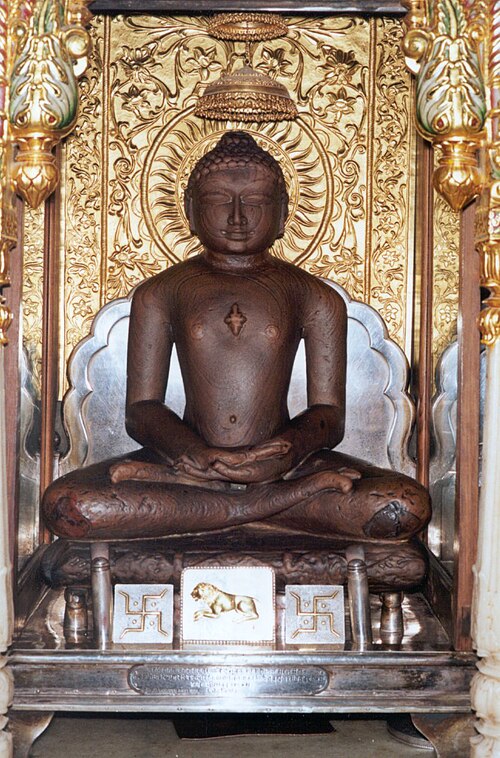
Lord Mahavira, the 24th Tirthankara, whose life and teachings codified the path of radical non-violence and spiritual liberation.
The Conquerors of the Self: An Introduction to Jainism
Emerging from the profound spiritual soil of ancient India, Jainism represents one of the most rigorous and consistent paths toward liberation (Moksha) ever devised by the human spirit. Unlike systems that rely on external deities, Jainism (from the root ji, meaning "to conquer") focuses entirely on the individual's ability to conquer their own lower nature—their passions, attachments, and ignorance.
Those who have successfully navigated this path are known as Jinas (Conquerors) or Tirthankaras (Ford-Makers), beings who have crossed the turbulent river of worldly existence and built a "ford" for others to follow. The 24th and final Tirthankara of our current era, Mahavira, lived in the 6th century BCE, providing the philosophical and ethical structure that continues to guide the tradition today.
The Triad of Liberation: Three Jewels
The Jain path is anchored by three essential pillars, known as the Ratnatraya (Three Jewels), which provide the architectural framework for a soul’s ascent:
- Ahimsa (Non-Violence): This is not merely the absence of physical harm. Esoterically, Ahimsa is the recognition that every living being—from the smallest microscopic organism to the most complex human—possesses a soul (Jiva) of equal value. To harm another is to harm oneself, as all souls are interconnected in the cosmic web of existence.
- Anekantavada (Non-Absolutism): This is the intellectual application of Ahimsa. It teaches that truth is multi-faceted and that no single human perspective can contain the absolute whole. This leads to a radical tolerance and the understanding that different viewpoints are often just different "angles" on the same reality.
- Aparigraha (Non-Attachment): The realization that material possessions and emotional clingings are "heavy matter" that bind the soul to the lower worlds. By practicing simplicity and detachment, the soul becomes lighter and begins its natural ascent toward the "Ceiling of the Universe" (Siddhashila).
The Esoteric Physics of Karma
In most traditions, Karma is viewed as a moral law of cause and effect. In the unique "Spiritual Physics" of Jainism, Karma is considered actual physical matter.
The soul, in its pure state, is infinitely light, luminous, and omniscient. However, when the soul acts out of passion, anger, or greed, it creates a "vibration" that attracts microscopic karmic particles. These particles stick to the soul like dust on a moist surface, weighing it down and obscuring its natural light. The goal of the Jain practitioner is twofold: to stop the influx of new karmic matter (Samvara) and to burn away the existing particles through the "heat" of penance and meditation (Nirjara).
2026: The Year of the Multidimensional Witness
In the landscape of 2026, the Jain principle of Anekantavada becomes a vital cognitive survival tool. As algorithmic polarization reaches its zenith and "Zero-Sum" thinking threatens global stability, the ability to hold multiple perspectives simultaneously is a superpower.
2026 is the year of Intellectual Non-Violence. Jainism teaches us that the "Truth War" is a trap. By refusing to be an absolutist, the Sovereign Practitioner becomes immune to the digital hysteria. To practice Jainism in the mid-2020s is to be the "Peaceful Witness" who recognizes the "Partial Truth" in all sides, thereby maintaining a state of unshakeable internal equilibrium.
Meditative Contact: The Breath of Harmlessness
To align with the frequency of the Ford-Makers:
- The Centering: Sit in a comfortable posture. Visualize your soul as a sphere of pure, weightless white light in the center of your chest.
- The Recognition: Contemplate the space around you. Acknowledge that the air, the floor, and the walls are filled with life-forms you cannot see.
- The Invocation: Speak silently: "I am a friend to all living beings. I have no enemies. I release the heavy dust of the past. I seek the light of the Ford-Makers."
- The Vow: Commit to one act of conscious "Harmlessness" today—whether it is saving a small insect, speaking a gentle word to an adversary, or refusing to indulge in an angry thought.
References for Further Study:
- The Jaina Path of Purification by Padmanabh S. Jaini
- Akaranga Sutra (The first of the Jain Agamas)
- Outlines of Jainism by Jagmander Lal Jaini
- Philosophy of India by Heinrich Zimmer
Related Esoteric Inquiries:
- The Mutus Liber or Wordless Book of Alchemy: The Path of Silence, the Harvest of Celestial Dew, and the Alchemical Couple
- The Red Book of Carl Jung: Liber Novus, Active Imagination, and the Alchemy of Modern Individuation
- The Most Holy Trinosophia of the Comte de Saint Germain: Supreme Alchemy, Sacred Symbols, and the Wisdom of the Threefold Temple
Lux Esoterica.
2026.


Comments