Medieval Alchemical Manuscripts: Art from the Great Work
For seven centuries, alchemists encoded their most dangerous and most sacred knowledge not in plain text but in images — sequences of symbolic figures, allegorical scenes, and hermetic emblems that could be read only by those who already understood what they were looking at. These were not merely illustrations. They were instructions: maps of the Great Work, the process of transforming base matter (and the self) into gold (and spiritual completion). The Aurora Consurgens, attributed to Thomas Aquinas and produced in Zurich around 1420, and the Ripley Scroll, attributed to the English alchemist George Ripley and copied in multiple versions from the 15th century onward, represent two peaks of alchemical visual art — documents of a tradition that refused to separate science, art, theology, and inner transformation into separate disciplines.
 [Unavailable: ❌ https://upload.wikimedia.org/wikipedia/commons/thumb/c/c2/Aurora_consurgens_zurich_060_f-29v-60_darkangel.jpg/250px-Aurora_consurgens_zurich_060_f-29v-60_darkangel.jpg ❌]
Aurora Consurgens (Zurich, c. 1420) — the dark angel, representing the prima materia in its initial state of nigredo (blackening); the first of the four stages of the alchemical Great Work
 [Unavailable: ❌ https://upload.wikimedia.org/wikipedia/commons/thumb/f/f3/Aurora_consurgens_zurich_023_f-11r-23_zodiac.jpg/250px-Aurora_consurgens_zurich_023_f-11r-23_zodiac.jpg ❌]
Aurora Consurgens — the zodiacal wheel as alchemical map; the signs correspond to stages of the Work and to the planets that govern the transformation of matter and soul
 [Unavailable: ❌ https://upload.wikimedia.org/wikipedia/commons/thumb/c/c1/Aurora_consurgens_zurich_044_f-21v-44_dragon-pot.jpg/250px-Aurora_consurgens_zurich_044_f-21v-44_dragon-pot.jpg ❌]
Aurora Consurgens — the dragon in the alchemical vessel; the dragon (Mercury, the volatile principle) must be fixed in the sealed flask before the Work can proceed to albedo (whitening)
 [Unavailable: ❌ https://upload.wikimedia.org/wikipedia/commons/thumb/c/c8/Aurora_consurgens_zurich_007_f-3r-7_building.jpg/250px-Aurora_consurgens_zurich_007_f-3r-7_building.jpg ❌]
Aurora Consurgens — the alchemical temple; the building represents the Philosopher's Stone as both a physical substance and a spiritual achievement — the house that contains the divine
 [Unavailable: ❌ https://upload.wikimedia.org/wikipedia/commons/thumb/1/1a/Ibn_Umayl_The_Silvery_Water.jpg/250px-Ibn_Umayl_The_Silvery_Water.jpg ❌]
Ibn Umayl, 'The Silvery Water' — a 10th-century Arabic alchemical manuscript; the Islamic alchemical tradition, transmitted through Spain to Europe, was the primary channel through which Hellenistic alchemy reached the medieval West
 [Unavailable: ❌ https://upload.wikimedia.org/wikipedia/commons/thumb/9/99/Rotulum_hieroglyphicum_G._Riplaei_Equitis_Aurati_Wellcome_L0068926_%28cropped%29.jpg/250px-Rotulum_hieroglyphicum_G._Riplaei_Equitis_Aurati_Wellcome_L0068926_%28cropped%29.jpg ❌]
The Ripley Scroll — attributed to George Ripley (c. 1415–1490), Canon of Bridlington; the scroll is a continuous visual narrative of the alchemical process, designed to be unrolled and read as a sequential instruction
 [Unavailable: ❌ https://upload.wikimedia.org/wikipedia/commons/thumb/5/5e/Alchemists_Revealing_Secrets_from_the_Book_of_Seven_Seals%2C_The_Ripley_Scroll_%28detail%29%2C_ca._1700.jpg/250px-Alchemists_Revealing_Secrets_from_the_Book_of_Seven_Seals%2C_The_Ripley_Scroll_%28detail%29%2C_ca._1700.jpg ❌]
Ripley Scroll (c. 1700 copy) — alchemists revealing secrets from the Book of Seven Seals; the transmission of secret knowledge through lineage and initiation was as important to alchemists as the laboratory operations themselves
 [Unavailable: ❌ https://upload.wikimedia.org/wikipedia/commons/thumb/9/97/Here_followeth_the_0c483k14n_d504rk93m_dl_full_size.jpg/250px-Here_followeth_the_0c483k14n_d504rk93m_dl_full_size.jpg ❌]
Ripley Scroll — detail from a 15th-century copy; the toad, the pelican feeding its young with its own blood, and the crowned hermaphrodite are among the central recurring symbols of the alchemical visual language
 [Unavailable: ❌ https://upload.wikimedia.org/wikipedia/commons/thumb/2/2f/Rotulum_hieroglyphicum_G._Riplaei_Equitis_Aurati_Wellcome_L0068937.jpg/250px-Rotulum_hieroglyphicum_G._Riplaei_Equitis_Aurati_Wellcome_L0068937.jpg ❌]
Ripley Scroll — Wellcome Collection copy; the alchemical hieroglyphs encode the process of transmutation in a visual language deliberately designed to be unintelligible to the uninitiated
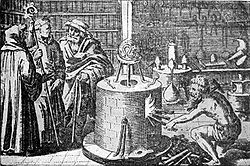 [Unavailable: ❌ https://upload.wikimedia.org/wikipedia/commons/thumb/0/03/Alchemical_Laboratory_-_Project_Gutenberg_eText_14218.jpg/250px-Alchemical_Laboratory_-_Project_Gutenberg_eText_14218.jpg ❌]
The Alchemical Laboratory — 17th-century engraving; the athanor (furnace), the alembic, the pelican flask, and the philosophical egg; the physical laboratory was understood as the outer expression of an inner operation
Related Esoteric Inquiries:
- The Mutus Liber: The Silent Book of Alchemical Revelation and the Visual Geometry of the Great Work
- The Mutus Liber: Alchemical Dew, Silent Iconography, and the Great Work Without Words
- The Ripley Scroll: Alchemical Iconography, the Pilgrim's Quest, and the Chemistry of the Stone
Lux Esoterica.
2026.


Comments