Mermaids: Daughters of the Deep, Omens of Fate and Transformation
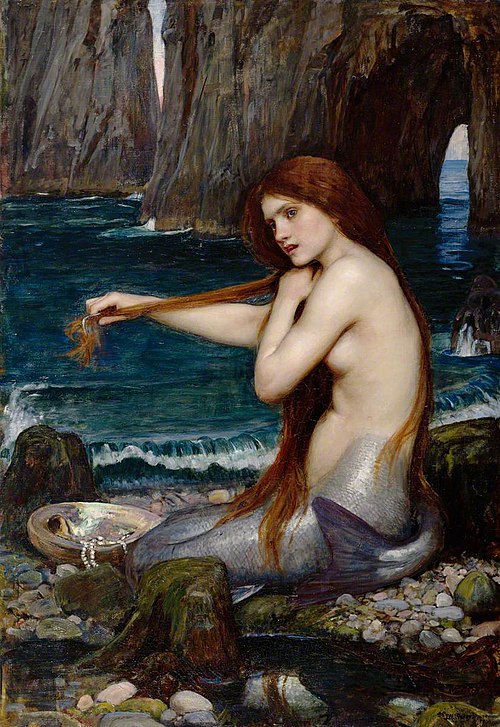
*A Mermaid* by John William Waterhouse (1900) — the Pre-Raphaelite vision of the mermaid as a figure of oceanic beauty and otherworldly longing.
From the earliest civilizations of the ancient Near East to the sailors' yarns of the Age of Exploration, from the folk traditions of the Celtic coastlines to the fairy tales of Hans Christian Andersen, the mermaid has haunted the human imagination with extraordinary persistence. She is the woman of the deep — half human in her beauty and her longing, half fish in her belonging to the cold, dark, unfathomable ocean. She sits at the boundary between two worlds, belonging fully to neither, and in this liminal existence she embodies something that every human being who has ever stood at the edge of the sea has felt: the pull of the depths, the call of what lies beyond the known, the terrible beauty of a world that we can glimpse but never truly inhabit.
The mermaid is not simply a pretty fantasy. She is a figure of ancient complexity — sometimes a goddess, sometimes a demon, sometimes a tragic soul longing for what she cannot have, sometimes a vengeful power capable of driving sailors to their doom. Across all her iterations, she represents the same archetypal experience: the encounter with a beauty that belongs to another order of existence, a beauty that cannot be possessed without destruction, that reveals by its very unattainability something essential about the nature of human longing and the relationship between the conscious world of the land and the unconscious depths of the sea.
Atargatis: The First Mermaid
The earliest clearly attested mermaid deity in recorded history is Atargatis — the great goddess of the ancient Aramean city of Hierapolis (modern Manbij in northern Syria), worshipped from at least the first millennium BCE and well into the Roman imperial period. She was the supreme goddess of the Arameans: a goddess of fertility, the sea, the moon, and fate, whose consort Hadad was the storm-god. Her temples were served by priests, sacred prostitutes, and elaborate ritual practices; her sacred fish-pools at Hierapolis, where sacred fish could not be touched under penalty of divine wrath, were among the wonders of the ancient world.
Atargatis was depicted in various forms — sometimes fully anthropomorphic, sometimes with the lower body of a fish — and the Greek and Roman writers who encountered her cult understood her fish-tailed form as expressing her mastery of the sea and water. The Greek name for her, Derceto, was associated with a myth in which the goddess, overcome with shame at a love affair that produced a child (later the legendary queen Semiramis), threw herself into a sacred lake and was transformed into a half-woman, half-fish form.
This origin myth is significant: the mermaid form as the result of shame and transformation, of a feminine divine power that has been brought into contact with the human world through erotic union and then retreated into the depths — the same pattern that appears in many later mermaid traditions. The goddess who descended to the human world through love, and withdrew into the depths when that love produced consequences, is a recurring mythological structure.

*Havfruen* (The Mermaid) by Elisabeth Jerichau Baumann (1873) — the mermaid as a figure of melancholy longing, gazing from the sea toward the human world she cannot fully enter.
The Sea as Unconscious: Mythological Depths
In the symbolic vocabulary of virtually every culture, the sea represents the unconscious — the vast, dark, unfathomable dimension of existence that underlies and surrounds the small island of consciousness on which human beings attempt to build their lives. The mermaid, as a being who inhabits this dimension and sometimes surfaces at its edge, naturally becomes a figure of everything that the unconscious contains and that the conscious mind desires and fears: beauty, depth, power, the promise of a different order of experience, and the danger of dissolution.
The earliest sea-deities of the ancient world — the Babylonian Tiamat, the Greek Pontus and Nereus, the Semitic Yam — were all associated with the primordial, undifferentiated state that preceded creation, the chaos from which the ordered world emerged and to which it might one day return. The mermaid inherits this association: she is a being from the primordial depths who has adopted the form of the human, or whose form combines the human and the primordial in a way that makes the boundary between them visible.
In Jungian depth psychology, the mermaid corresponds precisely to the anima in her oceanic aspect — the feminine soul-image as the personification of the unconscious in its most mysterious and potentially engulfing form. The sailor who is drawn to the mermaid is the ego encountering the unconscious in its most seductive guise: the encounter promises contact with a depth of experience that the daylight world cannot provide, but it also threatens dissolution. The mermaid at the bow of the ship is the unconscious rising to meet consciousness at its most exposed and mobile — out at sea, far from the solid land of habit and rational structure.
The Mermaid of Zennor: Cornwall's Ancient Tale
Among the most evocative mermaid legends in the British Isles is that of the Mermaid of Zennor — a story attached to the ancient Church of St. Senara in the Cornish village of Zennor, whose medieval bench-end carving of a mermaid (still visible today) is among the oldest and most beautiful mermaid images in England.
The legend tells of a beautiful, mysterious woman who came regularly to hear the singing of a young chorister named Mathew Trewella in the church. One day, Mathew followed the woman down to the sea and was never seen again — though fishermen reported hearing the voices of Mathew and the mermaid rising from beneath the waves near a place called Pendour Cove. Another version has a ship's anchor catching on the mermaid's door beneath the sea, and the mermaid rising to ask the sailors to move the anchor so she could return to her husband and children below.

The medieval carved mermaid bench-end in the Church of St. Senara, Zennor, Cornwall — one of the oldest surviving mermaid images in England, the focus of a beautiful local legend.
The Zennor legend contains in miniature the essential structure of the mermaid encounter: the being from the deep drawn by the beauty of human music (the choir boy's voice); the human drawn by the beauty of the sea-being; the crossing of the threshold; the permanent inhabiting of the other world; and the continuing relationship between the two worlds, expressed in the underwater voices heard by fishermen. The mermaid does not destroy Mathew but takes him into her world — a world he can inhabit, apparently contentedly, but cannot return from.
Hans Christian Andersen and the Soul
The most theologically explicit mermaid story in Western literature is Hans Christian Andersen's The Little Mermaid (1837) — a fairy tale of extraordinary depth and sadness that engages directly with the question that underlies all mermaid mythology: what is the relationship between the beautiful creature of the depths and the immortal human soul?
In Andersen's tale, the mermaid princess learns that mermaids have no immortal souls — they live three hundred years and then dissolve into sea-foam. Humans, by contrast, have immortal souls that ascend to heaven after death. The little mermaid's quest to become human is explicitly a quest for a soul — motivated not merely by love for a human prince but by the deeper desire for the immortal dimension of existence that her oceanic nature lacks.
The tale's tragic ending — the mermaid's refusal to kill the prince to save herself, her dissolution into sea-foam, and then her unexpected transformation into a spirit of the air who might, after centuries of good deeds, earn a soul — presents the mermaid's condition as one of profound spiritual incompleteness: beautiful, long-lived, possessing magical powers, but lacking the dimension of existence that gives human life its meaning and its dignity. The mermaid longs upward, toward the light and the human world, as the human soul longs upward toward the divine.

The Little Mermaid statue by Edvard Eriksen (1913), Copenhagen Harbor — Andersen's tragic mermaid who longed for a human soul, one of the most visited sculptures in the world.
Andersen's reading inverts the usual direction of the mermaid's longing: in most folk tradition, the mermaid draws humans down into the sea; in Andersen, the mermaid strains upward toward the human world. But both directions express the same fundamental insight: the mermaid lives at the boundary between two orders of existence, belonging fully to neither, longing for what she does not have.
Selkies: The Seal-People of the Northern Seas
Parallel to the mermaid tradition of temperate Europe, the selkie tradition of the Scottish Hebrides, Orkney, Shetland, and coastal Ireland represents a distinctive variation on the same mythological theme. Selkies (from Scots selch, seal) are seals that can shed their skins on land and appear as human beings — typically beautiful women who, if their seal-skin is stolen, cannot return to the sea and may be compelled to marry the man who has taken it, living among humans for years or decades before eventually recovering the skin and returning to the ocean, often leaving children behind.
The selkie tradition has a distinctive emotional register that distinguishes it from many mermaid stories: the selkie wife, however much she may love her human husband and children, always longs for the sea. When she finally returns to it, she is not escaping; she is returning to her true nature, her true home. The longing is not simply for freedom but for wholeness — for the dimension of existence from which she has been separated by the circumstances of love.
The selkie legend has been read as encoding a genuine human experience: the experience of belonging to two worlds, of having a nature that cannot be fully expressed in any single form of life. The selkie wife who gazes at the sea and weeps is the person who has made the accommodations that life requires but has not ceased to know that another dimension of existence calls to them — the artist who works in an office, the mystic who has married into ordinary life, the person who has abandoned one self in order to maintain another.
Mermaids as Omens: The Prophetic Tradition
In maritime folk tradition across many cultures, the mermaid was understood as a figure of prophecy and omen — particularly as a harbinger of storms, shipwrecks, and death. To see a mermaid was not necessarily to encounter a being of beauty; it was more often a warning, a sign that the sea was about to claim what the sea claimed.
The prophetic mermaid appears in traditions from Scotland to China, from the Caribbean to the Pacific Islands. She typically appears at the bow or stern of a doomed ship, combing her hair; she sometimes speaks, warning of the coming disaster; she sometimes remains silent but is nonetheless understood as the sign that not all who sail will return. The mermaid in this prophetic aspect is the sea itself personified — the ocean as a conscious power that knows when it is about to take a life, and that sends its human-faced representative to mark the moment.
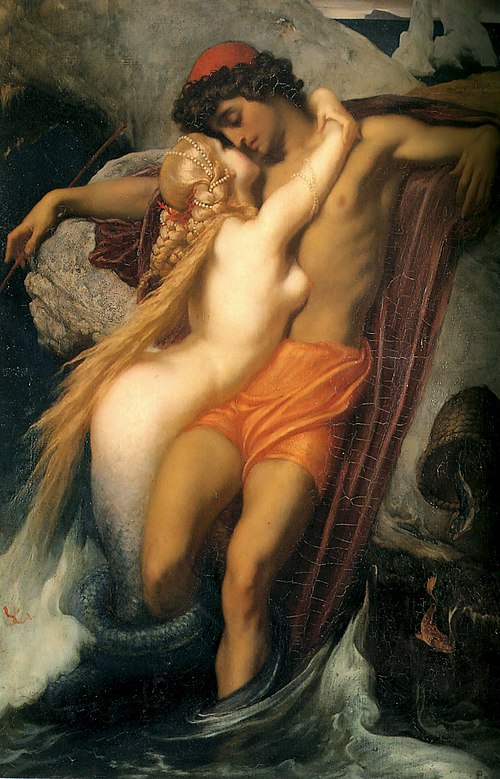
*The Fisherman and the Syren* by Frederic Lord Leighton (c. 1856–58) — the mermaid-siren drawing the fisherman toward the deep; the ancient drama of the human encounter with the oceanic feminine.
This prophetic dimension connects the mermaid to the tradition of oracular water-goddesses — the divine feminine in her capacity as the one who knows the future, who stands at the boundary between life and death and perceives what is coming before those still fully in the world can see it. The mermaid who combs her hair at the bow of a doomed ship is in this tradition: a being whose access to the deeper rhythms of existence — the tides, the storms, the movements of the deep — gives her knowledge that human beings, bound to the surface world, cannot possess.
The Global Mermaid: A Universal Image
The mermaid is one of the most globally distributed mythological beings in existence. Fish-tailed human figures appear in the art of ancient Babylon, ancient Egypt, classical Greece, pre-Columbian Mesoamerica, sub-Saharan Africa, South and Southeast Asia, the Pacific Islands, and across the Aboriginal traditions of coastal Australia — suggesting that the image of a half-human, half-fish being touches something genuinely universal in the human symbolic imagination.
In West African and Afro-Brazilian tradition, the Mami Wata (Mother Water) — a powerful spirit depicted as a mermaid or as a woman with a snake — is one of the most widely worshipped spiritual beings across coastal West and Central Africa and the African diaspora. Mami Wata is a spirit of abundance and sexuality, of wealth from the sea and the dangers that come with it; she is honored with offerings, she possesses devotees during ritual, and she is understood as the face of the sea as a living, powerful, feminine divine presence.
In Hindu tradition, the Apsaras — the celestial nymphs who inhabit the waters of heaven and the cosmic ocean — include forms that combine the human and aquatic; the Matsya avatar of Vishnu (the divine fish) represents the cosmic ocean as the source and sustainer of life; and countless local water-deity traditions across South Asia depict fish-tailed female beings as the guardian spirits of rivers, tanks, and the sea.
This global distribution suggests that the mermaid archetype is not a cultural accident but a genuine mythological constant — a symbolic form that arises wherever human beings stand at the edge of the sea and feel, in the depths below, the presence of something living, feminine, powerful, and ultimately unfathomable.
Conclusion: The Beauty That Cannot Be Held
The mermaid endures because she embodies the experience of desire for what belongs to another order of existence — the beauty that can be glimpsed but not possessed, the depth that can be approached but not inhabited, the call of the ocean that promises everything and delivers the terrible gift of dissolution.
She is the unconscious in its oceanic aspect: vast, beautiful, ancient beyond human reckoning, and ultimately more powerful than any individual ego that tries to seize and possess what belongs to the deep. The sailor who follows her goes to his death because he is trying to possess what can only be encountered, never captured. The one who stands at the edge of the sea and hears her song without following — who allows the longing without surrendering to it, who lets the depth speak without letting it consume him — receives the mermaid's real gift: a knowledge of depths that makes the ordinary world permanently larger, permanently more mysterious, permanently more alive.
She sings from the wave's edge. She always has. She always will.
— Lux Esoterica


Comentarios