Nikola Tesla: The Mystic Behind the Inventor, the Spiritual Vision Behind the Lightning

Nikola Tesla, circa 1890 — by the time this photograph was taken he had already demonstrated alternating current, envisioned wireless power transmission, and begun his lifelong communion with a universe he understood as fundamentally vibrational
In the official history of science, Nikola Tesla (1856–1943) appears as a genius inventor: the man who gave the world alternating current, the induction motor, radio transmission, and the foundational architecture of the electrical age. His rivalry with Thomas Edison, his eccentric habits, his tragic end in poverty in a New York hotel — these are the outlines most people know.
What the official history tends to omit is that Tesla himself did not understand his work in purely technical terms. He spoke of receiving inventions fully formed in visions. He corresponded with the Vedic philosopher Swami Vivekananda about the equivalence of matter and energy, prana and akasha. He was obsessed with the numbers 3, 6, and 9. He believed he was not so much inventing as receiving — tuning in to cosmic intelligence the way a radio tunes to a broadcast.
This is the Tesla that the esoteric tradition recognizes: not simply a great engineer, but a figure who stood at the intersection of science and mysticism, who intuited things about the nature of reality that conventional physics is still slowly confirming, and whose vision of a unified, vibrating, conscious universe places him squarely within the oldest streams of esoteric thought.
The Visionary Method: Invention as Reception
Tesla's accounts of his creative process are among the most extraordinary in the history of science. He did not work primarily through experiment and trial. He worked through vision — complete, detailed, three-dimensional mental simulations that he could rotate, examine, run, and test in his mind before constructing anything in the physical world.
In his autobiography My Inventions (1919), Tesla described the method in precise terms: "When I get an idea I start at once building it up in my imagination. I change the construction, make improvements and operate the device in my mind. It is absolutely immaterial to me whether I run my turbine in my mind or in my shop. The inventions are identical."
This is not the standard account of how scientific discovery works. The dominant model — hypothesis, experiment, revision, confirmation — describes the process of validation. What Tesla was describing was something different: the process of reception. The completed machine arrived first, interior and whole. The physical construction was merely a formality, a translation from the mental plane to the material.
This resonates unmistakably with the esoteric doctrine of ideation as creative force — the Hermetic principle that the mental plane is primary and the physical plane derivative. What Tesla called his "visionary method" is structurally identical to what occult tradition calls working on the inner planes: clarifying the intention in consciousness before manifesting it in matter. Whether or not Tesla would have accepted that framing, the structural parallel is exact.
The visions began in childhood and were frequently accompanied by phenomena he found difficult to explain: flashes of light that accompanied every new thought, detailed hallucinations of scenes and objects so vivid they were indistinguishable from physical reality, and what he described as moments of apparent perception of things at a distance. He sought medical attention, but found no explanation. In later life, he concluded that these experiences were the source of his creative capacity, not symptoms of pathology.
The Aether and the Vibrational Universe
Tesla never accepted the conclusion that the Michelson-Morley experiment (1887) had disproved the existence of the aether — the medium that nineteenth-century physics had proposed as the carrier of electromagnetic waves. Where mainstream physics concluded that electromagnetic radiation needed no medium and that the aether concept was therefore superfluous, Tesla maintained throughout his life that the aether was real, that it was the fundamental medium of the universe, and that understanding it correctly would transform both science and civilization.
His reasons were not sentimental. He had built his entire career on electromagnetic phenomena, and his intuition — which had proven reliable with the induction motor, with AC transmission, with radio — told him that the universe was not a void through which waves somehow propagated without a medium, but a plenum: a fullness, a continuous field of vibrating energy within which matter was a pattern and all physical phenomena were modifications of an underlying unity.
This is not merely an outdated scientific position. It is the central claim of the esoteric tradition since the earliest Hermetic texts: that the apparent void is full, that matter is energy in a particular configuration, that what appears solid is in reality vibrational structure. The Kybalion's second principle — Vibration ("nothing rests; everything moves; everything vibrates") — describes the same fundamental insight that Tesla was pursuing through electromagnetic physics.
Tesla's conception of the aether was not passive. He believed it was permeated by intelligence — a cosmic ordering principle that structured the vibrations of matter and energy into the forms that the physical world displayed. This is a view indistinguishable from the esoteric doctrine of the anima mundi (world soul), the intelligence immanent in the universe that the Hermetic, Neoplatonic, and Stoic traditions all in different ways describe.

Tesla with his resonant transformer equipment — his lifelong project was to demonstrate that the Earth itself could serve as a conductor for wireless energy transmission, an ambition rooted in his belief that the planet was a living vibrational system
Tesla and Swami Vivekananda: The Meeting of Two Traditions
In 1896, Tesla met Swami Vivekananda (1863–1902), the Indian philosopher who had brought Vedanta to the West through his famous address at the Parliament of the World's Religions in Chicago in 1893. The meeting produced an extraordinary exchange.
Vivekananda was seeking scientific validation for the Vedic concepts of prana (the universal life-force, the vibrational energy underlying all manifest reality) and akasha (the primordial space or medium within which prana moves and from which all matter condenses). Tesla was seeking a physical theory that could account for the phenomena he was working with. Each found in the other a confirmation of what he was approaching from a different direction.
In a letter to a colleague, Vivekananda wrote with excitement that Tesla believed he could demonstrate mathematically that force and matter could be reduced to potential energy — which Vivekananda saw as equivalent to the Vedic understanding of prana and akasha. Tesla never published this work in the form Vivekananda hoped for, but the exchange reveals the depth of Tesla's engagement with Vedic metaphysics.
The structural equivalence is genuinely striking. Akasha in Vedic cosmology is the fifth element, the primordial substratum that precedes and underlies earth, water, fire, and air — the field from which all manifest reality precipitates. Prana is the universal energy, the vibrational force that animates all forms within that field. Tesla's "aether" and the electromagnetic energy he worked with map precisely onto these concepts.
This was not a superficial parallel that either man noticed casually. It was a recognition, from two different directions — one empirical and technical, one philosophical and experiential — of the same underlying truth: that the universe is not a collection of isolated objects in empty space but a unified field of vibrating energy, and that what we call matter, force, and consciousness are all modifications of that single underlying reality.
The Sacred Numbers: 3, 6, and 9
Among Tesla's most discussed eccentricities is his obsessive relationship with the numbers 3, 6, and 9. He walked around buildings three times before entering. He performed tasks in multiples of three. He required eighteen napkins at dinner (eighteen being divisible by three, six, and nine). He stayed in hotel rooms whose numbers were divisible by three. He is widely quoted — though the original source is disputed — as saying: "If you only knew the magnificence of the 3, 6, and 9, then you would have a key to the universe."
Whether or not he said exactly that, the pattern in his behavior is well-documented. The question is what it means.
In numerology and esoteric mathematics, 3, 6, and 9 occupy a special position. They are the only single-digit numbers that, when added to themselves repeatedly (doubling sequences), never appear — while all other numbers cycle through them without exception. The sequence 1, 2, 4, 8, 7, 5 (doubling: 1, 2, 4, 8, 16→7, 32→5, 64→1...) never produces 3, 6, or 9. Meanwhile, 3+6=9, 3+3=6, 6+6=12→3, 9+9=18→9. These numbers form a closed system within the decimal structure.
Tesla's obsession with these numbers reflects his sense — intuitive rather than formalized — that there is a mathematical structure to the universe that goes beyond what physics had yet captured: an ordering principle expressed in number, not unlike the Pythagorean conviction that the cosmos is fundamentally numerical and that mathematics is the language of creation.
Wardenclyffe and the Vision of Free Energy
Tesla's most ambitious project — and his most catastrophic failure from the standpoint of conventional business success — was Wardenclyffe Tower on Long Island (1901–1917). The official description of the project was a global wireless communications system. But Tesla's private notes reveal a more extraordinary ambition: the wireless transmission of electrical energy to any point on Earth, without wires, without cost per unit, available to any receiver anywhere on the planet.
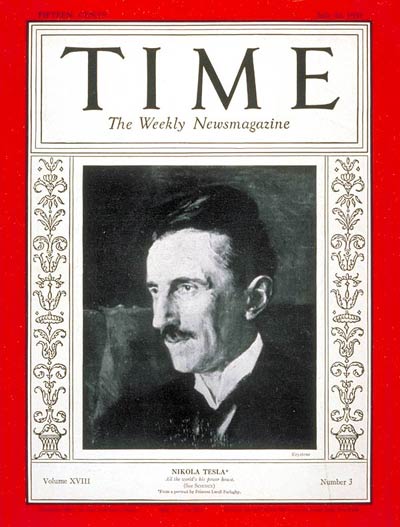
Tesla on the cover of Time Magazine on his 75th birthday, July 20, 1931 — the caption reads "All the world's his power house." By this point he had been working in near-poverty for years, his great projects unfunded, his vision of free energy for all humanity still unrealized
Tesla believed that the Earth itself — its surface, its ionosphere, the space between — was a natural resonant cavity for electromagnetic energy. By oscillating a transmitter at the Earth's own resonant frequency, he believed it would be possible to pump energy into this cavity and extract it anywhere on its surface, the way a vibrating tuning fork will cause a resonant string to vibrate without direct contact.
The vision was not technically impossible — the Schumann resonance (the electromagnetic resonance of the Earth-ionosphere cavity, around 7.83 Hz) is real and measurable. What Tesla envisioned was an engineering application of this resonance at scales his financial backers — first J.P. Morgan, then others — found either impractical or threatening. It was threatening not technically but economically: if energy could be transmitted wirelessly to any point on Earth at near-zero marginal cost, the entire infrastructure of metered, piped, and sold electricity would be superfluous.
This is why free energy is, in the esoteric tradition that has grown up around Tesla, not merely a technical concept but a spiritual and political one. What he was attempting to do was make universally available — to every human being regardless of wealth or location — the fundamental resource of the industrial world. The project was killed not by physics but by capital.
Tesla wrote in 1900: "Electric power is everywhere present in unlimited quantities and can drive the world's machinery without the need of coal, oil, gas, or any other of the common fuels." Whether or not this vision was fully achievable in the form he imagined, the impulse behind it was unmistakably spiritual: a conviction that the abundance of the universe should be universally shared, that scarcity is a condition imposed by human arrangements rather than by nature.
The Inner Life: Celibacy, Solitude, and the Contemplative Inventor
Tesla never married. He was, by his own account, celibate throughout his life — a choice he connected explicitly with his creative work. He wrote that the presence of women disturbed his concentration and that the energy directed toward romantic and sexual life was the same energy he needed for invention.
This is the doctrine of sublimation as it appears in both Eastern and Western esoteric traditions: the redirection of vital energy (prana, libido, Qi) from its habitual biological channels toward creative, spiritual, or intellectual work. Whether Tesla formulated it in those terms, the parallel is precise.
His solitude was not merely physical but psychic. He worked with extraordinary concentration, often without sleep for days, in states of absorption that resemble what the contemplative traditions call one-pointed mind — the condition in which all mental energy is gathered and directed toward a single object, producing extraordinary depth and clarity of perception.
His relationship with pigeons in the final decades of his life — particularly his care for a white female pigeon he described as the great love of his life — has been interpreted variously as eccentricity, loneliness, and mental deterioration. But it is also possible to read it as the natural terminus of a life lived in radical openness to non-human forms of consciousness: the man who had spent decades listening to the vibrations of the universe found, in the end, that a creature of air and light understood him as well as any human companion had.
Tesla in the Esoteric Tradition
The esoteric tradition has claimed Tesla more enthusiastically than he ever claimed it, and some of that enthusiasm has produced mythologies that go beyond the evidence — claims of death rays, suppressed technologies, secret government programs, and communications with extraterrestrial intelligence that range from imaginative to absurd.
What the actual record shows is something more interesting and more credible: a man whose mode of knowing was fundamentally intuitive and visionary rather than analytical; whose metaphysics assumed the primacy of vibration, the reality of a cosmic medium, and the intelligence immanent in nature; whose encounter with Vedic philosophy felt to him like recognition rather than discovery; and whose grandest practical project was the democratization of energy — the attempt to make universally available what the universe provides in abundance.
These are the hallmarks of the esoteric scientist: someone who investigates the outer world while remaining aware that the investigator is part of what is being investigated; who takes seriously the testimony of inner experience as a source of knowledge about outer reality; and who pursues technical mastery not as an end in itself but as a means toward a vision of what human civilization might become.
Tesla's famous saying, whether or not it is precisely worded as he said it, captures this vision exactly: "The day science begins to study non-physical phenomena, it will make more progress in one decade than in all the previous centuries of its existence."
He was pointing at the same horizon the esoteric tradition has always pointed at: the place where the inner and the outer, the measurable and the experienced, the electron and the awareness that observes it, turn out to be aspects of a single thing — vibrating, luminous, and inexhaustibly generous to those patient enough to listen for its frequency.
— Lux Esoterica


Comentarios