Raja Yoga: The Royal Path of the Mind

Patanjali — the sage who, around 400 CE, systematized thousands of years of yogic insight into the 196 aphorisms of the Yoga Sutras: the foundational text of Raja Yoga.
Of the four paths of yoga described in the Bhagavad Gita, Raja Yoga is the one that most closely resembles what the modern world calls "science." It does not ask you to believe. It does not ask you to feel. It asks you to observe — with the same rigor that a scientist applies to external phenomena — the landscape of your own inner experience: the movement of thought, the fluctuations of emotion, the nature of consciousness itself.
Raja Yoga (raja means "king" or "royal") is sometimes called the "yoga of the mind" or the "yoga of meditation." Its goal is identical to the other paths: liberation from the suffering caused by mistaking the conditioned self for the ultimate reality. But its method is distinctive: a precise, systematic, eight-step science of inner transformation, designed to still the mind completely and reveal what lies beneath the noise.
The tradition's canonical text is the Yoga Sutras of Patanjali — 196 aphorisms of extraordinary compression that contain, in seed form, the entire practical psychology and metaphysics of the path.
Patanjali and the Yoga Sutras

Pages from a manuscript of the Yoga Sutras with Patanjali's own commentary (*bhasya*) in Sanskrit and Devanagari script — the text that defines Raja Yoga as a complete system.
Patanjali (estimated c. 400 CE, though some scholars place him earlier) was not the inventor of yoga — the practices he described had existed for centuries or millennia before him. He was their codifier: the one who took a vast, scattered body of meditative wisdom and organized it into a coherent, teachable system.
The Yoga Sutras open with perhaps the most important definition in the history of Indian thought:
"Yogas chitta vritti nirodha."
"Yoga is the cessation of the modifications of the mind." — Yoga Sutras 1:2.
This is both extraordinarily simple and infinitely deep. The ordinary mind is never still. It is in constant motion — producing thoughts, reactions, memories, fantasies, judgments, plans, fears. This constant movement (vritti means "whirlpool" or "fluctuation") is what prevents us from perceiving reality directly. We do not see things as they are. We see them through the filter of our mental conditioning.
When the mental fluctuations cease — even briefly, even partially — what remains? The next sutra answers: "Then the seer abides in its own nature." (1:3). The pure consciousness (purusha in Patanjali's system) that was always present but hidden behind the noise of thought becomes self-evident. This is yoga. Everything else in the Yoga Sutras is the how.
The Eight Limbs: Ashtanga Yoga
The method Patanjali prescribes is Ashtanga Yoga — the eight-limbed path. It is a complete curriculum for human transformation, moving from the outermost to the innermost dimensions of human experience.
The First Limb — Yama (Ethical Restraints): Five principles that govern one's relationship with the world: ahimsa (non-violence in thought, word, and action), satya (truthfulness), asteya (non-stealing, including non-coveting), brahmacharya (right use of vital energy), and aparigraha (non-grasping, simplicity). These are not moral rules imposed from outside but practical necessities: a mind riddled with violence, deception, greed, and excessive desire cannot be still. Ethical behavior is the foundation of meditation, not its opposite.
The Second Limb — Niyama (Personal Observances): Five disciplines of personal life: saucha (purity of body and mind), santosha (contentment), tapas (disciplined effort, "heat"), svadhyaya (self-study through scripture and self-observation), and ishvara pranidhana (surrender to the divine or to the highest principle). The niyamas cultivate the internal conditions from which meditation can naturally arise.
The Third Limb — Asana (Posture): In Patanjali's original teaching, asana means simply "a steady, comfortable seat" — the ability to sit still for extended meditation without physical agitation. The elaborate system of yoga postures familiar from modern practice is a later development (primarily from the Hatha Yoga tradition). The essential quality Patanjali seeks is sthira sukham asanam — stability and ease combined. The body must be disciplined enough to cease being a distraction.
The Fourth Limb — Pranayama (Breath Regulation): The systematic regulation of the breath is one of the most powerful tools in the Raja Yoga practitioner's arsenal. The breath and the mind are intimately connected: when the mind is agitated, the breath is agitated; when the breath becomes slow, even, and subtle, the mind follows. Patanjali describes pranayama as the practice that "removes the veil obscuring the inner light" — it directly prepares the mind for the more interior limbs.
The Fifth Limb — Pratyahara (Withdrawal of the Senses): Ordinarily, the attention follows the senses outward — drawn constantly to sounds, sights, tastes, sensations, smells. Pratyahara is the deliberate reversal of this movement: the withdrawal of the senses from their objects, like a tortoise drawing its limbs into its shell. This is not suppression but redirection — the attention learns to remain with itself rather than scattering outward. This limb marks the transition from the outer to the inner practices.
The Sixth Limb — Dharana (Concentration): The focused direction of attention onto a single object — a mantra, a flame, the breath, a divine image, or simply the space within the heart. Where pratyahara withdraws attention from the outside, dharana places it within. The mind is held, by gentle and persistent effort, at a single point. Inevitably it wanders. It is returned. Wandering, return, wandering, return — this is the practice. Over time, the intervals of wandering shorten and the periods of stable focus lengthen.
The Seventh Limb — Dhyana (Meditation): When dharana (concentration) becomes continuous and unbroken, it becomes dhyana — true meditation. The difference is qualitative, not merely quantitative. In dharana, the practitioner is still making effort to hold the mind. In dhyana, the holding happens naturally — the mind flows toward its object without being pushed. There is a quality of absorption, of effortless presence, that distinguishes meditation from concentration.
The Eighth Limb — Samadhi (Integration, Absorption): The culmination of the path. In samadhi, the distinction between the meditator, the act of meditation, and the object of meditation dissolves. Only the object remains — and then even the object dissolves, leaving pure awareness knowing itself. Patanjali describes multiple levels of samadhi, culminating in nirbija samadhi (seedless samadhi): a state of awareness so complete and so stripped of all conditioning that no future karmas can be planted. The mind has become what it always was beneath its noise: chit — pure consciousness.
The Role of Swami Vivekananda
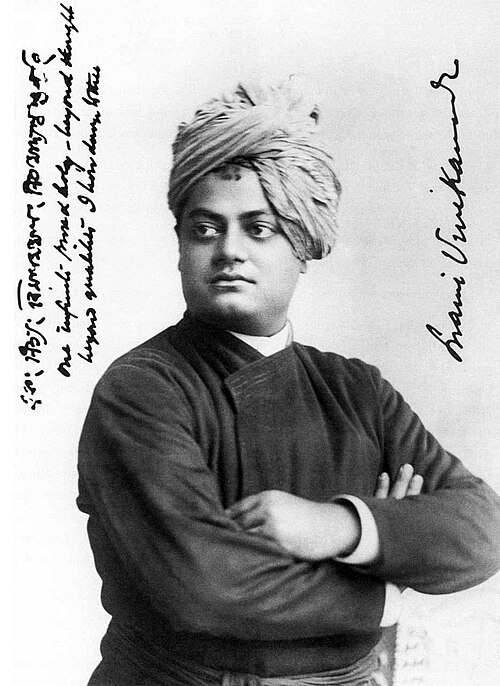
Swami Vivekananda photographed in Chicago in September 1893, during the Parliament of the World's Religions — where his address brought Vedanta and Raja Yoga to global attention for the first time.
The global dissemination of Raja Yoga owes an incalculable debt to Swami Vivekananda (1863–1902) — the disciple of Ramakrishna who, in his appearance at the Parliament of the World's Religions in Chicago in 1893, introduced a Western audience to Hindu philosophy for the first time on anything like equal terms.
His book Raja Yoga (1896) was a turning point. It presented Patanjali's system in accessible English as a universal science of mind — not as exotic religion but as rational investigation. He argued that just as physical science investigates the external world through experiment, Raja Yoga investigates the internal world with equal rigor. The laboratory is the human mind. The experiments are the practices of the eight limbs. The results are reproducible by anyone willing to do the work.
Vivekananda's framing was enormously influential. It made yoga respectable in Western intellectual circles, prefigured modern psychology's interest in consciousness, and opened the door for the global spread of meditative practice that continues to accelerate today.
The Kleshas: The Five Causes of Suffering
A central contribution of Patanjali's psychology is his analysis of the kleshas — the five afflictions that keep consciousness bound:
- Avidya (ignorance) — the fundamental misperception of taking the impermanent as permanent, the painful as pleasurable, the non-self as the Self
- Asmita (I-am-ness) — the identification of pure consciousness with the body-mind instrument
- Raga (attachment) — clinging to pleasant experiences
- Dvesha (aversion) — repulsion from unpleasant experiences
- Abhinivesha (fear of death) — the fundamental clinging to existence
All five kleshas are, according to Patanjali, rooted in avidya — the primal ignorance of one's own nature. Raja Yoga, by stilling the mind and revealing the true nature of consciousness, dissolves avidya at the root and thereby dissolves all five kleshas simultaneously.
This is elegant in a way that purely behavioral approaches to human suffering are not. You cannot solve avidya by trying harder to be less attached. You can only solve it by seeing clearly — by perceiving, directly and without mediation, what you actually are. And that perception is precisely what samadhi delivers.
The Subtle Body in Raja Yoga
While Patanjali's system is more philosophical than physiological, the broader Raja Yoga tradition incorporates the teaching on the subtle body that pervades Hindu esotericism: the system of chakras (energy centers) along the spine, the nadis (energy channels) through which prana (life force) flows, and the central channel Sushumna through which kundalini energy rises when the practice matures.
In this framework, the eight limbs of Patanjali are understood as a progressive purification of the entire being — physical, energetic, mental, and spiritual. The pranayama practices clear the nadis. The meditative limbs raise and refine the quality of prana. Samadhi is understood not just as a mental state but as a full-body energetic event: the awakening of the central channel and the dissolution of all energetic obstructions.
The Relationship to the Other Yogas
The Bhagavad Gita presents karma, jnana, and bhakti as the three primary paths. How does Raja Yoga relate to these?
Swami Vivekananda saw Raja Yoga as the systematic, scientific form that all yogic practice takes — the explicit articulation of the inner processes that operate in all paths. The karma yogi's practice of non-attachment is raja yoga applied to action. The jnana yogi's self-inquiry is raja yoga applied to intellectual discrimination. The bhakta's absorption in devotion is raja yoga applied to the heart.
In practice, most serious practitioners of any path eventually incorporate elements of all four. The stillness cultivated in Raja Yoga makes the discriminating inquiry of jnana more precise. The purity cultivated in karma yoga makes meditation more effortless. The devotion of bhakti gives meditation an emotional depth that pure technique cannot supply.
Beginning the Royal Path
Raja Yoga begins not in samadhi but in the most ordinary of places: sitting still, watching the breath, noticing the mind's incessant movement. The simplicity is deceptive. Most people who try for the first time discover, with some shock, that they cannot observe their own mind for thirty seconds without being pulled away by thought.
This discovery is itself the teaching. The moment you notice you have been pulled away — that is awareness. That noticing, that return, is the beginning of the eight-limbed path. Every return is a repetition of the most fundamental gesture of Raja Yoga: the mind turning toward itself, consciousness becoming aware of its own nature, the royal awareness recognizing its own sovereignty.
The mind that has stilled itself is not empty. It is full — full of the light that was always there, beneath the noise.
Raja Yoga is the science of the inner world — rigorous, systematic, verifiable, and ultimately pointing toward the same recognition that all the great traditions have called by different names: that consciousness is primary, that liberation is not a future achievement but a present recognition, and that the mind, when it finally stops running from itself, finds only itself — vast, luminous, and completely at peace.
— Lux Esoterica
Related Esoteric Inquiries:
- Jnana Yoga: The Path of Knowledge and the Inquiry That Dissolves the Seeker
- Bhakti Yoga: The Path of Devotion and the Love That Dissolves the Distance Between Self and God
- Karma Yoga: The Path of Selfless Action and the Secret of Acting Without Being Enslaved by Results
Lux Esoterica.
2026.


Comments