Sacred Mountains: The Axis Mundi of the World's Religions
Every major religious tradition has its sacred mountain — and the mountain is sacred not merely by convention but by the structure of human spiritual experience. The mountain is the axis mundi: the point where heaven and earth meet, the center of the world, the place where the divine descends and the human ascends. Its height places it above the ordinary horizontal world, in the realm of clouds, lightning, and stars. Its summit is inaccessible to ordinary life — you must make an effort, a journey, a sacrifice of ease and security to reach it. These qualities make the mountain the natural image of spiritual aspiration in every tradition: you must climb. The easy path does not go there. And what you find at the summit, if you reach it, cannot be described to those who have not made the journey — it can only be pointed toward, from below, by the mountain's summit piercing the sky.
 [Unavailable: ❌ https://upload.wikimedia.org/wikipedia/commons/thumb/e/e3/Kailash_north.JPG/330px-Kailash_north.JPG ❌]
Mount Kailash, Tibet (6,638m) — the most sacred mountain in Asia, revered by Hindus (as the abode of Shiva), Tibetan Buddhists (as the dwelling of Demchok), Jains (as the site of Adinath's liberation), and Bon practitioners (as the seat of the sky goddess Sipaimen); the only major sacred mountain never climbed — to summit it is considered the gravest possible sacrilege
 [Unavailable: ❌ https://upload.wikimedia.org/wikipedia/commons/thumb/c/c7/Mt_Kailash_sat.jpg/250px-Mt_Kailash_sat.jpg ❌]
Mount Kailash satellite view — the four great rivers of Asia (the Indus, the Ganges tributary, the Brahmaputra, and the Sutlej) all originate within 100km of Kailash; the mountain is literally the source of subcontinental life; in Hindu cosmology, it sits at the center of the world, the divine axis around which the cosmos rotates
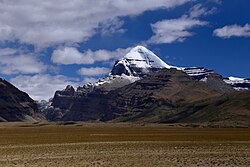 [Unavailable: ❌ https://upload.wikimedia.org/wikipedia/commons/thumb/2/23/Kailash-Barkha.jpg/250px-Kailash-Barkha.jpg ❌]
Mount Kailash from the Barkha plain — the 52km circumambulation (kora) of the mountain is completed by thousands of pilgrims annually; Hindus walk it clockwise, Bon practitioners counterclockwise; one kora is said to erase a lifetime of sins; 108 koras achieve enlightenment; the walk takes 3 days on foot and 2 weeks for those who prostrate the entire route
 [Unavailable: ❌ https://upload.wikimedia.org/wikipedia/commons/thumb/9/94/KailashKoraProsternation.jpg/250px-KailashKoraProsternation.jpg ❌]
Tibetan pilgrim prostrating the Kailash kora — full-body prostration, in which the devotee lies flat on the ground and rises to pray before taking the next step; to prostrate the entire 52km circuit is an act of devotion requiring weeks; it is the most extreme form of the pilgrimage — the body itself becoming an offering
 [Unavailable: ❌ https://upload.wikimedia.org/wikipedia/commons/thumb/5/54/KailashMani.jpg/250px-KailashMani.jpg ❌]
Mani stones along the Kailash kora — the Tibetan tradition of carving sacred texts and images into stone; the mani stone (inscribed with *Om Mani Padme Hum*) placed at a sacred site is an act of permanent devotion; the stone endures after the carver dies, continuing to send the prayer into the world
 [Unavailable: ❌ https://upload.wikimedia.org/wikipedia/commons/thumb/e/e8/Olympus_National_Park_30.jpg/250px-Olympus_National_Park_30.jpg ❌]
Mount Olympus, Greece (2,917m) — the home of the twelve Olympian gods in Greek mythology; the highest peak in Greece, often cloud-covered, which enhanced its divine associations; the ancient Greeks did not worship on Olympus itself (they could not reach the summit) but directed prayer toward it as the physical location of the divine assembly
 [Unavailable: ❌ https://upload.wikimedia.org/wikipedia/commons/thumb/d/d7/Athos_-_from_NW.jpg/250px-Athos_-_from_NW.jpg ❌]
Mount Athos, Greece (2,033m) — the 'Holy Mountain,' home to twenty Eastern Orthodox monasteries that have maintained continuous monastic life for over a millennium; women have been excluded since the 10th century CE; the Byzantine monastic tradition treats the entire peninsula as a single sacred precinct, dedicated to the Virgin Mary
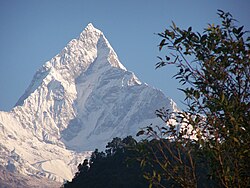 [Unavailable: ❌ https://upload.wikimedia.org/wikipedia/commons/thumb/6/62/Machapuchre-wow.jpg/250px-Machapuchre-wow.jpg ❌]
Machapuchare (Fishtail Mountain), Nepal (6,993m) — sacred to the Hindu god Shiva, considered one of his abodes; no climbing expedition has ever reached the summit — the Nepalese government banned attempts in 1964 out of respect for its sacred status; the mountain remains inviolate, its perpetual snow a visible sign of divine presence
 [Unavailable: ❌ https://upload.wikimedia.org/wikipedia/commons/thumb/5/56/Hindukailash.JPG/250px-Hindukailash.JPG ❌]
Hindu pilgrims at Mount Kailash — the gathering of devotees from multiple traditions at the same sacred mountain is a living demonstration of the mountain's capacity to transcend the categories of any single religion; Hindus, Buddhists, Jains, and Bon practitioners walk the same kora, honoring the same peak, from within their different frameworks
 [Unavailable: ❌ https://upload.wikimedia.org/wikipedia/commons/thumb/0/06/Yaks-Kailash-Manasarovar.jpg/250px-Yaks-Kailash-Manasarovar.jpg ❌]
Yaks at Lake Manasarovar, Kailash — the sacred lake (4,590m elevation) at the base of Kailash is itself a pilgrimage destination; Manasarovar ('mind lake' in Sanskrit) is where Brahma himself bathes, and its waters are believed to purify all karma; to bathe in it and see Kailash simultaneously is among the rarest and most blessed experiences available to a living human being
Related Esoteric Inquiries:
- The Staff: The Vertical Axis and the Syntax of the Journey
- Ley Lines and Sacred Sites: The Earth's Hidden Energy Grid
- The True Cross: The Geometry of Sacrifice and the Syntax of the Axis Mundi
Lux Esoterica.
2026.


Comments