Sumerian Tablets: The Dawn of the Sacred Scribe and the Fixation of Reality
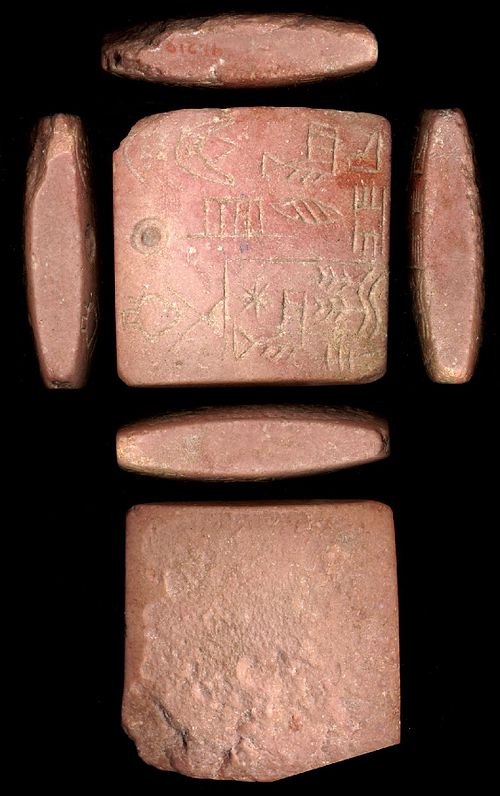
A Sumerian protoliterate clay tablet (c. 3100–2900 BCE)—the earliest evidence of the human attempt to fix the logos into the density of matter.
The stylus and the Clay: An Introduction to Sumerian Magic
In the fertile crescent of Mesopotamia, over five thousand years ago, a revolution occurred that was not just technological, but deeply metaphysical: the birth of writing. The Sumerians did not invent Cuneiform simply for accounting; they invented it as a way to "Capture the Decree." To the Sumerian mind, the universe was governed by the Me—divine decrees or archetypal blueprints that established the laws of physics, social order, and spiritual reality. By pressing a reed stylus into wet clay, the Sacred Scribe was performing an act of Sacred Word Creation, bringing the unmanifest Me into the manifest world.
This is the origins of Linguistic Sovereignty. The scribe was the one who could bridge the gap between the gods (the Anunnaki) and the people. A word written in clay was a word "Fixed" in the material plane. It was an act of Sacred Wisdom that recognized the power of the Logos to shape the density of our experience. To study the Sumerian Tablets is to return to the root of the Great Work, where the vibration of the spirit first met the resistance of the earth.
The Enuma Elish and the Tablets of Destinies: The Architecture of Authority
In the Babylonian and Sumerian creation myths, most notably the Enuma Elish, the ultimate power in the universe is not held by a sword, a scepter, or a crown, but by the Tablets of Destinies (Tup Shimati). Whoever possessed these tablets held the legal, spiritual, and physical authority over the entire cosmos and the flow of time.
1. The War for Authority
The myth describes a primordial conflict between the forces of chaos (represented by the dragon-mother Tiamat) and the forces of order (represented by the younger god Marduk). Before the battle, Tiamat gave the Tablets of Destinies to her consort Kingu, making him the supreme ruler of the host of chaos. When Marduk defeated Tiamat and captured Kingu, his first and most significant act of Sovereignty was to seize the Tablets. By placing the tablets upon his own chest, he "Legitimatized" his rule and established the precise order of the stars, the seasons, and the destiny of humanity.
* Esoteric Meaning: The Tablets of Destinies represent the Primary Blueprints and the "Operating System" of our personal and collective reality. To "Wear the Tablets" is to take absolute responsibility for your own life-stream. It is the realization that reality is not a series of random, chaotic accidents, but is a "Script" that can be edited and rewritten by those who possess the stylus of awareness. The "Gods" are simply those who have mastered the code.
2. The Power of the Naming: Creating the World
The Enuma Elish begins with the evocative words: "When on high the heaven had not been named, and the earth below had not been called by a name..." In Sumerian and Babylonian thought, a thing does not truly exist—it has no "Function" or "Essence"—until it has been given a name by a scribe or a god.
* The Alchemical Goal: The sacred scribe is the one who learns the "True Names" (Summu) of things. By naming a demon, a fear, or a disease, you gain vibrational power over it. By naming a virtue, a goal, or a divine quality, you vibrate it into manifest being. This is the Ars Magna of language—the science of using the word to bridge the gap between the unmanifest potential and the manifest density.
The Scribe as Alchemist: Transmuting the Word into Matter
The education of a Sumerian scribe (the Dub-sar) in the Edubba (the "Tablet House") was a long, rigorous, and deeply ritualized process. It involved not only the technical mastery of thousands of cuneiform signs but also the study of mathematics, sacred law, astronomy, and theurgical ritual. The scribe was a scientist of the spirit.
- The Purification of the Clay: The clay used for the tablets was not just common mud; it had to be carefully selected from the riverbanks, purified of all grit and impurities, and properly hydrated. This is a direct metaphor for the Internal Vessel of the scribe's own mind. Only a purified, disciplined, and hydrated consciousness can accurately receive and record the divine decrees (Me). If the clay is brittle, the word will crack.
- The Fixation of the Volatile: Cuneiform signs are composed of wedge-shaped marks that look like "Birds' footprints" in the mud. This represents the alchemical process of Fixing the Volatile—taking the fleeting, airy, and "bird-like" intuitions of the spirit and turning them into a stable, earthy, and permanent law. The scribe takes the "Fire" of the idea and grounds it in the "Earth" of the tablet. Every stroke of the stylus is a physical anchor for a spiritual truth. This is the ultimate act of Sacred Word Creation.
Sacred Writing and the Architecture of Time
The Sumerian scribes were the first to organize the "Grid" of human time. They were the ones who divided the circle into 360 degrees and the hour into 60 minutes, numbers they considered sacred because of their mathematical perfection and their relationship to the celestial cycles.
- The Harmonization of the Cycles: By recording the movements of the planets (especially the eight-year cycle of Venus and the twelve-year cycle of Jupiter) on clay tablets over centuries, the scribes realized that time itself was a repeating, rhythmic pattern. They were the first to understand the Law of Periodicity and the Law of Rhythm. They saw that by knowing the past "Decrees" of the stars, they could predict the future "Destiny" of the land.
- The Archive of the Spirit: The tablets provided a "Continuity of Consciousness" that allowed wisdom to be passed down through generations without distortion. They were the first "External Memory" of the human race, allowing the Great Work of spiritual evolution to survive the death of the individual body. The tablet is the "Incorruptible Body" of the word.
Breaking the Grid: The Sovereignty of the Permanent Script
In our current era, we are surrounded by a "Digital Script"—a relentless torrent of ephemeral data, pixels, and signals that have no physical density and are often used to manipulate, distract, and harvest human attention. This digital script is the ultimate "Volatile" force; it is easily changed, deleted, and controlled by external, centralized grids.
The Sumerian tablets remind us of the radical power of Permanent Fixation. When you write your intentions, your names for the divine, and your own life-decrees in a physical medium—on paper, in stone, or even in the "Clay" of your own disciplined, daily habits—you are performing an act of Ontological Sovereignty. You are refusing to let your destiny be written by the fleeting, digital whims of the machine.
- The Scribe's Internal Firewall: By mastering the "Signs" of your own internal language—by naming your shadows, your goals, and your divine lineage with absolute precision—you build a firewall against the synthetic narratives and the "False Decrees" of the world. You realize that you are not a character in someone else's story; you are the sacred scribe who holds the stylus and the clay. You are the author of your own Tablet of Destiny.
Meditative Contact: The Stylus of Light
To align with the frequency of the Sacred Scribe, the Fixation of Truth, and the Sovereignty of the Word:
- The Centering: Sit in a quiet, dark place. Close your eyes and imagine you are sitting in the courtyard of a temple in the ancient city of Uruk, five thousand years ago. Feel the warmth of the Mesopotamian sun and smell the damp river mud and the burning cedar incense.
- The Tablet: Visualize a clean, smooth, and perfectly hydrated clay tablet resting in your lap. This tablet represents the Next Cycle of Your Life.
- The Stylus: Visualize a stylus made of pure, unshakeable white light in your right hand. This stylus is your Conscious Intent.
- The Inscription: Choose one "Sacred Decree" you wish to fix in the matter of your life (e.g., "I AM SOVEREIGN," "I AM ABUNDANT," "I AM THE LIGHT"). Imagine pressing the stylus of light into the clay of your life, carving the cuneiform wedges with absolute, rhythmic precision. See the light filling the grooves in the clay.
- The Invocation: Speak silently: "I am the scribe of my own soul. I am the stylus of the one mind. I carve the decrees of the spirit into the matter of the earth. My words are fixed. My destiny is mine. I am sovereign. I am the writer of my own book of life. So it is written, so it is fixed."
- The Action: Today, write down your primary "Decree" for the coming month on a physical piece of paper with a real pen. Fold it carefully and place it under a heavy stone or in a sacred place. This is your physical "Tablet" for the Great Work of this cycle.
Through the ancient, geometric wedges of the cuneiform, we rediscover the modern power of the sovereign word. We learn that we are not the subjects of an accidental destiny, but the scribes of a divine one. The clay is waiting, and the stylus is in your hand.
— Lux Esoterica
References for Further Study:
- The Sumerians: Their History, Culture, and Character by Samuel Noah Kramer
- Enuma Elish: The Babylonian Creation Myth - L.W. King translation
- The Literature of Ancient Sumer - Jeremy Black et al.
- The Inner Sky by Steven Forrest
- A Manual of Esoteric Astrology by Sepharial
- Cuneiform: Ancient Scripts by Irving Finkel and Jonathan Taylor
- Babylonian Magic and Sorcery by Leonard W. King
- The Harps that Once... Sumerian Poetry in Translation by Thorkild Jacobsen
Related Esoteric Inquiries:
- Zen Buddhism and the Art of Nothingness: The Direct Experience of the Void
- The Toltec Path: Mastering Awareness, Intent, and the Warrior's Sovereignty
- The Chaldean Oracles: Fire and Logic - The Theurgical Path to the One
Lux Esoterica.
2026.


Comments