The Bhagavad Gita: The Song of God and the Battlefield of the Soul

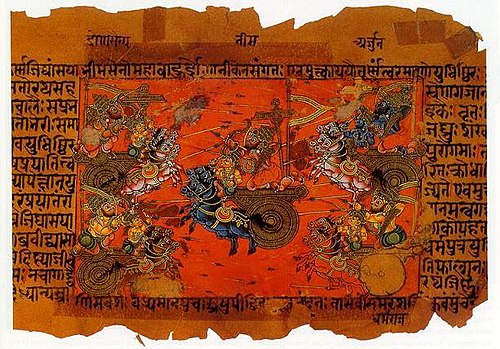
A 19th-century illustrated Sanskrit manuscript of the Bhagavad Gita, Chapter 1 — depicting Arjuna's chariot between the two armies.
There is a moment that every soul recognizes, even if they have never stood on a literal battlefield: the moment when everything you thought you knew collapses, when duty and love seem to pull in opposite directions, when the path forward looks impossible and the past irretrievable. It is in exactly this moment — frozen between two vast armies, his bow slack in his hands, his knees shaking — that Arjuna receives the greatest spiritual teaching humanity has ever recorded.
The Bhagavad Gita, or Song of God, is a 700-verse Sanskrit poem embedded within the colossal epic of the Mahabharata. It unfolds as a dialogue between the warrior-prince Arjuna and his charioteer Krishna — who is, in reality, the Supreme Being in human form. This brief but inexhaustible text has shaped the spiritual life of billions across millennia and has been called, by figures as diverse as Gandhi, Emerson, Thoreau, and Oppenheimer, the single most profound summary of the human condition ever written.
The Battlefield of Kurukshetra
To understand the Gita, one must first feel the weight of its setting. The great war of Kurukshetra — the dharmayuddha, or righteous war — has been building for years. Two branches of the same royal family, the Pandavas and the Kauravas, have finally arrived at the moment of total confrontation. The field of Kurukshetra, in what is today the state of Haryana in northern India, was already considered a sacred site — a dharmakshetra, a field of righteousness — before the battle.
Kurukshetra — the sacred plain in Haryana where the great war of the Mahabharata was fought.
Arjuna, the greatest archer of his age, asks Krishna to drive his chariot between the two armies so he can see who he must fight. What he sees destroys him: on the other side stand his teachers, his grandfather Bhishma, his cousins, his friends. Men he loves. He puts down his bow. He cannot do this. He would rather be killed than kill. He speaks to Krishna with the anguish of a man who has just encountered the irreducible tragedy at the heart of moral life.
Krishna's response takes up the next seventeen chapters. It is the Bhagavad Gita.
The Nature of the Soul
Krishna begins with what might seem like a cold correction, but which is in fact an invitation into the deepest metaphysical reality: Arjuna grieves for those who should not be grieved for, because the soul — the Atman — is eternal and cannot be killed.
"Never the spirit was born; the spirit shall cease to be never. Never was time it was not; End and Beginning are dreams." — Gita 2:20, in Edwin Arnold's translation.
The Atman (individual soul) is identical in its essence with Brahman (the Universal Soul, the ground of all being). This is the great non-dual insight that Hindu metaphysics calls Advaita: not-two. When you see a person die, you are witnessing the dissolution of a temporary form. The consciousness within — like a flame passed from candle to candle — simply moves on. This understanding, Krishna tells Arjuna, is not a cold abstraction: it is the only foundation stable enough to act from.
What we cling to as "I" — the body, the personality, the social role — is all transient. The Atman is nityah (eternal), sarvagata (omnipresent), sthanu (immovable), achala (unshakeable), sanatanah (ancient and ever-new). Arjuna's grief, Krishna suggests, is the grief of someone who has confused the costume for the dancer.
The Three Paths of Liberation
The genius of the Gita is that it does not offer a single path. It offers three — and ultimately reveals them as facets of one jewel.
Karma Yoga: The Path of Action
Karma yoga is the yoga of action without attachment to results. This is perhaps the Gita's most radical and misunderstood teaching. Krishna does not tell Arjuna to abandon action, to retreat to a monastery, to renounce the world. He tells him to act — but to act without clinging to the fruits of that action.
"You have a right to perform your prescribed duties, but you are not entitled to the fruits of your actions. Never consider yourself the cause of the results of your activities, and never be attached to not doing your duty." — Gita 2:47.
This is a teaching of extraordinary psychological precision. Most of our suffering arises not from what happens to us, but from our desperate need to control outcomes. We act not from the clarity of what the present moment requires, but from anxiety about the future and memory of the past. Karma yoga says: do what is yours to do. Do it completely. Then release the result to the cosmos. This is not passivity — it is the highest form of engaged presence.
Gandhi called this teaching the central axis of his whole life. He wore his charkha (spinning wheel) as a sacrament of karma yoga: to spin thread not to become rich, but because it was the right action to perform, regardless of outcome.
Jnana Yoga: The Path of Knowledge
Jnana yoga is the path of direct spiritual knowledge — not book learning, but the direct perception of reality as it is. The jnani (practitioner of jnana yoga) asks, relentlessly: Who am I? What is this "I" that perceives, fears, loves, and dies? Following the thread of inquiry all the way to its source, the jnana yogi discovers what Ramana Maharshi would later call the Self — the pure awareness that witnesses all experience but is itself uncaused, unconditioned, and beyond all categories.
The Gita teaches that the Kshetra (field of experience, the body and world) and the Kshetrajna (the Knower of the field, the witnessing consciousness) are distinct. Suffering arises when we confuse the two — when we identify with the field (the body, emotions, thoughts) rather than recognizing ourselves as the Knower. Jnana yoga is the systematic practice of making this distinction alive in direct experience.
Bhakti Yoga: The Path of Devotion
Bhakti yoga — the path of love and devotion — is in many ways the culmination of the Gita's teaching. In chapter twelve, when Arjuna asks which path is superior, Krishna gently indicates that bhakti — love for the divine — is the easiest and most complete.

Krishna with his flute — the divine musician whose song calls the soul home. The flute is a symbol of surrender: hollow within so that the divine breath may pass through.
Bhakti is not mere sentiment or religious emotion. It is a total reorientation of consciousness toward the divine — a radical act of love that gradually dissolves the ego's insistence on its own centrality. The great bhakti saints of India — Mirabai, Tukaram, Kabir, Andal — demonstrate what this looks like in practice: lives that became songs, every action a form of worship, every moment a conversation with the beloved.
"Fix your mind on Me, be devoted to Me, worship Me, bow down to Me. So shall you come to Me. I promise you truly, for you are dear to Me." — Gita 18:65.
The Cosmic Vision: Vishvarupa
At the peak of the Gita's teaching, Arjuna asks to see Krishna's true form. What follows — in chapter eleven — is one of the most astonishing passages in all world literature. Krishna grants Arjuna divya chakshus (divine sight), and what Arjuna beholds is the Vishvarupa: the Universal Form.
Arjuna sees Krishna as a being of infinite mouths, infinite eyes, infinite arms — the entire cosmos contained within a single presence. He sees all the warriors on both sides of the battlefield being drawn into Krishna's mouths like rivers flowing into the sea. He sees birth and death, creation and destruction, all occurring simultaneously within this boundless body of light. He is terrified. He begs Krishna to return to his gentle human form.
The Vishvarupa is not a piece of mythological decoration. It is a direct communication of the Gita's central metaphysical claim: that the divine is not a being among other beings but the very ground of being itself — the reality within which all things arise and into which all things dissolve. The battlefield of Kurukshetra is not separate from this reality. Arjuna's crisis is not separate from it. Nothing is outside it.
J. Robert Oppenheimer famously quoted Gita 11:32 — "I am become Death, the destroyer of worlds" — at the moment the first atomic bomb detonated over the New Mexico desert in 1945. The choice of this verse was not accidental. Oppenheimer, who read the Gita in Sanskrit, recognized that he had glimpsed — in a terrible modern version — the same annihilating vision that Arjuna received on Kurukshetra.
Dharma: The Sacred Duty
Running through the entire Gita is the concept of dharma — a word so rich that no single translation captures it. Dharma is cosmic order, moral law, sacred duty, one's natural function in the great web of existence. It is what is right, not in an abstract sense, but specifically for this person, at this moment, in this situation.
Arjuna's dharma as a warrior (kshatriya) is to fight when war is just and unavoidable. Running from the battlefield would not be compassion — it would be a violation of his very nature and his place in the cosmos. The Gita insists that it is better to follow your own dharma imperfectly than to follow another's dharma perfectly. This is not an endorsement of the caste system as a social hierarchy, but a recognition that each consciousness has its own specific path, its own irreplaceable form of contribution to the whole.
In a broader, trans-historical reading, this teaching speaks to the anxiety of our own time: the pressure to live someone else's life, to perform an identity shaped by social media and comparison, rather than listening to the still, deep voice that knows exactly what this particular soul is here to do.
The Gita and Western Thought
The Bhagavad Gita arrived in the Western world in 1785, when Charles Wilkins produced the first English translation. Its impact was immediate and lasting. Ralph Waldo Emerson called it "the first of books" and incorporated its teachings into the founding documents of American Transcendentalism. Henry David Thoreau kept a copy at Walden Pond and wrote that "in the morning I bathe my intellect in the stupendous and cosmogonal philosophy of the Bhagavad-Geeta."
Wilhelm von Humboldt, the great German linguist and philosopher, wrote that the Gita was "the most beautiful, perhaps the only true philosophical song existing in any known tongue." The poet T.S. Eliot drew from it in Four Quartets. Carl Jung found in its psychology of consciousness a mirror for his own work on the Self and individuation.
The Gita's influence on Western esotericism has been equally profound. Theosophy, founded by Blavatsky in the 19th century, made the Gita a cornerstone of its teachings on karma and reincarnation. The concept of karma — cause and effect operating across lifetimes — as understood in the Gita entered global spiritual discourse largely through the Theosophical movement.
The Inner Battlefield
The esoteric tradition has always insisted on reading the Gita simultaneously on two levels: the literal (a historical battle) and the symbolic (the eternal inner war of the soul).
The Pandavas represent the higher faculties of the human being: wisdom, discernment, virtue, strength in service of truth. The Kauravas represent the ego-driven forces: pride, greed, attachment, the insistence that the small self is the ultimate reality. Every moment of conscious life is, in this reading, a Kurukshetra — a field where these two armies meet.
Arjuna's paralysis is the paralysis of the spiritual seeker at the moment of real commitment: when the path forward requires giving up something precious, when the old self must actually die for the new one to live. This is the dark night of the soul in Hindu dress. And Krishna's teaching is always the same: do not flee into numbness. Do not freeze in grief. Take up your bow. Act from your deepest nature. Trust the eternity that you are.
Living with the Gita
For those who wish to work with the Gita as a living text rather than a historical artifact, there are a few entry points that tradition consistently recommends.
The first is to read it slowly, a few verses at a time, allowing each verse to be not an idea to understand but an experience to feel. The Gita was composed as a song — its Sanskrit rhythms carry a frequency that the mind can receive even without understanding every word.
The second is to work with Chapter Two, which contains in compressed form the entire teaching. If one could truly absorb chapter two, the rest of the Gita would open by itself.
The third is to identify, in one's own life, the specific place where Arjuna's crisis is playing out: the moment of paralysis, the relationship where love and duty are in tension, the creative project that seems impossible because you care too much about the outcome. The Gita speaks directly to this moment. It always has. It always will.
It is not a text about war. It is a text about freedom — the freedom that comes when you finally understand what you are, and from that understanding, act without fear.
The Bhagavad Gita has outlasted empires, survived invasions, and traveled to every corner of the world because it speaks to something that cannot be colonized or destroyed: the naked encounter between a human soul and the fact of its own divine nature. Whether you are a devotee of Krishna or a secular practitioner of mindfulness, whether you approach it as mythology or as metaphysics, this ancient song finds you where you are and whispers the same impossible, liberating truth: you are not who you think you are. The battlefield is real. And you are not alone on it.
— Lux Esoterica


Comentarios