The Chaldean Oracles: Neoplatonic Theurgy and the Divine Mind

An engraving of Iamblichus of Chalcis—the Syrian Neoplatonist philosopher who defended theurgic ritual as the soul's path to divine union.
The universe does not speak in prose; it sings in fragmented fire. In the twilight era of the classical world, as the temples of ancient Greece and Rome were slowly crumbling under the rising tide of institutional orthodoxy, a group of pagan mystics sought a direct, unmediated gateway to the heavens. They found their answer not in sterile rational arguments, but in a mysterious, fragmented collection of second-century Greek hexameter verses: The Chaldean Oracles. Attributed to a father and son duo known as Julian the Chaldean and Julian the Theurgist (who coined the very word theurgy), these poetic fragments became the sacred scripture of late antiquity. For the great philosophers of Neoplatonism, these oracles were a divine revelation—a map of the cosmic hierarchy and a practical manual for using the physical world as a sacred springboard to return the human soul to its source in the Divine Mind.
This article explores the deep, mystical depths of the Chaldean Oracles, tracing its sophisticated tripartite cosmology, the revolutionary practice of theurgy over vulgar magic, the alchemical role of solar fire, and its enduring influence on Western occultism in 2026.
The Pagan Bible of Late Antiquity: Neoplatonic Reverence
To understand the immense status of the Chaldean Oracles, one must look at how they were treated by the intellectual titans of Late Platonism. When the brilliant philosopher Proclus was asked which books he would preserve if all the libraries of the world were burning, he replied that he would save only two: the Timaeus of Plato and the Chaldean Oracles.

A classic marble bust of Plotinus, whose philosophy of emanation laid the theoretical foundation upon which the Chaldean Oracles and theurgic practice were built.
While early Platonists like Plotinus sought union with the One through purely intellectual contemplation, the later Neoplatonists recognized a profound human problem: the human soul, densified and weighed down by its descent into the physical body, is too fragmented to climb back to the heavens through reason alone. The intellect, severed from its cosmic roots, becomes trapped in its own logical loops.
The Syrian philosopher Iamblichus radically reshaped Platonism by defending the necessity of ritual magic—theurgy—defined literally as "the work of the gods". He argued that since the entire physical universe was created through the descending emanation of divine forces, the physical world itself must contain the hidden keys to return to the source. The Chaldean Oracles provided the perfect textual and cosmological foundation for this ritual system, acting as a bridge between the abstract philosophy of Plato and the concrete practice of stellar temple magic.
The Cosmology of the Three Worlds: Father, Mind, and Hecate
The cosmology of the Chaldean Oracles is a beautiful, three-layered tapestry of divine emanation. It divides reality into three concentric, cosmic worlds:
1. The Empyrean (The Intelligible Realm): The highest, most spiritual world, governed by the First Father—a pure, transcendent Mind characterized by Silence and Light. The Father does not actively participate in creation; he exists as a pure potentiality, a silent flame from which all life flows.
2. The Aetherial (The Intellectual Realm): The middle world, governed by the Second Mind, also known as the Demiurge or the Ruler. This is the active, ordering intellect that shapes the chaotic raw materials of reality into the harmonious patterns of the physical cosmos.
3. The Material (The Sublunary Realm): Our physical world, subject to gravity, decay, and the limitations of time and space.
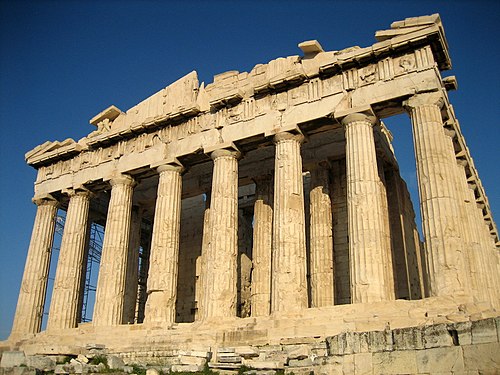
The Parthenon in Athens—a permanent monument of classical Hellenic paganism, which Neoplatonic theurgists sought to defend against the rising tide of institutional orthodoxy.
But how does the transcendent Light of the Empyrean cross the massive gap to reach our dense, physical earth? The oracles solve this cosmic mystery through the majestic figure of Hecate.
In the Chaldean system, Hecate is not the dark, sinister witch of popular medieval lore. She is the supreme World-Soul (Anima Mundi), the cosmic womb and the vital mediatrix that stands directly at the boundary between the spiritual and material realms. From her right side flows the source of life; from her left side, the physical laws that govern the stars and planets. She is the cosmic gateway, the pneumatic bridge through which the descending divine rays are channeled into physical matter, and through which the rising soul must pass on its return to the One.
Theurgy vs. Goetia: Aligning with the Gods
In the ancient world, as in 2026, magic was often viewed with deep suspicion, associated with curses, love potions, and the selfish manipulation of natural forces for personal wealth or power. The Neoplatonists called this vulgar, manipulative magic goetia (sorcery).
The Chaldean Oracles drew a sharp, absolute line between goetia and theurgy:
* Goetia (Sorcery): An act of cosmic hubris. The sorcerer attempts to command, bind, or trick planetary spirits and low demons to do his bidding, dragging the spiritual forces down into the mud of earthly desire.
* Theurgy (Sacred Magic): An act of absolute humility. The theurgist does not command the gods; they align themselves with them. Theurgy is the art of ritual synchronization. The practitioner understands that the Demiurge, when constructing the universe, placed specific, divine signatures (symbola or synthemata) into the physical world—certain stones, plants, sounds, and geometric shapes that vibrate in perfect harmony with the celestial spheres.
By gathering these physical signatures into a sacred circle, the theurgist creates a resonant alchemical vacuum, a lightning rod that draws down the pure, qualified energy of a specific god. The goal of theurgic ritual is not to change the mind of the gods, but to lift the disordered, earthly consciousness of the human being up into their perfect, eternal order, facilitating henosis—direct, mystical union with the Divine.
The Alchemical Fire and the Symbola of Ascent
The Chaldean Oracles are obsessed with the element of fire. They do not view fire merely as a physical chemical reaction, but as the supreme material representative of the Divine Mind.
According to the oracles, the Demiurge placed a spark of this divine, creative fire (the fire of the intellect) at the absolute center of every human heart. This spark is our true identity—the immortal, spiritual soul that has become trapped in the cold, wet matrix of physical flesh and earthly desires.
To free this spark, the theurgist utilizes the symbola—the material keys of creation:
* Stones and Minerals: Certain crystals, like the solar heliotrope, which naturally catch and concentrate the rays of the Sun.
* Sacred Herbs: Plants that follow the cycles of the day, absorbing the divine breath of the planetary spheres.
* Divine Names: Vowels and words of power chanted in specific, non-conceptual patterns, echoing the cosmic music of the spheres.

A complex ritual magic circle from the Heptameron—representing the historical descent and evolution of Neoplatonic theurgy into the grimoire traditions of the European Middle Ages and Renaissance.
During the ritual, the theurgist focuses their mind, using these material keys to build a resonant fire within. The physical fire on the altar acts as a somatic focal point, allowing the practitioner to burn away the dense, material "vessel" of the lower senses, releasing the spiritual spark to ascend through the planetary spheres and cross the Hecatean gateway into the pure Light of the Intelligible Realm.
The Legacy: From late Antiquity to the Golden Dawn
When the pagan temples were finally closed and the Neoplatonic Academy of Athens was officially dissolved by Emperor Justinian in 529, the Chaldean Oracles went underground. Yet, their theological power was so immense that they continually resurfaced to shape the history of Western mysticism.
During the Renaissance, the Greek scholar Gemistus Plethon brought the fragmented texts to Florence, where he introduced them to Cosimo de' Medici and Marsilio Ficino. Ficino was spellbound, translating the oracles into Latin and integrating their solar-fire cosmology into his own Hermetic planetary magic.
Later, in the nineteenth century, the founders of the Hermetic Order of the Golden Dawn synthesized the Chaldean Oracles into their advanced grades, requiring initiates to study and chant the fragmented verses during their ceremonial initiations. The famous "Lesser Banishing Ritual of the Pentagram" and the invocation of the planetary spheres in modern ritual magic are direct, historical descendants of late Neoplatonic theurgy.
Awakening the Inner Fire
As we navigate the sterile, utility-driven landscapes of 2026, our physical lives are often characterized by a profound spiritual displacement. We live in concrete environments that have no regard for the sacred, our attention constantly fragmented by digital noise, our minds severed from the orderly rhythms of the living cosmos.
The Chaldean Oracles call us back to a universe that is alive, interconnected, and vibrating with divine intelligence. They challenge the flat, modern view that the physical world is merely dead matter to be extracted and consumed.
The deep secret of the oracles is that the entire universe is a massive, ongoing ritual of theurgy. Every leaf that grows, every crystal that forms, and every beat of the human heart is a physical signature of the Divine Mind seeking expression in form.
By silencing the lower noise of the senses, by contemplating the sacred geometry of the stars, and by treating our own lives as a conscious ritual of alignment, we can awaken the divine spark of fire within our own hearts. We can transform our daily actions into theurgy, discovering the ultimate Pagan secret: that the gateway through the planetary spheres is not a space we travel to, but a depth of silent, radiant consciousness we awaken inside our own souls.
— Lux Esoterica
Related Esoteric Inquiries:
- The Corpus Hermeticum and the Divine Mind: The Revelation of Poimandres, Sacred Theosophy, and the Keys of Universal Intellect
- Lenormand Card 12: Los Pájaros (The Birds / The Owls) — The Buzz of Communication, Divine Duality, and the Voice of the Air
- The Corpus Hermeticum: The Divine Revelations of Hermes Trismegistus and the Mind of the Universe
Lux Esoterica.
2026.


Comments