The Gospel of Mary Magdalene: Gnosticism and the Sacred Feminine

A Greek papyrus fragment of the Gospel of Mary (P. Rylands III 463) discovered at Oxyrhynchus, Egypt—a silent witness to a lost Gnostic tradition of female spiritual leadership.
The ultimate truth is not spoken by the crowds, but whispered in the silence of the wilderness. For centuries, the dominant narrative of early Christianity presented a uniform, institutionalized faith built upon the patriarchs of the Roman Church. However, beneath the shifting sands of Egypt lay buried a very different story. In 1896, a German scholar purchased a papyrus codex in Cairo—the Berlin Gnostic Codex 8502—that would forever shatter the traditional boundaries of Christian history. Hidden within its worn, leather-bound pages was a text of stunning theological depth and revolutionary spiritual authority: the Gospel of Mary. Written in the second century, this remarkable work of Gnostic Christianity presents Mary Magdalene not as the penitent prostitute of medieval myth, but as the supreme visionary, the keeper of the savior's most advanced teachings, and the true leader of the apostles.
This article explores the deep, mystical waters of the Gospel of Mary, analyzing its Gnostic cosmology of material dissolution, the soul’s ascent through the seven hostile powers of the cosmos, the dramatic clash of spiritual authority between Mary and Peter, and its enduring message for the awakening of the sacred feminine in 2026.
The Redemptive Myth: Mary as the Apostle to the Apostles
To understand the revolutionary impact of the Gospel of Mary, one must first dismantle one of the most successful character assassinations in history. In the year 591, Pope Gregory the Great delivered a famous homily in Rome that officially conflated Mary Magdalene with the unnamed weeping sinner in the Gospel of Luke and Mary of Bethany. In a single theological stroke, the primary witness to the Resurrection—the Apostola Apostolorum—was reduced to a weeping, hyper-sexualized penitent whose spiritual voice was silenced by her shame.

Mary Magdalene contemplating the scriptures, as painted by Leonardo da Vinci’s student Giampietrino. Gnostic texts remember her as the foremost visionary and disciple of the Savior.
The Gospel of Mary paints an entirely different portrait. The text begins after the resurrection, with the Savior departing from the disciples, leaving them in deep grief and terror. They weep, saying: "How shall we go to the gentiles and preach the gospel of the kingdom of the Son of Man? If they did not spare him, how will they spare us?"
At this moment of despair, Mary stands up. She comforts them, turning their hearts toward the Good, and begins to encourage them. Seeing her strength, Peter recognizes her unique position: "Sister, we know that the Savior loved you more than the rest of woman. Tell us the words of the Savior which you remember, which you know, but we do not, nor have we heard them."
Mary does not weep or repent; she speaks with the calm, absolute authority of a master initiator. She describes a profound vision of the Savior, explaining that she saw him not with her physical eyes, but with the "mind"—the Nous—which stands as the mediating bridge between the physical brain and the spiritual soul.
The Gnostic Cosmology: The Dissolution of Matter
The first portion of the surviving manuscript containing the Gospel of Mary records a dialogue between the Savior and the disciples concerning the nature of matter and sin.
The Savior teaches that all physical forms, all created natures, are temporary and bound to dissolve back into their original elements. The material world is not our true home; it is a chaotic, densified manifestation of cosmic forces that have fallen away from the divine source, the Pleroma.
* The Root of Matter: Matter is a state of imbalance, characterized by the friction of opposing forces. It is the nature of the body to grow, decay, and dissolve.
* The Source of Peace: Peace is found only by turning inward, aligning with the "Good"—the Agathon—which is the ultimate, undivided reality.
* The Illusion of Sin: The Savior declares that "there is no sin" in the absolute sense. What the world calls sin is simply the soul’s self-forgetfulness—its tendency to act in accordance with the chaotic, animal passions of the physical body. By acting in alignment with the lower nature, the soul binds itself to the wheel of physical rebirth and cosmic suffering.
True salvation, therefore, is not a matter of moralistic obedience or belief in external dogmas. It is an act of mysticism—the conscious awakening of the divine spark within the human mind, allowing the soul to realize its absolute freedom from the material matrix.
The Ascent of the Soul: Navigating the Seven Hostile Powers
The centerpiece of Mary's revelation is her vision of the soul's ascent through the seven hostile powers that rule the cosmic spheres. In Gnostic cosmology, the solar system is not a neutral physical space, but a series of energetic barriers guarded by the Archons—planetary rulers who seek to keep human souls trapped in a state of amnesia and material slavery.
As the liberated soul rises toward the spiritual heavens, it must confront and overcome each of these seven powers, answering their hostile interrogations with the absolute power of gnosis:
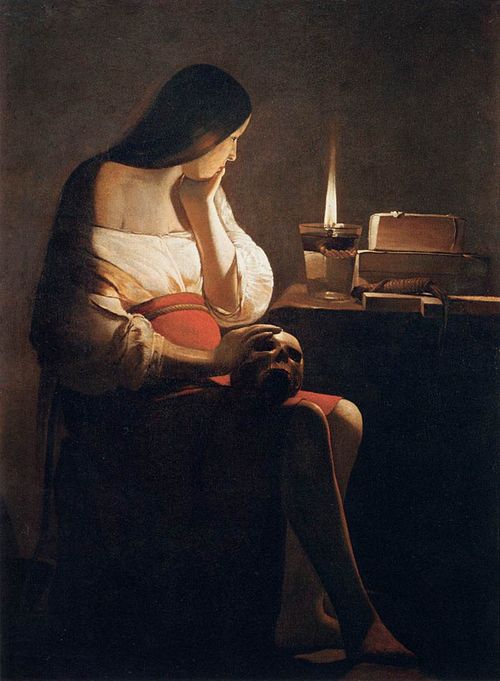
Georges de La Tour's famous Chiaroscuro painting of Mary Magdalene contemplating a candle flame—representing the inner, contemplative Gnosis that guides the soul through the planetary spheres of darkness.
- Darkness: The base state of ignorance and material gravity. The soul answers: "I have recognized you. You do not hold me."
- Desire: The binding force of physical attachment and addiction. The soul declares: "I did not see you descending, but now I see you ascending. Why do you lie to me, since I belong to you?"
- Ignorance: The mental fog that prevents self-awareness. The power demands: "Where are you going? In wickedness are you bound!" The soul replies: "Do not judge me. Though bound, I have not bound. I was not recognized, but I have recognized that the All is being dissolved."
- The Zeal of Death: The paralyzing fear of mortality and loss.
- The Kingdom of the Flesh: The illusion that the physical body is the ultimate limit of human identity.
- The Foolish Wisdom of Flesh: The intellectual arrogance that rationalizes away the spiritual realms in favor of sterile materialism.
- Wrathful Power: The final, violent storm of egoic anger and pride. It demands: "From whence do you come, slayer of men, and where are you going, conqueror of space?"
The soul answers this final tyrant with majestic, lyrical authority: "What binds me has been slain, and what turns me about has been overcome, and my desire has been ended, and my ignorance has died. In a world I was released from a world, and in a type from a heavenly type, and from the fetter of oblivion which is transient. From this time on will I attain to the rest of the time, of the season, of the age, in silence."
This is the ultimate Gnostic map of liberation. The powers of the Archons are not external demons; they are the unrefined, instinctual shadows of our own psychology. To conquer the powers is to integrate the shadow, transforming the unaligned ego into a silent, luminous vessel of pure spirit.
The Battle of Authority: Peter vs. Mary
When Mary finishes recounting her vision, the silent harmony of the disciples is instantly shattered by the rising forces of human ego and patriarchy.
Peter, reacting with shock and jealousy, refuses to accept that a woman could hold a higher spiritual authority than the male disciples. He demands: "Did the Savior really speak with a woman in private, without our knowledge? Are we all to turn around and listen to her? Did he prefer her to us?"
Andrew joins Peter, declaring that Mary's teachings are too strange and radical to be true Gnosticism: "Say what you think about what she has said. I at least do not believe that the Savior said this. For certainly these teachings are strange ideas."
Mary, deeply hurt by their lack of faith, begins to weep: "My brother Peter, what do you think? Do you think that I have thought this up myself in my heart, or that I am lying about the Savior?"

Artemisia Gentileschi’s portrayal of Mary Magdalene—a powerful image of feminine dignity, resolve, and spiritual independence that echoes her historical stand in the Gnostic scriptures.
At this critical moment, Levi (Matthew) steps forward to defend Mary, rebuking Peter with severe courage: "Peter, you have always been hot-tempered. Now I see you contending against the woman like the adversaries. But if the Savior made her worthy, who are you indeed to reject her? Surely the Savior knows her very well. That is why he loved her more than us."
This dramatic confrontation is not merely an ancient argument; it is a historical mirror of the great theological war that raged in the second and third centuries.
* The Path of Peter: Represented the external, hierarchical, and institutional Church, which sought to establish authority through male apostolic succession, written creeds, and physical control.
* The Path of Mary: Represented the internal, experiential, and charismatic Gnostic movements, which valued direct visionary experience, mystical illumination, and the equal spiritual leadership of women.
By declaring Mary's vision invalid, Peter and Andrew chose the path of external structure over internal revelation, laying the foundation for a Church that would exclude the feminine voice for nearly two millennia.
The Sophia Archetype: The Sacred Feminine and Gnosis
In the deep, alchemical currents of Gnostic philosophy, Mary Magdalene is far more than a historical figure; she is a physical crystallization of the Divine feminine principle—the archetype of Sophia (Divine Wisdom).
In Gnostic myth, Sophia is the Aeon who fell from the divine Pleroma, bringing about the creation of the material world. Her redemption is achieved through gnosis—the awakening of her divine nature and her subsequent return to the heavens.
Mary Magdalene represents the redeemed Sophia on earth. Unlike Peter, whose mind is constantly preoccupied with rules, hierarchy, and physical limitations, Mary’s consciousness is receptive, intuitive, and silent. She is the fertile womb of the spirit, capable of receiving the highest, non-verbal transmissions of the Divine.
Without this receptive, feminine capacity, the masculine intellect (represented by Peter) becomes rigid, dogmatic, and violent. It constructs a church of stone, but loses the living water of the spirit.
The Return of the Silence
As we navigate the highly polarized, noise-saturated currents of 2026, the Gospel of Mary Magdalene sounds a clarion call across the centuries. It reminds us that our primary spiritual authority does not reside in external institutions, holy books, or patriarchal dogmas.
It resides in the silent depths of our own consciousness.
The Gospel of Mary calls us to integrate our own inner masculine and feminine forces. We must possess the courage of Levi to defend the intuitive, mystical heart against the cold, structuring intellect of Peter. We must learn to navigate the seven cosmic powers of darkness within our own minds, answering ignorance with self-knowledge, fear with presence, and wrath with silence.
By turning our gaze backward, silencing the lower senses, and awakening the divine spark of Nous within, we can ascend the planetary spheres of the ego, discovering the ultimate Gnostic secret of Mary: that the Savior we are searching for is the very Light of the Soul that has been waiting in the silence since the beginning of time.
— Lux Esoterica


Comentarios