The I Ching: The Book of Changes and the Oracle That Discovered Binary Code

A Song Dynasty (960-1279 CE) printed edition of the I Ching — one of the earliest surviving printed versions of a text that had been transmitted for approximately three thousand years before the invention of printing. The Song period saw an intense revival of I Ching scholarship and the development of many of the Neo-Confucian commentaries still studied today
In 1701, the German mathematician and philosopher Gottfried Wilhelm Leibniz received a letter from the French Jesuit missionary Joachim Bouvet, who was working at the Chinese imperial court. Enclosed with the letter was a diagram: the sixty-four hexagrams of the I Ching, arranged by the Song Dynasty scholar Shao Yong in a sequence that mapped each hexagram to a binary number from 0 to 63, using broken lines for 0 and solid lines for 1.
Leibniz, who had independently invented binary arithmetic a few years earlier, recognized what he saw immediately: the oldest divination text in the world, composed in China three thousand years before his birth, had discovered the same binary system he was using to lay the mathematical foundations of modern computing.
The I Ching — Yì Jīng (易經), "The Book of Changes" — is the oldest of the Chinese classics: a text whose core symbols are attributed to the legendary sage-king Fu Xi (c. 2800 BCE in the mythological chronology), whose arrangement into the full sixty-four hexagrams is attributed to King Wen of the Zhou dynasty (c. 1050 BCE), whose individual line judgments were added by King Wen's son the Duke of Zhou, and whose philosophical commentaries — the Ten Wings — are attributed to Confucius (551-479 BCE), though modern scholarship questions this attribution.
This layered authorship spanning three thousand years is itself a statement about the nature of the text: the I Ching is not a fixed system but a living one, constantly enriched by each generation of commentators, consultants, and contemplatives who have brought their understanding to its symbols.
The Structure: Eight Trigrams, Sixty-Four Hexagrams
The fundamental building blocks of the I Ching are the eight trigrams (Bāguà, 八卦): combinations of three lines, each line either solid (—, yang) or broken (- -, yin). Eight possible combinations of three binary elements produce eight figures.
Each trigram carries a name, a natural image, a direction, an element, and a family relationship:
| Trigram | Name | Image | Quality |
|---|---|---|---|
| ☰ Qián | Heaven / The Creative | Sky, father | Strong, initiating |
| ☷ Kūn | Earth / The Receptive | Earth, mother | Yielding, nurturing |
| ☳ Zhèn | Thunder / The Arousing | Thunder, eldest son | Movement, initiating |
| ☵ Kǎn | Water / The Abysmal | Water, middle son | Danger, flowing |
| ☶ Gèn | Mountain / Keeping Still | Mountain, youngest son | Stopping, resting |
| ☴ Xùn | Wind / The Gentle | Wind/Wood, eldest daughter | Penetrating, following |
| ☲ Lí | Fire / The Clinging | Fire, middle daughter | Clarity, depending |
| ☱ Duì | Lake / The Joyous | Lake, youngest daughter | Joy, openness |
These eight trigrams, stacked in every possible pair, produce the sixty-four hexagrams (guà, 卦): six-line figures that constitute the complete vocabulary of the I Ching's sixty-four situations of change. Each hexagram has a name, a judgment, and a set of line statements (one for each of the six lines), providing up to six additional layers of commentary depending on which lines are "moving" (changing from yin to yang or vice versa).
The structure is not arbitrary. The sixty-four hexagrams constitute what the tradition understands as a complete map of the situations that arise in the cycle of change — not every situation that has ever occurred in history, but every archetypal quality of situation: the moment of new beginning (Hexagram 1, Qián, Pure Heaven), the moment of receptive waiting (Hexagram 2, Kūn, Pure Earth), the difficult first steps (Hexagram 3, Zhun, Sprouting), the fool's initial ignorance (Hexagram 4, Méng, Youthful Folly), and so through sixty-four nodes of the cycle of change.
Consulting the Oracle: Coins and Yarrow Stalks
The traditional method of consulting the I Ching uses fifty yarrow stalks in a complex divination process that takes approximately fifteen minutes to complete. The stalks are counted and sorted through four operations, each of which produces a remainder of 6, 7, 8, or 9. Six lines are generated in this way, from the bottom of the hexagram to the top, producing the complete hexagram.
The simpler and more widely used contemporary method uses three coins tossed six times. Each toss produces one line: three heads (value 3+3+3=9) gives a moving yang line; three tails (2+2+2=6) gives a moving yin line; two heads and a tail (3+3+2=8) gives a stable yin line; two tails and a head (2+2+3=7) gives a stable yang line. Moving lines change to their opposite after the hexagram is established, creating a second "resulting hexagram" that describes where the situation is heading.
The I Ching consultation is not, in the tradition's understanding, a random process. It is a synchronistic one: the configuration of stalks or coins that results from the consultation is understood to reflect the quality of the moment — not through mechanical causation but through the meaningful correspondence between the inner state of the questioner and the outer configuration of the consulting process. This is the basis of Carl Jung's famous foreword to the Richard Wilhelm translation, where he describes his own repeated consultations with the oracle and his conclusion that the results were consistently meaningful rather than random.
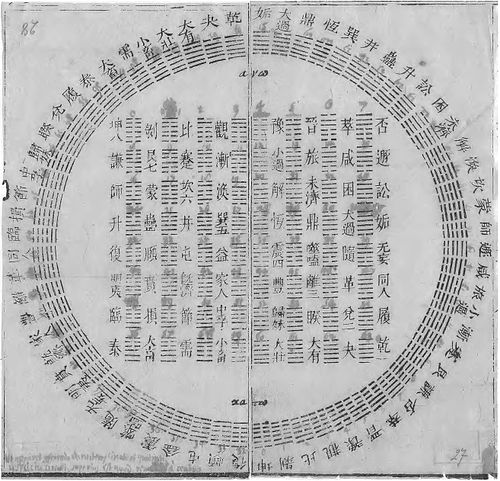
The diagram of I Ching hexagrams from the collection of Gottfried Wilhelm Leibniz (1701), received from the Jesuit missionary Joachim Bouvet. Leibniz recognized in the hexagram sequence the binary arithmetic he had independently developed — the mathematical foundation of modern computing, encoded in a three-thousand-year-old Chinese divination text
Jung and the Western Reception
Carl Jung's Foreword to Richard Wilhelm's landmark German translation of the I Ching (1924, translated into English by Cary Baynes in 1950) is one of the most important documents in the Western reception of Chinese thought. Jung describes consulting the oracle about itself — asking, in effect, what it thinks of Western attempts to understand it — and receiving a hexagram (Hexagram 50, Ting, The Cauldron) that seemed to comment directly on the situation of a bronze vessel serving to contain and transmit nourishment from the past.
Jung approached the I Ching through the framework of synchronicity — his concept of meaningful coincidence — and found in it what he described as "an age-old world-view" that complemented rather than contradicted modern psychological understanding. Where Western science sought causal explanations — what causes what — the I Ching offered a correlative understanding: what belongs together in this moment, what is the quality of this time, what does the whole constellation of present circumstances suggest?
This is the I Ching's fundamental philosophical contribution: the concept of synchronous rather than causal causality. In the Western scientific tradition, the question "why?" is answered by tracing a chain of prior causes. In the I Ching tradition, "why?" is also answered by considering what else is happening at the same moment — what belongs together, what resonates, what the whole configuration suggests. This is not anti-scientific; it is a different epistemological register, one that modern physics has increasingly had to reckon with in discussing quantum entanglement and non-local correlations.
Wilhelm's translation project was itself a remarkable act of cultural transmission. Wilhelm (1873-1930), a German Protestant missionary who spent twenty years in China and became deeply immersed in Chinese culture and thought, worked with the Confucian scholar Lao Nai-hsüan to produce a translation that captured not only the literal meaning of the text but something of its contemplative quality. His translation remains, a century later, one of the most widely used and respected in the English-speaking world.
The Philosophy of Change
The title — Book of Changes — expresses the text's central philosophical claim: that change is the fundamental nature of reality. Nothing is static; everything is in the process of becoming its opposite. Yang at its extreme becomes yin; yin at its extreme becomes yang. Summer contains the seed of winter; every full moon contains the seed of darkness. The sixty-four hexagrams are not sixty-four states but sixty-four moments of transition: snapshots in the endless flow of change.
This is the heart of Taoist thought — wú cháng (無常), impermanence — expressed not as a metaphysical abstraction but as a working map for navigating the flux of experience. The I Ching's wisdom is not "here is what is true forever" but "here is what is true now, in this configuration, in this moment of the cycle — and here is what it is becoming."
The ideal response to the I Ching's situational map is dé (德, virtue or power) aligned with dào (道, the Way): not forcing, not resisting, but flowing with the quality of the moment in a way that is appropriate to what the situation actually is rather than what we wish it were. This is the teaching behind the famous concept of wú wéi (無為, non-action or effortless action): not passivity, but action that is so attuned to the situation that it flows without resistance.
Working with the I Ching: Practical Guidance
The I Ching is consulted with a clearly formulated question — not a yes/no question but an open inquiry into the quality of a situation or the appropriate response to a decision. The question should be genuine: the oracle tends to respond to authentic uncertainty, not hypothetical testing.
After consulting (by coins or stalks), identify the primary hexagram, read its name and judgment, then consider each of the individual line statements corresponding to the moving lines (if any). The resulting hexagram (formed by changing all the moving lines to their opposites) describes where the energy of the situation is heading.
The interpretation process is contemplative rather than analytical. The I Ching's language is often indirect, poetic, and image-based: it speaks in agricultural metaphors, military situations, weather phenomena, and court life drawn from three-thousand-year-old Chinese culture. The reader's task is not to decode a message mechanically but to sit with the images and allow them to resonate with the question.
This is why the I Ching resists digital consultation tools that simply return a list of key words. The value of the text lies precisely in its indirectness — in the way its ancient images force the reader to do their own work of translation, finding where the situation of crossing a great river or waiting at the ford or the superior person remaining firm resonates with the actual texture of the present situation. That work of active interpretation is itself the practice.
The I Ching has been consulted across three thousand years of Chinese history by emperors, generals, merchants, scholars, and ordinary people navigating the challenges of ordinary life. Carl Jung consulted it. John Cage used its hexagrams to generate musical compositions. Philip K. Dick used it to navigate the plot of The Man in the High Castle. These very different uses — philosophical, aesthetic, literary, personal — all point to the same quality in the text: a genuine wisdom that seems to speak to the situation of whoever approaches it with sufficient receptivity and honesty.
The Book of Changes has changed continuously, and continues to change, through every reader who brings to it the authentic uncertainty of a genuine question. That is its nature. That is its teaching. That is its name.
— Lux Esoterica


Comentarios