The Labyrinth: Sacred Architecture of the Impossible Journey
The labyrinth is one of the oldest and most widespread sacred symbols in the world — found in rock art, floor mosaics, coins, manuscripts, cathedral floors, and garden paths across six thousand years of human civilization. Its fundamental structure — a single winding path that reaches the center by the most indirect possible route — encodes a spiritual truth that cultures with no contact with each other have independently recognized: that the journey to the center of anything (the self, the sacred, the truth) does not proceed in a straight line. You will double back. You will seem to move away from the goal before moving toward it. The path is the teaching. Unlike the maze (which has multiple paths and dead ends), the labyrinth has only one path: you cannot get lost, and you cannot take a shortcut. You can only walk it.

The labyrinth of Chartres Cathedral (c. 1201-1235 CE) — the most famous walking labyrinth in the world, 12.8 meters in diameter, set into the stone floor of the nave; pilgrims who could not make the journey to Jerusalem walked this labyrinth on their knees as an act of devotion; the center is called 'Jerusalem'

The classical 7-circuit labyrinth — the oldest and most widespread labyrinth design, found from Crete to India to the American Southwest to Scandinavia; the 7 circuits may correspond to the 7 classical planets, the 7 chakras, the 7 days of the week, or the 7 notes of the musical scale — in each tradition the number encodes completeness
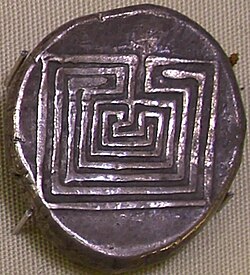
Labyrinth on a Knossos silver coin (c. 400 BCE) — the Palace of Knossos in Crete, with its maze-like floor plan of 1,500 interconnected rooms, was almost certainly the historical origin of the labyrinth myth; the Greeks associated it with Daedalus's creation to contain the Minotaur; the Cretans placed the labyrinth on their coins as their defining symbol

Theseus and the Minotaur, Attic red-figure kylix by Aison (c. 410 BCE) — Theseus kills the Minotaur in the center of the labyrinth; the hero enters the maze (the unconscious, the underworld, the place of death) by following the thread given by Ariadne (love, intuition, the guide) and emerges transformed

Daedalus mosaic, Zeugma Museum, Gaziantep (Roman period) — Daedalus, the master craftsman who built the labyrinth, is depicted with the tools of his art; he who builds the maze cannot always escape it — Daedalus was trapped in his own creation, escaping only by inventing wings, then watching his son Icarus fall

Theseus and the Minotaur, tile design by Edward Burne-Jones — the Pre-Raphaelite revival of the myth; Burne-Jones depicts the moment of encounter at the labyrinth's center as a private, almost tender confrontation; the monster and the hero face each other in a space from which there is no exit except through transformation

Roman labyrinth pattern — the Romans adapted the classical Greek labyrinth for their mosaic floors, organizing it in four quadrants around the central boss; the Cretan pattern (unicursal, flowing) was transformed into a more architectural, rectilinear form that fit the Roman preference for order and symmetry

The Man in the Maze (I'itoi ki:), Tohono O'odham Nation — the man at the center of a spiral labyrinth is I'itoi, the creator; the design represents the journey of life, the choices made at each turn, and the wisdom found at the center; this North American labyrinth tradition developed entirely independently of the Cretan one

Labyrinthine wall carvings, Hoysala temples, Halebidu, India (12th century CE) — the intricate interlocking geometric patterns of Hoysala temple architecture create a visual labyrinth in stone; the worshipper's eye enters the pattern and is led inward, replicating in perception the same journey that the body takes in walking a labyrinth

Hedge labyrinth — the garden labyrinth tradition, which developed in the Renaissance as a secular adaptation of the medieval cathedral labyrinth, reintroduced walking as a contemplative practice; the Hampton Court maze (1690) and its descendants in parks and gardens worldwide carry the ancient pattern into spaces where anyone can walk it

Cathedral nave interior — the Chartres labyrinth, seen in the context of the full cathedral space; the labyrinth lies directly in the main axis of the nave, between the west entrance and the choir; a pilgrim who enters the cathedral and follows the path from door to center to altar walks the spatial theology of the building in its most compressed form


Comentarios