The Roman Catacombs: Underground Art and the Birth of Christian Visual Language

Beneath the streets of Rome, in a network of underground galleries that extends for hundreds of kilometers through the volcanic tufa rock on which the city stands, lies one of the most important and least visited art collections in the world. The Roman catacombs — underground burial complexes used by Christians, Jews, and pagans between roughly the second and fifth centuries CE — preserve the earliest sustained body of Christian visual art in existence: frescoes painted directly on the plaster of burial chambers, carved sarcophagi, incised inscriptions, and a rich vocabulary of symbols that represent the first attempts of a new religious community to give visual form to its beliefs about death, resurrection, and the nature of the divine.
The word "catacomb" itself comes from the Latin catacumbas — "near the hollows" — a name originally applied to a specific area along the Appian Way south of Rome before becoming the general term for all underground Christian burial sites. The catacombs were not, as popular legend has long held, secret hiding places where persecuted Christians retreated from Roman authorities. Roman law, deeply influenced by Etruscan and Greek traditions, considered burial sites inviolable regardless of the religion of the interred; the catacombs were known to the Roman authorities and were legally protected as loci religiosi (religious places). Christians used them primarily because they needed large quantities of inexpensive burial space — the Christian practice of bodily burial (as opposed to cremation, the standard Roman practice) required physical space for each deceased member of the community — and because the soft volcanic tufa of the Roman subsoil could be excavated relatively easily and cheaply by specialized workers called fossores.
The earliest Christian catacombs date to around 150–200 CE, a period when the Christian communities of Rome were growing rapidly but were still economically and socially marginal. The great catacomb complexes — San Callisto (Callixtus) on the Appian Way, Domitilla on the Via Ardeatina, Priscilla on the Via Salaria, Sebastian on the Via Appia — developed over generations, their tunnel networks expanding outward and downward as new burial niches (loculi), chambers (cubicula), and arched tomb recesses (arcosolia) were added. San Callisto, the official cemetery of the Church of Rome beginning in the early third century under Pope Zephyrinus, became the burial place of sixteen popes and thousands of martyrs; its Crypt of the Popes is still one of the most moving sites in early Christian Rome. At their peak, the major catacomb complexes could extend over multiple levels to depths of fifteen meters or more, with thousands of individual burials arranged along kilometers of corridors.
The art painted on the walls and ceilings of the catacomb chambers is, by any measure, modest in its technical ambition. These were not the workshops of the Roman state or the wealthy aristocracy; the painters were artisans working quickly in difficult conditions, by lamplight, on damp plaster. Yet from this modest technical base emerged something of extraordinary historical and theological importance: the first visual vocabulary of Christianity, invented almost from scratch by communities that had inherited a religion of the word — a religion of texts, sermons, and oral tradition — and were now for the first time, in the face of death, reaching for images.
The earliest Christian symbols in the catacombs are deliberately cryptic — not because Christians were hiding from authorities, but because the symbolic register was simply the natural visual language of late antique religious culture, in which direct representation of sacred subjects was considered less powerful than allusive symbol. The Ichthys (Greek: ΙΧΘΥΣ, "fish") encoded in its letters the acronym Iesous Christos Theou Yios Soter (Jesus Christ, Son of God, Savior) and became one of the most powerful symbols of early Christianity. The Chi-Rho (☧) — the superimposed first two letters of the Greek Christos — appeared widely. The anchor (a cross with a curved base, recalling the ship's anchor but encoding the form of the cross) symbolized hope and stability in faith. The dove (the Holy Spirit descending at the baptism of Christ, but also the dove of peace and the soul's release from the body) appears constantly, often bearing an olive branch.
Among the figurative subjects, the most important and most frequently depicted is the Good Shepherd — a young, beardless figure carrying a sheep on his shoulders, sometimes flanked by additional sheep. This image did not originate with Christianity; it was borrowed directly from the Greek and Roman kriophoros (ram-bearer) tradition, a pastoral image of civic virtue and beneficence that had circulated in Greco-Roman art for centuries. The Christians appropriated it and filled it with the specific content of the Gospel of John (chapter 10), in which Christ describes himself as the Good Shepherd who lays down his life for his sheep. The borrowing is significant: early Christian art was not created in isolation from its surrounding visual culture but in active, creative conversation with it, taking images from the existing repertoire and recharging them with new theological meaning. The Good Shepherd in the catacombs is identifiably the same figure as the Greco-Roman kriophoros — and yet he is entirely different, because the community that looks at him sees in him not a symbol of pastoral virtue but the divine Shepherd of humanity who defeated death.
The Orant — a figure, usually female, standing with arms raised in the ancient gesture of prayer — is the other major figurative type of the catacombs. The Orant represents the soul of the deceased in a state of eternal prayer: lifted up, arms spread, facing God in an attitude of openness and supplication. Sometimes the Orant is identified by an inscription as a specific individual; more often she is a generic type, representing every Christian soul in its post-mortem relationship with the divine. The Orant and the Good Shepherd frequently appear together in the same composition — the soul praying, and the Shepherd who carries it — making a complete theological statement in two figures: the posture of the human before God, and the divine response.
Biblical narrative scenes make up the third major category of catacomb imagery, and they were selected with unmistakable theological logic. The scenes chosen are almost invariably typological — that is, they depict episodes from the Hebrew Bible that were understood by early Christians as prefigurations of Christ's death and resurrection, and therefore as visual promises of the resurrection available to all the faithful. Jonah, thrown into the sea and swallowed by the great fish for three days before being vomited out alive, prefigures Christ's three days in the tomb. Daniel in the lions' den, preserved unharmed, prefigures Christ's victory over death. The Three Hebrew Children (Shadrach, Meshach, and Abednego) walking unburned through Nebuchadnezzar's furnace, prefigure the resurrection of the body from its mortal destruction. Lazarus, raised from the dead at the command of Christ, is the most direct scriptural promise of resurrection available, and his image — a small mummy-wrapped figure emerging from a tomb before the outstretched hand of Christ — is one of the most frequently represented narrative scenes in all of catacomb art. Each of these scenes was understood not merely as historical narrative but as a promise spoken directly to the dead person in whose burial chamber it was painted.
The catacomb paintings also preserve some of the earliest surviving images of Christ himself and of the Virgin and Child. The beardless Good Shepherd type gave way, gradually, to a bearded Christ figure drawn from the conventions of the Greco-Roman philosopher portrait: a dignified, mature male figure with long hair and beard, clearly authoritative but not yet the hieratic, frontal Pantocrator of Byzantine tradition. The oldest known image of the Virgin and Child — a fresco in the Catacomb of Priscilla, generally dated to the late second or early third century CE — shows a seated woman nursing a child, with a figure beside her (perhaps a prophet, perhaps a wise man) pointing to a star: a remarkably intimate and human image for a theology that would later develop so elaborate and hierarchical a doctrine of the Mother of God.
The catacombs were used intensively as places of Christian pilgrimage for three centuries after they ceased to function as active burial sites (the practice of catacomb burial declined after the Peace of the Church in 313 CE, as Christians could now bury their dead in above-ground cemeteries). The tombs of the martyrs — especially in San Callisto and San Sebastian — became major destinations for pilgrims from across the Christian world, and the graffiti of pilgrims (names, prayers, acclamations scratched into the plaster walls by tens of thousands of visitors over three centuries) are themselves a remarkable document of popular religious devotion in late antiquity. The catacombs were eventually sealed and forgotten in the early medieval period, rediscovered in 1578 when a vineyard worker fell through the roof of a buried gallery, and have been systematically studied and excavated ever since. Today, open to the public and cared for by the Pontifical Commission for Sacred Archaeology, they remain one of the most direct connections available to the visual and spiritual imagination of the earliest Christians.
The images in this gallery move through the major subjects of catacomb art: the Good Shepherd in his multiple versions; the Orant figure in her gesture of eternal prayer; the Agape feast (the communal meal that combined elements of the Eucharist and the funeral banquet); the earliest representations of Christ; the Virgin and Child in their most ancient surviving form; and the interior architecture of the galleries themselves — the corridors of niches, the painted chambers, the flickering space where the earliest Christian communities came to bury their dead and to paint, on the walls of rock, their conviction that death was not the last word.

The Good Shepherd — catacomb fresco, Rome, 3rd century CE; the most frequently depicted subject in early Christian catacomb art; borrowed from the Greco-Roman kriophoros (ram-bearer) tradition and recharged with the theological content of John chapter 10, in which Christ calls himself the shepherd who lays down his life for his sheep; the young, beardless figure carrying a lamb on his shoulders became the first distinctively Christian image of Christ

Good Shepherd — detail, catacomb fresco; the pastoral warmth of this image — its intimacy, its complete absence of the hierarchical severity of later Byzantine Christ imagery — reflects the early Christian community's self-understanding: a small, marginal, closely-bound group gathered under the care of a shepherd who knows each member by name
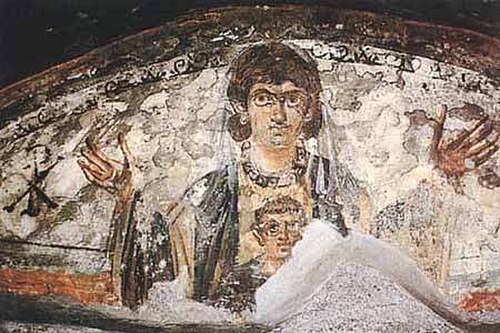
Virgin and Child — catacomb fresco, Catacomb of Priscilla, Rome, late 2nd or early 3rd century CE; among the oldest surviving images of the Virgin Mary and the Christ child; the intimacy and humanity of this image — a nursing mother, a pointing prophet or wise man, a star — precedes by more than a century the elaborately theological Theotokos iconography that would dominate later Christian art

Jonah thrown into the sea — catacomb fresco; the story of Jonah, swallowed by the great fish and disgorged after three days, was one of the most important typological subjects in early Christian art: Christ himself invokes it (Matthew 12:40) as a prefiguration of his three days in the tomb and resurrection; depicting Jonah in a burial chamber was a visual promise spoken directly to the dead: as Jonah was saved, so shall you be

Baptism scene — Catacomb of San Callisto (Callixtus), Rome; baptism — the ritual of entry into the Christian community through water — was one of the key sacramental subjects in early Christian visual art; the image encodes the theological understanding of baptism as a death and resurrection (Romans 6:4): the baptized person dies to the old life and rises, like Christ, to a new one

Agape feast — catacomb fresco; the communal meal of the early Christian community combined elements of the Eucharist (the ritual memorial of the Last Supper) with the Roman funeral banquet (the refrigerium, a meal shared with the dead); figures recline around a table laden with bread and fish — the characteristic foods of Christian symbolism — in an image that collapses the boundaries between the community of the living and the community of the dead

Eucharistic bread — catacomb fresco detail; the loaves of bread depicted in catacomb scenes carry multiple layers of theological meaning: the bread of the Eucharist (the body of Christ); the bread of the multiplication of the loaves (the miraculous feeding of the multitude); and the bread of the heavenly banquet promised in the Kingdom of God; to paint bread in a tomb was to insist that hunger — like death itself — is temporary

Bread and fish — catacomb fresco; the combination of bread and fish in early Christian imagery recalls the multiplication of loaves and fishes (all four Gospels), the Eucharist, and the fish symbol (Ichthys) of Christ himself; this deceptively simple still-life composition carries an entire theological program within it

Saint Paul as philosopher — catacomb fresco; early Christian art frequently depicted Paul and other apostles in the visual conventions of the Greco-Roman philosopher: the dignified, bearded intellectual figure of the Hellenistic world; this was a deliberate cultural claim — Christianity was not barbarism or superstition but a philosophy, a way of life grounded in reason and wisdom equal or superior to the philosophical schools of antiquity
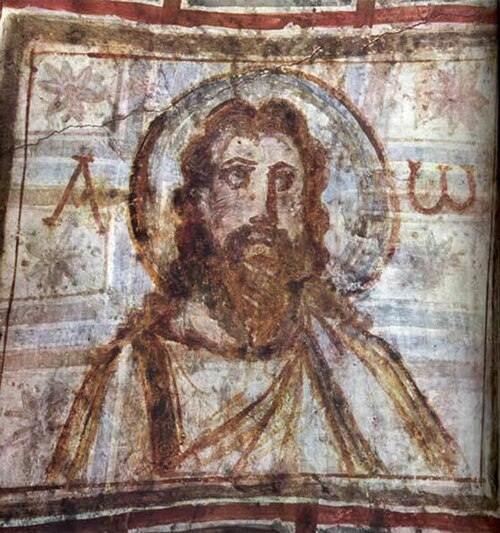
Bearded Christ — catacomb fresco; the transition from the young, beardless Good Shepherd type to the mature, bearded philosopher-Christ type reflects the developing theological ambition of the Christian community; the bearded figure, drawn from the conventions of the Greek philosopher portrait (particularly the iconography of Zeus and of Hellenistic kings), conveys authority, wisdom, and divine gravitas

Interior of the Catacomb of San Sebastian, Rome; the long corridors of loculi (burial niches) cut into the volcanic tufa rock extend for kilometers beneath the Via Appia; the fossores (catacomb workers) who excavated and maintained these galleries were a recognized professional class within the early Christian community; the sheer physical scale of the catacomb networks — hundreds of kilometers in total — reflects the size and organizational capacity of the Roman Christian community by the 3rd century CE

Roman sarcophagus with Christian scenes — carved relief; the transition from catacomb fresco to carved sarcophagus relief represents the economic rise of the Christian community in the 3rd and 4th centuries; wealthy Christians commissioned elaborate marble sarcophagi decorated with biblical scenes arranged in the continuous narrative format inherited from Roman historical relief; these objects are some of the finest examples of late Roman sculpture and of early Christian theological visual thinking


Comentarios