The Werewolf: Lycanthropy, the Beast Within, and the Transformation That Cannot Be Stopped

Lycaon Transformed into a Wolf - oil on canvas, Los Angeles County Museum of Art. The first werewolf of the Western tradition: the king of Arcadia punished by Zeus for his cannibalism, his human form dissolving into the form of a wolf.
There is a transformation that runs through every mythology, every folklore, every horror tradition of the Western world: the human being who becomes, under specific conditions - the full moon, a curse, a belt of wolf-skin, a drink of water from a wolf's footprint - a wolf. Not metaphorically. Not symbolically. Actually, physically, a wolf: a four-legged predator with no memory of having been a person, driven by hunger and by the animal's absolute relationship to its body.
Lycanthropy - from Greek lykos (wolf) and anthropos (human) - is one of the oldest and most cross-culturally distributed concepts in supernatural tradition. The werewolf, the wolf-man, the man-who-becomes-wolf appears in ancient Greece (the Arcadian cult of Zeus Lycaeus), in Roman satire, in Norse berserker tradition, in medieval French romance, in the witch trial records of the 16th and 17th centuries, and in virtually every folklore tradition of northern and central Europe. It is not a local phenomenon but a structural feature of the human imagination - the recurring recognition that the boundary between the human and the animal is not as fixed as civilization requires it to be.
The werewolf is not a monster from outside. It is the monster that has always been inside - the animal nature that culture partially domesticates but never fully eliminates, the hunger and the violence and the nocturnal awareness that sleep in the civilized person and wait for the conditions that will wake them.
The First Werewolf: Lycaon of Arcadia
Western tradition's founding werewolf story belongs to Ovid, who recounts in the Metamorphoses (Book I) the myth of Lycaon, king of Arcadia. Zeus (Jupiter), disturbed by reports of human wickedness, descended to earth in human form to investigate. He arrived at Lycaon's court; the king, either skeptical of his divine guest's identity or malicious toward gods in general, decided to test him by serving him human flesh - specifically, the flesh of a captive Molossian hostage who had been killed for the purpose.
Zeus was not fooled. In his divine rage he destroyed Lycaon's palace with thunderbolts and transformed the king into a wolf - but a wolf that retained the essential features of Lycaon's character: the hunger for flesh, the cruelty, the murderous appetite that had expressed itself in cannibalism now expressed itself in the wolf's natural predation.

Werewolf woodcut - Sebastian M nster, Cosmographia, 1544. The first Renaissance popular image of the werewolf: a man in mid-transformation, the body caught between human and animal form, the moment of becoming made visible.
The Lycaon myth establishes the moral logic of lycanthropy that Western tradition would maintain: the werewolf transformation is a punishment that makes literal what was already figuratively true. Lycaon was a beast in his soul before he became one in his body; the transformation does not change his nature but reveals it. He was always this wolf; Zeus simply removed the human disguise.
Before the myth proper, there was a cult: the Lycaean Games at Mount Lycaeus in Arcadia included, according to ancient sources, a ritual in which a man ate a mixture of human and animal entrails and was thereafter transformed into a wolf, remaining in that form for nine years - reverting to human form if he could refrain from eating human flesh for the entire period. This ritual, whatever its actual content (the ancient sources may exaggerate), represents the oldest attested werewolf complex in the Western world: a religious institution that deliberately involved the crossing of the human-animal boundary.
Roman Werewolves: Petronius and the Road to Capua
The Roman satirist Petronius, in his Satyricon (c. 60 CE), gives the earliest surviving extended narrative of a werewolf encounter. The freedman Niceros recounts how, traveling one night to visit a woman, he was accompanied by a soldier. At a crossroads near some tombs, the soldier stripped off his clothes, urinated in a circle around them, and transformed into a wolf, which immediately ran off howling into the night. Niceros arrived at his destination and was told that a wolf had attacked the livestock; the animal had been wounded in the neck by a farmhand with a pitchfork.
When Niceros returned to town, his soldier companion was lying in bed with a doctor treating a neck wound. The wound was in exactly the place the wolf had been hit.
The Petronius story establishes the narrative structure of the medieval and modern werewolf tale: the transformation at night, the resumption of human form by day, the wound that persists across the transformation (connecting the wolf's experience to the human body), and the social figure who "knows" - who sees the impossible and cannot unsee it.
The Norse Wolf Warriors: Ulfhednar and Berserkers
Norse tradition offers a voluntary lycanthropy - not punishment but achievement. The ulfhednar (wolf-coats) were a class of Norse warriors who wore wolf-skins and were said to fight in a wolf-like state, immune to fire and iron, possessed of a wolf's strength and ferocity. Related to the better-known berserkers (bear-skin warriors), they represented the deliberate cultivation of the animal nature as a military resource - the human will temporarily setting aside the civilized self and calling up the predator.

Bronze plate from land, Vendel Period (c. 550-800 CE) - showing a wolf warrior or ulfhe inn: a human figure in wolf-skin, the military lycanthropy of Norse warrior culture. Swedish History Museum, Stockholm.
The V lsunga Saga gives the most extended Old Norse werewolf narrative: Sigmund and his son Sinfj tli find wolf-skins that transform those who wear them into wolves for a fixed period. They spend time in wolf-form, living in the forest and fighting, before removing the skins and resuming human form. The wolf-skin is a tool - a technology of transformation - rather than a curse.
This voluntary, controlled lycanthropy is fundamentally different from the punishment-model of the Lycaon tradition. The Norse warrior wolf is not being shown what he always was; he is choosing to access an aspect of himself that is real but not permanently available. The animal nature is a resource, not a revelation of hidden corruption.
Bisclavret: The Noble Werewolf
Marie de France, the 12th-century French poet, gave medieval literature its most humane treatment of werewolves in her lai "Bisclavret" (c. 1160-1170). A Breton baron is secretly a werewolf - but a noble, well-behaved one. He transforms each week into wolf-form and needs to hide his clothing somewhere safe to be able to transform back; without the clothes, he is stuck as a wolf.
His wife, upon learning the secret, betrays him: she has her lover steal the clothing. The baron is trapped in wolf-form and eventually becomes a member of the king's court - a domesticated wolf who behaves with more honor than the humans around him. When the wife and her new husband appear at court, the wolf attacks them - and the wolf's violence is, in the narrative's moral logic, entirely justified. The wolf is the true baron; the wife is the real monster.
Marie de France's werewolf inverts the moral logic of the Lycaon myth: here the animal form is not a revelation of hidden depravity but a condition imposed by betrayal. The "beast within" is not the wolf's form but the wife's treachery. The animal that the court has domesticated is the most honorable person in the story.
The Witch Trials and the Werewolf Persecutions
Between approximately 1400 and 1700, werewolves were not merely mythological creatures but legal facts in much of Europe. Hundreds of men and women were tried, convicted, and executed for the crime of lycanthropy - of having transformed into wolves and committed murders in that form.
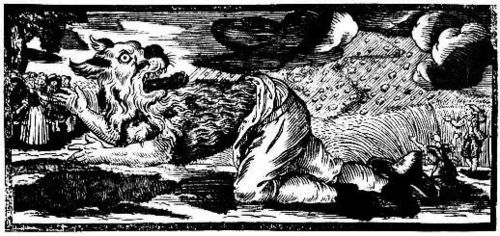
German woodcut depicting a werewolf attack - 1722. The early modern werewolf as legal reality: a creature whose existence was accepted by courts, theologians, and physicians, and whose alleged crimes were prosecuted with the full seriousness of capital law.
The most famous case is that of Peter Stumpp (executed in Cologne, 1589), who confessed under torture to being a werewolf for twenty-five years, to having killed and eaten numerous people in wolf-form, and to having received his wolf-belt from the Devil. His execution was among the most elaborate of the period: he was tortured with red-hot pincers, his limbs broken on the wheel, then beheaded and burned. A pamphlet describing his crimes and punishment was printed in English in 1590.
Gilles Garnier (executed in Dole, 1573) was convicted of killing and eating children in the guise of a wolf - a case in which forensic and eyewitness evidence (neighbors claimed to have seen a wolf with Garnier's face) was presented in court alongside his own confession.
These trials reflect the convergence of several anxieties: the threat of actual wolf attacks (wolves were a real danger in rural Europe until the 18th century), the witch-trial machinery that was processing accusations of diabolical compact, and the persistent folk belief in transformation. The werewolf of the trial records is the werewolf of the peasant imagination: the neighbor who is not entirely human, who goes out at night in a shape that is not his, who eats what should not be eaten.
The Esoteric Transformation: Integration of the Animal Self
The werewolf occupies a unique position in the symbolic bestiary: it is not an animal, not a human, but the boundary between them made flesh - the creature that demonstrates, in its very form, that the boundary is not fixed. Its existence asserts something that civilization spends enormous energy denying: that the animal has not been fully tamed, that the wolf is still present, that the moon can still call up something that the working day suppresses.
In Jungian depth psychology, the werewolf corresponds to the shadow in its most feral form - the aspect of the personality that was not socialized, that retains the full force of instinct, appetite, and territorial aggression that civilization required to be muted. The werewolf transformation represents what happens when this shadow content is not recognized and integrated but simply suppressed: it breaks out periodically, at the call of whatever internal moon triggers its release, and acts out what was denied expression.
The silver bullet that kills the werewolf is alchemically significant: silver is the metal of the moon, of reflection, of the feminine principle - the lunar metal kills the lunar monster. The werewolf that is called up by moonlight is killed by the moon's material embodiment. The integration of the shadow requires not force but reflection: the silver mirror turned toward the creature that the light of the sun was never permitted to see.
The esoteric tradition offers not the silver bullet but the integration: the recognition that the wolf has not gone anywhere, that it is part of you, that its energy - properly channeled, properly acknowledged - is the energy of vitality, of instinct, of the body's truth. The person who makes peace with their inner wolf does not eliminate the animal nature; they bring it into consciousness, give it appropriate expression, make it part of the whole rather than the excluded thing that waits for the moon.
-
- Lux Esoterica*
Related Esoteric Inquiries:
- Krampus: The Alpine Demon of December, Dark Mirror of Saint Nicholas and the Fear That Shapes Good Children
- Baba Yaga: The Iron-Toothed Witch of the Forest, Guardian of the Threshold Between Life and Death
- Hecate: The Torchbearer at the Crossroads, Mistress of Magic and the Hidden World
Lux Esoterica.
2026.


Comments