Tiwanaku: Sacred Architecture of the Andes and the Gateway of the Sun
Tiwanaku (or Tiahuanaco) — built on the Bolivian altiplano at 3,840 meters above sea level, on the southern shore of Lake Titicaca — was the capital of one of the most powerful and far-reaching civilizations of pre-Columbian South America. Between approximately 500 and 1000 CE, Tiwanaku exerted religious, cultural, and economic influence across a vast area of the Andes, from what is now southern Peru to northern Chile and Argentina. Its architecture — the Gateway of the Sun, the Akapana pyramid, the Kalasasaya ritual court, the massive stone monoliths — was built with a technical precision that has astonished archaeologists: massive stones transported from quarries 90 kilometers away, fitted together without mortar to tolerances of less than a millimeter, some blocks connected by bronze I-shaped clamps melted and poured directly into grooves cut in the stone. The city was the cosmological center of its world, its architecture a three-dimensional image of the sacred geography of the Andean universe.

The Gateway of the Sun (Puerta del Sol), Tiwanaku — carved from a single block of andesite weighing approximately 10 tons; the central figure is the Staff God (Viracocha?), a deity with a rectangular head, holding a staff in each hand, with 48 attendant figures arranged in three rows; the gateway may have functioned as a solar calendar, the sun aligning with it on the spring equinox

Gateway of the Sun by E.G. Squier (1877) — the 19th-century explorer's drawing of the gateway as he found it, toppled and cracked through the central frieze; the crack was caused by earthquake or deliberate demolition during the Spanish colonial period; the gateway was re-erected in the 20th century in approximately its original position

Tiwanaku architectural detail by Arthur Posnansky — the early 20th-century Bolivian scholar who spent decades measuring and documenting the site; Posnansky controversially argued that the astronomical alignments at Tiwanaku indicated a construction date of 15,000 BCE, a claim rejected by mainstream archaeology but reflective of the site's capacity to exceed conventional explanations

Fraile Monolith, Tiwanaku — one of several massive anthropomorphic monoliths that once stood in the Kalasasaya ritual court; the figure holds a kero (drinking vessel) and a snuff tablet, the ritual objects of Andean ceremony; the body is covered in carved symbols and figures that encode cosmological and genealogical information in a visual language still being deciphered
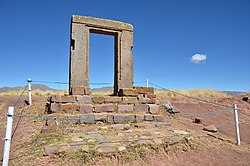
Gateway of the Moon (Puerta de la Luna), Tiwanaku — a smaller, less ornate gateway than the Solar one; the moon's role in Andean cosmology complemented rather than opposed the sun's — the two celestial bodies governed complementary aspects of the agricultural and ceremonial calendar that organized Tiwanaku life


Comentarios