Harmonia Macrocosmica: The Celestial Cartography of Andreas Cellarius
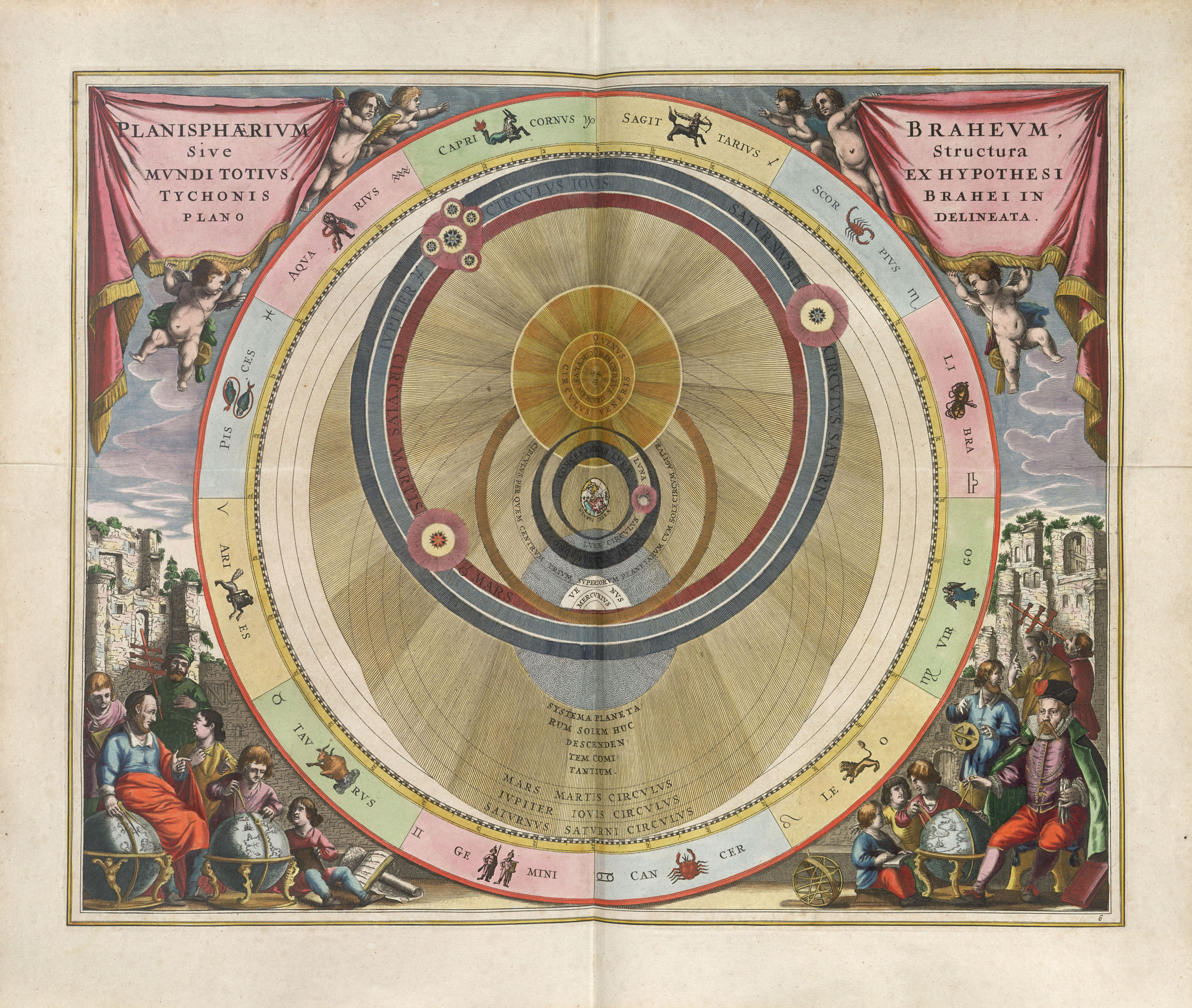
Planisphaerium Braheum: A masterpiece of the Golden Age of Dutch Cartography, illustrating the complex intersection of math and mysticism.
The Architecture of the Heavens: Introduction
If the Mappa Mundi is a map of the soul's earthly exile, then the Harmonia Macrocosmica (1660) of Andreas Cellarius is a blueprint of its celestial home. Produced during the height of the Dutch Golden Age, this atlas is widely considered the most beautiful celestial chart ever created. But beyond its aesthetic brilliance lies a deep esoteric intent: the desire to harmonize the conflicting models of the universe.
In the 17th century, the world was caught between the geocentric model of Ptolemy and the heliocentric revolution of Copernicus. Cellarius, a mathematician and schoolmaster, sought to map all these possibilities, treating the cosmos not just as a physical space, but as a living, harmonic structure—a "Macrocosm" that mirrors the "Microcosm" of the human mind.
The Planisphaerium Braheum: A Cosmic Synthesis
The image provided above, the Planisphaerium Braheum, illustrates the unique "Tychonic System" developed by Tycho Brahe. In this model, the Earth remains at the center, but the planets revolve around the Sun, which in turn revolves around the Earth.
Esoterically, this model represents a specific stage of spiritual development. It is the attempt to remain grounded in the physical experience (Earth at the center) while acknowledging the overwhelming power of the Divine Source (the Sun as the center for the other planets). It is a map of Transition—a visual representation of a humanity that has realized it is part of something larger, but is not yet ready to let go of its central importance.
The Harmony of the Spheres
The title of the atlas, Harmonia Macrocosmica, is a direct reference to the Pythagorean concept of the "Music of the Spheres." Cellarius believed, along with contemporaries like Johannes Kepler and Robert Fludd, that the movements of the planets were governed by musical intervals.
To look at a Cellarius map is to see a musical score. Each constellation, each planetary orbit, and each degree of the zodiac is a "note" in a cosmic symphony. In the Lux Esoterica tradition, we use these charts as meditative aids. By contemplating the perfect symmetry and order of the Cellarius plates, the practitioner can "retune" their own internal harmony, aligning their personal will with the Mundane Music of the universe.
Sacred Geometry in the Stars
Cellarius’s maps are masterclasses in Sacred Geometry. Every plate is built on a foundation of circles, triangles, and squares. The use of the "Armillary Sphere" in many of his illustrations highlights the concept of the universe as a series of interlocking rings—a celestial cage that is also a ladder.
In 2026, as we enter a new era of space exploration and digital mapping, the work of Cellarius reminds us that the "Heavens" are more than just empty space. They are an organized hierarchy of energies. The map is a tool to help us navigate these energies, ensuring that we do not get lost in the infinite.
Conclusion: The Cartographer of Light
Andreas Cellarius was more than a mapmaker; he was a Cartographer of Light. He showed us that the universe is not a chaos, but a cathedral. Whether the Sun or the Earth is at the center is, in some ways, a secondary question. The primary truth is the Harmonia—the underlying order that connects the smallest atom to the largest galaxy.
As you move through your day, remember the Planisphaerium. You are a point in a magnificent, turning map. You are exactly where you are meant to be.
Lux Esoterica.
2026.


Comentarios