Iamblichus and the Life of Pythagoras
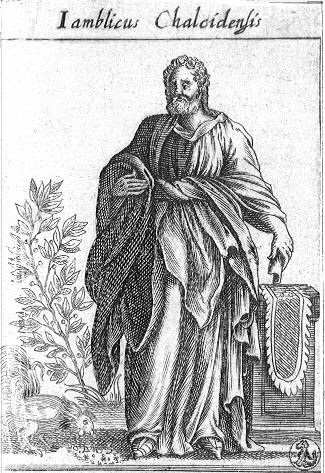
Pythagoras left no writings. He died around 500 BCE, and the first biographies were written centuries later. By the time a Syrian philosopher named Iamblichus wrote his Life of Pythagoras, about eight hundred years had passed, and the man had become a legend: a sage who could be in two places at once, who spoke to animals, and who had a golden thigh.
Iamblichus did not write history in the modern sense. He wrote a guide to a way of life, and the book is better read as a portrait of an ideal than as a record of facts.
The Author
Iamblichus lived from about 245 to 325 CE. He was born in Chalcis, in Syria, and studied in Rome under Porphyry, himself a student of Plotinus. He then returned to the East and founded a school at Apamea. His fame in antiquity was great, and he was nicknamed "the divine."
Among his works is a planned series of ten books on Pythagorean philosophy, of which the Life of Pythagoras is the first and only a few survive, and a treatise now known as On the Mysteries, a defense of ritual and theurgy against the doubts of Porphyry.
For Iamblichus, Pythagoras was the founder of true philosophy, the man who taught the Greeks the sciences of number, music and the soul. He saw himself as heir to that tradition.
What We Know and Don't Know
The historical Pythagoras was born on the island of Samos around 570 BCE. About 530 he moved to Croton, a Greek city in southern Italy, where he drew a group of followers. They lived by shared rules, shared property and a code of purity.
The community had political influence until it was attacked, probably in the later part of the sixth century or the early fifth. Some accounts say that its meeting house was burned.
Beyond this outline, scholars disagree about almost everything. Did Pythagoras prove the famous theorem about triangles? Probably not. The theorem was known earlier in Babylonia and elsewhere. Did he discover the numerical ratios of musical harmony? The story told by later writers, in which he heard blacksmiths' hammers, is a legend, and the physics in it does not hold up.
The Way of Life
The best parts of Iamblichus' book describe a manner of living. Novices are said to have kept silence for a period of years, listening before they spoke. The group arranged the day with morning walks, study, exercise, shared meals and an evening review of the day's deeds.
Members were asked to look back each night and ask what they had done wrong, what they had done right, and what they had left undone.
The Pythagoreans were known for rules such as abstaining from certain foods, among them beans, and for sayings like "do not step over a crossbar." These sayings, called akousmata, were taught without explanation, and later writers argued about what they meant. The best explanation is that many were taboos or symbols whose meaning was lost.
Miracles and Music
Iamblichus repeats stories that cannot be checked. Pythagoras is said to have stopped a bear from killing, calmed a raging crowd with song, and appeared in two cities on the same day. A well-known tale has him show his golden thigh to a priest. The stories grew with each retelling, and a careful reader should treat them as devotion.
Music has a special place in the book. Iamblichus says that the Pythagoreans used song and lyre to heal the soul, to calm anger and to prepare for sleep and waking. The belief that music affects mood is ancient, and modern studies show that music can indeed influence emotion. The claim of a precise cure of the soul is a tradition, not a result.
The Tetractys
One symbol stands at the center of Pythagorean memory: the tetractys, a triangle of ten points arranged in four rows of one, two, three and four. According to tradition, the members swore their oath by the one who gave the tetractys to the community.
The numbers one, two, three and four add up to ten, and they also give the main musical ratios: the octave, the fifth and the fourth. For the Pythagoreans, a small figure held the key to number and to harmony.
A Word of Care
Some modern readers copy the Pythagorean diet, long silences or number rituals. Fasting, avoiding foods or making major life changes without advice can harm health. Anyone considering such a regime should speak to a doctor.
Closing
Iamblichus wrote about Pythagoras to show that philosophy is a way of living, not only a body of ideas. The book is full of legends, but the central picture is plain: a community that valued friendship, study, music and an honest evening reckoning.
Whether or not the sage of Croton ever lived exactly like that, the picture has lasted, and it asks a lasting question: what would our days look like if we arranged them as a path?
Related Esoteric Inquiries
- Thomas Taylor and the Eleusinian Mysteries: The Theurgical Restoration of the Ascent
- Sallustius, On the Gods and the World: A Neoplatonic Catechism
- The Chemical Wedding of Christian Rosenkreutz: Day 7 (The Return and the Guardians)
Lux Esoterica.
2026.


Comments