Atalanta Fugiens, Emblem 42: Nature as the Alchemical Guide
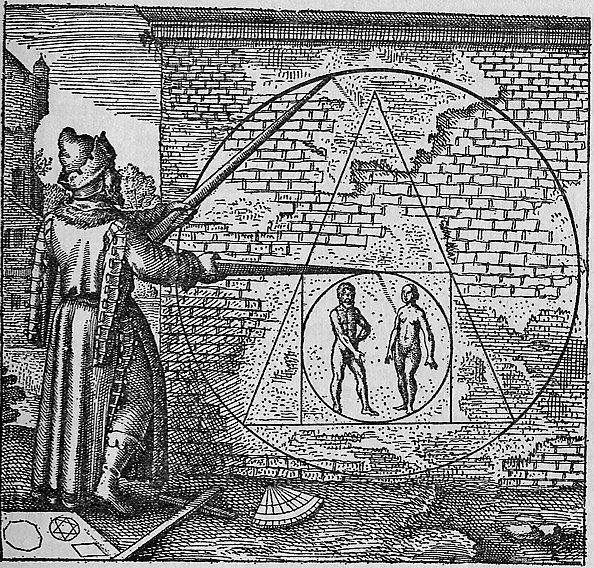
Which guides should a person trust when exploring a hard subject? Michael Maier, a seventeenth-century physician and alchemist, gave his answer in a motto. "Nature, reason, experience and reading," he wrote, should be your leader, your staff, your spectacles and your lamp.
The line comes from the forty-second emblem of his book Atalanta Fugiens, one of the strangest works of the age: a book of pictures, verses and music, made to be seen, read and sung. The advice in the motto is so plain that it could be given to a student today.
A Book to Hear
Atalanta Fugiens means "Atalanta Fleeing." It was printed in Oppenheim, Germany, in 1617 (some catalogs give 1618), with engravings by Matthäus Merian. It contains fifty emblems. Each one has a picture, a motto, a Latin poem, a prose commentary and a short piece of music called a fugue, written for three voices.
The title refers to the Greek myth of Atalanta, the swift runner, who was outrun by Hippomenes when he dropped golden apples in her path.
Maier uses the myth as a picture of the alchemical work. In his reading, Atalanta stands for the volatile, fleeing part of matter and Hippomenes for the fixed part, and the golden apples are what delays the runner. The three voices of each fugue are tied to the characters of the tale.
The Author
Michael Maier was born in Rendsburg, in northern Germany, in 1568 or so. He studied medicine, became a doctor and later served at the court of Emperor Rudolf II in Prague, a place that gathered alchemists, astronomers and artists. He traveled widely, including a stay in England, and wrote a number of alchemical books, defended the Rosicrucian manifestos in print and died in Magdeburg in 1622.
Maier believed that ancient myths were disguised alchemical teaching. In other books he read the labors of Hercules and the Egyptian gods as hidden accounts of the Great Work. Modern scholars see this as a fascinating but unprovable theory.
The Forty-Second Emblem
The motto of Emblem 42 in Latin addresses the person who works with chemistry, the alchemist: for this person, nature, reason, experience and reading should be the guide, the staff, the spectacles and the lamp. The four powers come with four tools.
Nature leads the way, as a guide does. Reason is the staff, a support that keeps the walker steady. Experience is a pair of spectacles, to see clearly what is in front of the eyes. Reading, the study of earlier authors, is a lamp that lights the path.
This is a thoughtful recipe for learning. A good student needs a teacher in the world itself, a method of thinking, hands-on practice and the wisdom of books. Each one corrects the others. Reading without experience becomes fantasy, and experience without reading wastes the effort of earlier generations.
The Emblem Book
Atalanta Fugiens belongs to a popular genre. The first emblem book, the Emblemata of the Italian lawyer Andrea Alciato, appeared in 1531 and started a craze that lasted for more than a century. An emblem combined a short motto, a picture and a verse to teach a moral or a secret. Readers loved the puzzle of finding the meaning in the link between image and words.
Maier's book is unusual because it adds music. The fugue is a form in which one voice chases another, which suits a story about a runner and her pursuer. A reader could look, read and sing, using three senses at once. The idea that music and number reveal the order of the world is an old one, and Maier turned it into a game for a table of friends.
An Alchemy of the Senses
Why does a book of alchemy talk about spectacles and lamps rather than furnaces? Because the alchemists knew that their writings were hard to read, and that many people lost their way. Maier warns, here and elsewhere, against hurry and against trusting a single authority. The emblem is a call for balance in a field full of secrecy and fraud.
It is also a reminder that alchemy was part of the early story of experiment. Maier's contemporaries were beginning to ask for observation and reason as guides, though they still used the language of symbol and secret.
A Word of Care
Alchemical books often describe heating mercury, lead, antimony or arsenic. These substances are poisonous, and the vapors can cause serious harm. Nothing in this old literature should be tried at home.
Closing
The forty-second emblem could hang on the wall of a modern library: let nature lead, let reason steady you, let experience clear your sight, and let books light the way. Maier lived in a time of mystery and of rising science, and his advice sits comfortably in both. It is a quiet treasure in a loud and curious book.
Related Esoteric Inquiries
- Atalanta Fugiens, Emblem 49: The Child in the Alchemical Fire
- Atalanta Fugiens, Emblem 46: The Two Dogs and the Alchemical Hunt
- Atalanta Fugiens, Emblem 44: Typhon and the Alchemical Chaos
Lux Esoterica.
2026.


Comments