Atalanta Fugiens, Emblem 41: The Death of Adonis
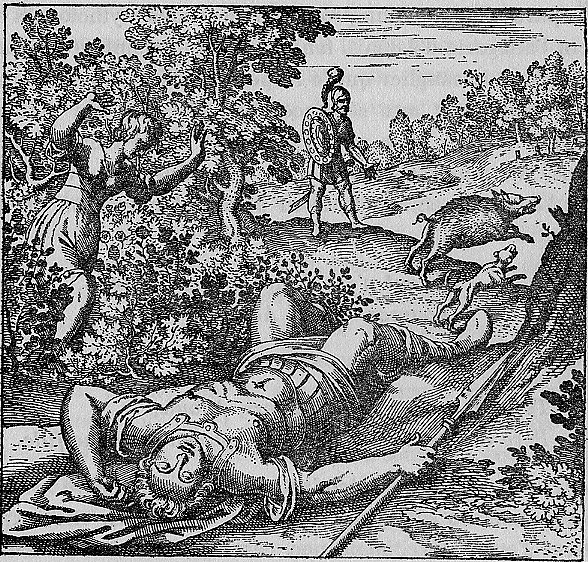
A warrior lies on his back on the grass, his armor dented, one hand holding a spear. At the right, a wild boar charges away with a small hound at its heels. At the left, a woman with raised arms runs through a thorny rosebush, and a helmeted figure with a shield stands behind her on the slope.
This is the forty-first emblem of Michael Maier's Atalanta Fugiens, and its motto tells a short myth: Adonis is killed by a boar, and Venus, running to him, stains the roses with her blood.
The book was printed in 1617 at Oppenheim. It has fifty emblems, and each one joins an engraving, a Latin verse, a prose discourse and a fugue for three voices. The engravings are attributed to the workshop of Matthäus Merian. Maier, a physician at the court of Emperor Rudolf II, took many subjects from the poets of Greece and Rome.
The Motto
The Latin line gives the whole tale. A young hunter is killed by a boar. The goddess of love runs to him, and as she runs, her blood stains the roses red.
The picture shows all the parts: the body, the boar, the hound and the goddess in the thicket.
The Myth of Adonis
Adonis was a young man of great beauty, loved by Aphrodite, whom the Romans called Venus. He loved to hunt, and she warned him to avoid dangerous animals. He did not listen. A boar struck him, and he bled to death.
The poets told the story in several ways, and the sources differ on who sent the boar. In the Lament for Adonis attributed to the Greek poet Bion, the goddess hurries to her lover through the woods, and thorns tear her feet. Where her blood falls, roses grow red. Where his falls, the anemone blooms.
The Red Rose
The motto turns to the roses. Before the myth, say the old poets, roses were white. The blood of the goddess made them red.
This is a legend and not natural history. Alchemists loved the image because it joined two colors of the Work. The white rose and the red rose stood for the white and red stages, and the change of one into the other was the most important step.
Death and Return
Adonis was honored in cult as a god who died and came back. In the old festivals of the Adonia, women mourned his death with laments and planted small gardens in pots that grew quickly and withered fast. Some versions of the story say that he spent part of each year in the underworld and the rest with Aphrodite.
The pattern fits the Work. A bright and beautiful form must die before it can return in a deeper state. Maier uses the death of Adonis as a sign of the dark stage that comes before the red.
The Weeping Goddess
The most human figure in the engraving is Venus, with her arms thrown up and her feet in the thorns. She does not stand and mourn. She runs, and the thorns cut her.
Alchemical readers took her blood as the tincture that colors the roses. A deep red comes from a wound. The emblem teaches that beauty and pain are tied, and that a real transformation costs something.
A Reading for Today
The emblem speaks to anyone who has lost someone young or has seen a promising life cut short. The myth does not hide the shock. It gives grief a color: the roses that bloom because of what was spilled.
The Engraving
The body of Adonis dominates the foreground. He lies diagonally across the picture, in a Roman cuirass, with his arm around the spear and his face turned up and away. The boar is drawn in profile, its tusks and bristles clear, and the hound barks behind it.
At the left, the woman's cloak whips behind her as she plunges into the leaves. A distant hillside and a stand of bare trees close the scene.
The Fugue
Each emblem has its own fugue for three voices, and each voice follows the one before it. The name of the book recalls Atalanta, the swift huntress of Greek myth who stopped to pick up golden apples. Recordings of the fugues are available, and they pair well with this picture.
Contemplating the Emblem
For those who wish to work with this image:
- Look at the body, the boar and the running goddess in turn.
- Ask what in your life was bright and has ended, and what it left behind.
- Think of a warning you once ignored and what it taught you.
- Place a red flower in a glass of water and let it speak of memory.
A Word of Care
The myth speaks of a violent death. If grief feels too heavy to carry, speak with someone you trust or a professional counselor. The emblem is a symbol, and the tradition's claims about the white and red stages cannot be confirmed.
Closing
A fallen hunter, a charging boar, a goddess in the thorns. Maier gave the dark stage of the Work the face of an old myth. For the seeker, the teaching is solemn and tender: from loss, the red rose grows.
Related Esoteric Inquiries
- Atalanta Fugiens, Emblem 49: The Philosophical Child with Three Fathers
- Atalanta Fugiens, Emblem 48: The King Healed by the Waters
- Atalanta Fugiens, Emblem 47: The Wolf and the Dog
Lux Esoterica.
2026.


Comments