Atalanta Fugiens, Emblem 45: The Sun and its Shadow
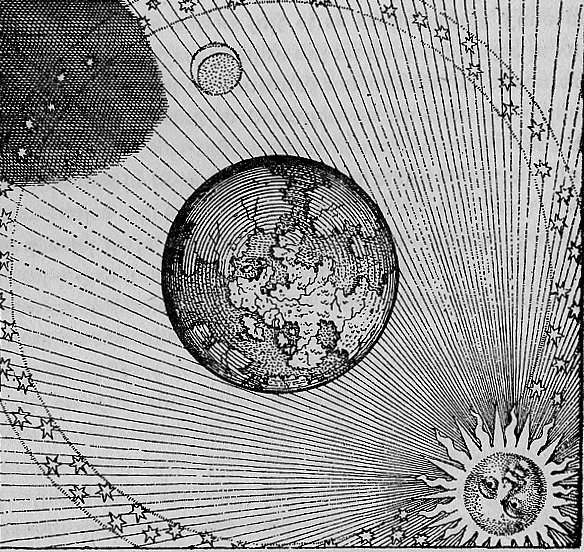
The picture is a diagram more than a landscape. A round earth, its continents sketched in tiny lines, hangs at the center. Straight rays stream from a face of the sun in the lower right and cross the whole page.
Behind the earth, in the upper left, a dark cone fills the corner, scattered with stars, and a small pale moon floats beside it. Arcs of stars circle the page. This is the forty-fifth emblem of Michael Maier's Atalanta Fugiens, and its motto says: the Sun and its shadow complete the work.
The book was printed in 1617 at Oppenheim. It has fifty emblems, and each one joins an engraving, a Latin verse, a prose discourse and a fugue for three voices. The engravings are attributed to the workshop of Matthäus Merian. Maier, a physician at the court of Emperor Rudolf II, was keenly interested in the heavens.
The Motto
The Latin line is short. Two partners work together: the Sun, which gives light, and its shadow, which follows. Together they bring the Work to its end.
The shadow is not an enemy in this line. It is a partner that finishes what the light starts.
The Earth's Shadow
The engraving shows an astronomical fact. The earth, lit by the sun, casts a long cone of darkness into space on the side away from the light. When the moon passes through it, we see a lunar eclipse.
Maier's contemporaries knew this well. Astronomers had measured the shadow, and diagrams like this one appeared in textbooks. The emblem borrows the look of a scientific figure to say something deeper.
Light and Shade
In the engraving, the sun is a human face ringed with rays, and the rays pour past the earth in straight lines. The shadow occupies the corner opposite. The earth lies between them.
The old tradition said that the Work needed both the bright and the dark. It spoke of the white and the black, the day and the night. Without the shadow, the light would have nothing to shape, and without the light, the shadow would be mere emptiness.
The Shadow as Partner
In many cultures a shadow was a kind of companion of the self. The Egyptians believed in the shadow as part of a person's being. Greek writers spoke of shades in the underworld.
The emblem takes this idea in a quiet direction. A shadow shows where something stands. A thing without a shadow is not solid. The motto implies that the dark side of a thing is proof of its substance.
The Work Completed
The word for complete in the Latin is persiciunt, which means to carry through to the end. The picture says that the final step needs both partners. A project is brought to its close not by light alone, but by the contrast that gives it depth.
Some readers have linked this to the end of the Work, where gold appears with a warm and living color. That is a reading, and the emblem does not insist on it.
A Reading for Today
The emblem speaks to anyone who tries to be only bright. Many of us hide our dark side, our doubts and failures, as if they spoiled the work. The picture says that the shadow is a necessary part of the picture.
It also says that a shadow always points back to a light. Where there is shade, there is sun somewhere. Sorting out which is which is part of the task.
The Engraving
The figure is drawn with great precision. The earth's surface is made of tiny curved lines, and its edge is darker than its center. The sun is a round face, with eyes, nose and mouth, surrounded by pointed flames. Its rays are drawn as long, thin parallel lines that fan out over the page.
The shadow cone is solid black dotted with white stars, and the moon, small and pale, sits just outside it. Rings of stars arc across the sky like orbits.
The Fugue
Each emblem has its own fugue for three voices, and each voice follows the one before it. The name of the book recalls Atalanta, the swift huntress of Greek myth who stopped to pick up golden apples. Recordings of the fugues are available, and they pair well with this picture.
Contemplating the Emblem
For those who wish to work with this image:
- Look at the rays, the globe and the cone of dark behind it.
- Ask what you tend to hide, and whether it gives your work depth.
- Think of a shadow you cast at noon and one at dusk.
- Find a place where light and shade meet, and sit there for a few minutes.
Closing
A sun, a globe, a cone of darkness. Maier drew the heavens as a lesson in partnership. For the seeker, the teaching is balanced: the Work is completed by the light and by the shadow it casts.
Related Esoteric Inquiries
- Atalanta Fugiens, Emblem 46: The Two Eagles of East and West
- Atalanta Fugiens, Emblem 30: The Sun and the Moon
- Atalanta Fugiens, Emblem 27: Entering the Rosary Without the Key
Lux Esoterica.
2026.


Comments