Simon Magus and the Great Announcement: The Primordial Fire
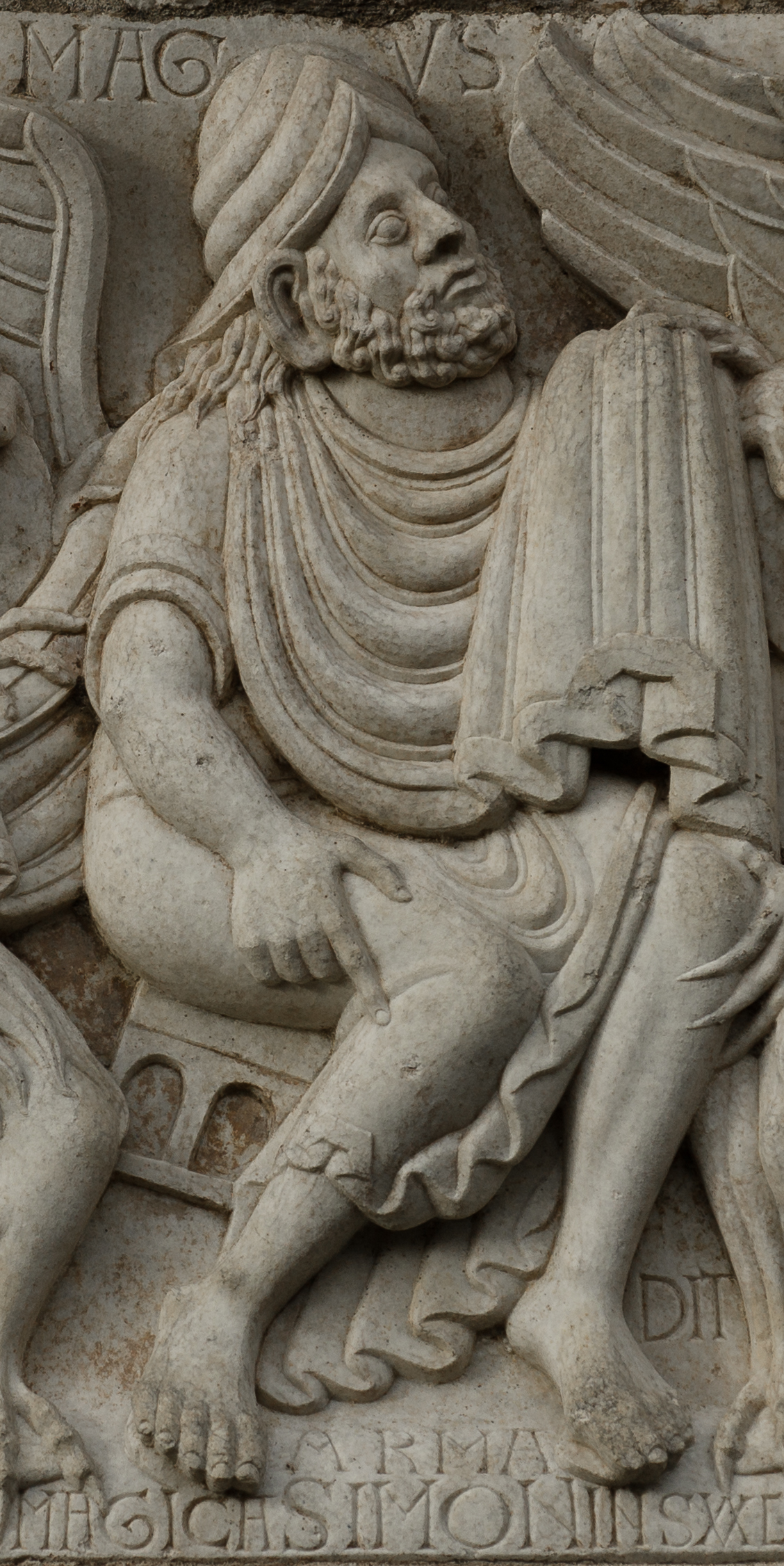
A word of English comes from him, though most people who use it have never heard his name. To commit simony is to buy or sell a church office, and the term goes back to a man in the Book of Acts named Simon, who saw the apostles lay hands on believers and offered them money for the power to do the same.
Peter rebuked him sharply. That is nearly all the New Testament says. Later Christian writers decided that this Simon of Samaria, called Simon Magus, was the first of all heretics, and attributed to his circle a strange and beautiful text called the Great Announcement.
Simon in Acts
The scene is in the eighth chapter of Acts. In the city of Samaria, a man named Simon had practiced magic and amazed the people, claiming to be someone great, and they called him "the Great Power of God." When Philip preached, Simon believed and was baptized.
Then Peter and John arrived and gave the Holy Spirit by the laying on of hands. Simon offered them money for the same ability. Peter answered that his money would perish with him and told him to repent. Simon asked them to pray for him, and the passage ends there.
Later writers filled in the rest. The second-century Christian apologist Justin Martyr, who was himself from Samaria, wrote that Simon came to Rome and was honored as a god. Irenaeus, a bishop in Gaul, called Simon the source of all heresies. These claims are Christian polemic and should be read with caution.
Helen and the Thought
In the later accounts, Simon was said to travel with a woman named Helen, whom he had found in a brothel in Tyre. He taught that she was the first Thought of God, the divine idea that had come down to earth and been imprisoned in a succession of bodies, including that of Helen of Troy.
He claimed to have come to free her. The story echoes the myth of a fallen divine female figure found in many Gnostic texts.
The details come from hostile reporters, so it is hard to know how much is accurate. Some scholars think Helen was a symbol and not a woman. Others think she was a real person who was drawn into the legend.
The Great Announcement
The Church father Hippolytus of Rome, writing in the early third century, quotes at length from a work he calls the Apophasis Megale, "The Great Announcement," which he attributes to Simon. The text speaks of a universal root that it calls Fire.
This fire, it says, has two natures, one hidden and one manifest. The hidden things are concealed within the manifest, and the manifest are produced from the hidden.
From this fire come six "roots" in three pairs: mind and thought, voice and name, reason and reflection. They are joined in a seventh power, "the one who stood, stands and will stand." The thinker in this system sees the universe as an unfolding of a single source through a series of pairs. The imagery draws on Greek philosophy as well as the Hebrew Bible.
Did Simon Write It?
Most scholars today doubt that the text came from the Simon of Acts. It more likely belongs to a later school of Simonians in the second century that used his name. The text mixes Greek and Jewish ideas, and its theory of a fire with a hidden and a visible side has parallels with the philosopher Heraclitus.
Hippolytus may also have changed it as he quoted. The claim that Simon founded Gnosticism, which some popular writers repeat, is not accepted by modern historians, who see Gnostic ideas arising from several sources.
The Flight of Simon
A popular legend, found in the apocryphal Acts of Peter, says that Simon challenged Peter in Rome. He promised to fly in front of the crowd, and he rose into the air. Peter prayed, and Simon fell and was killed. The story is a legend and not a record, but it shows how thoroughly the early Church made the magician its great opponent.
A Word of Care
Teachers who claim to hold secret powers, and who ask for money in return, are the most familiar kind of fraud. The story of Simon began with someone who thought spiritual power could be bought. It is a good rule to be wary of anyone who sells it.
Closing
Simon of Samaria survives only through his enemies, and the Great Announcement only through quotation by a man who disapproved of it. Yet from the scraps comes an arresting thought: that one fire lies behind the world, half hidden and half seen.
It may not be Simon's, but the idea was strong enough to outlive its first critics, and it still makes a reader stop and look into a flame.
Related Esoteric Inquiries
- The Gnostic Simon Magus: The Standing One and Samaritan Gnosis
- The Concept of Our Great Power: The Gnostic Anatomy of Cosmic Authority
- The Letter of Peter to Philip: The Gnostic Anatomy of the Struggle
Lux Esoterica.
2026.


Comments