Sulfur: The Symbolism of the Active Fire
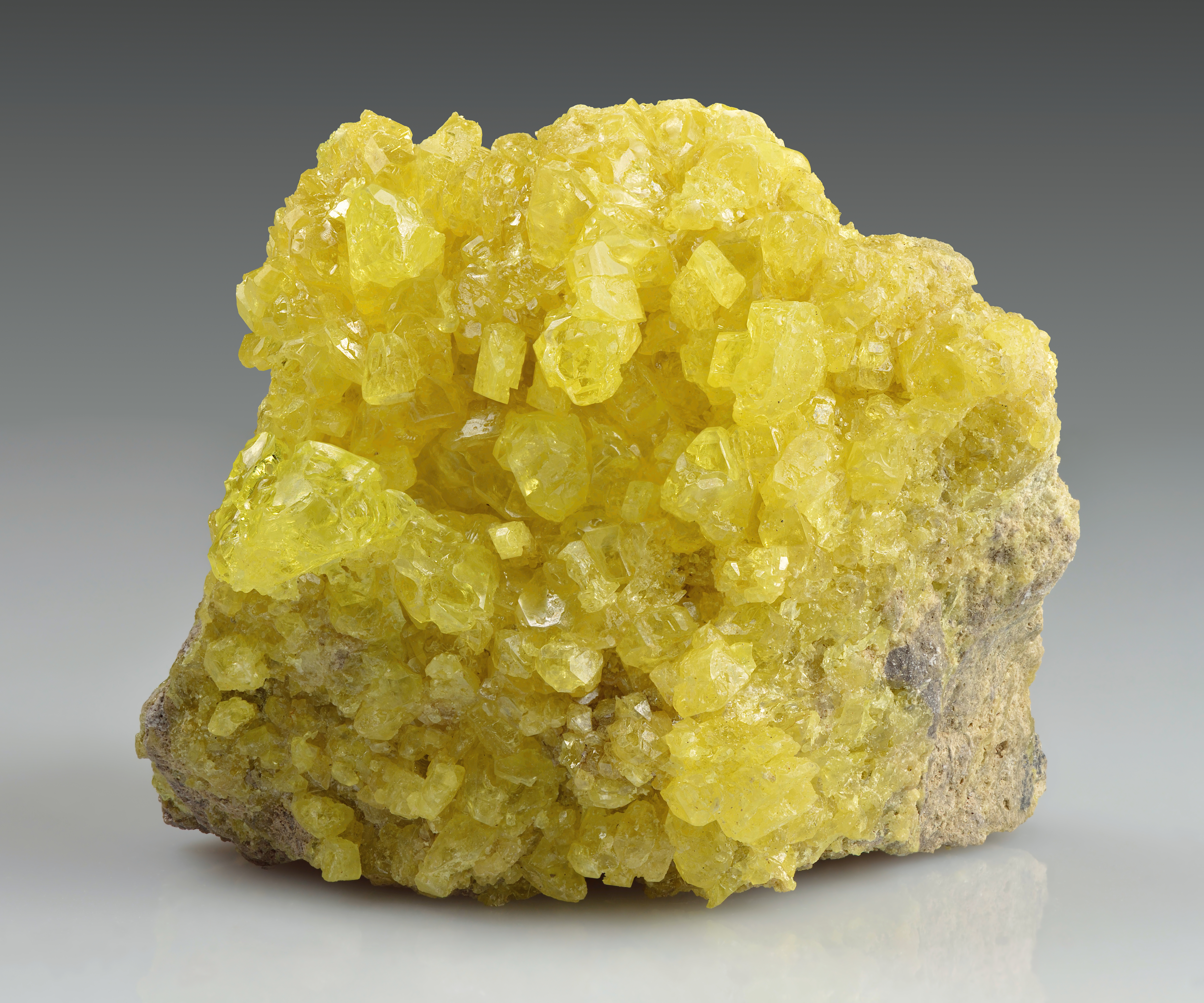
When Odysseus has killed the suitors who ruined his house, the hall is a slaughterhouse. In the twenty-second book of the Odyssey he asks his old nurse for something simple: sulfur and fire, to cleanse the house. The Greek word for the sulfur is theion, which looks very much like the word theios, "divine," and many readers have noticed the resemblance, though the two words may be unrelated.
A yellow rock that burns with a blue flame and a choking smell is a strange candidate for holiness, but sulfur has held the role for three thousand years.
Brimstone
The English word brimstone means "burning stone," from the old verb brennan, "to burn." Sulfur forms in nature around volcanoes and hot springs, where it crystallizes in bright yellow masses, and it was easy to find in lands such as Sicily and the Near East. When it burns, it makes a pale blue flame and a sharp, suffocating gas.
These qualities gave it a double reputation. On one hand it was a purifier, used by Greeks and Romans to fumigate houses, temples and sickrooms. Pliny the Elder lists it among the substances used in religious cleansing. On the other hand it was linked with punishment.
In Genesis, the Lord rains "brimstone and fire" on Sodom and Gomorrah, and in the Book of Revelation the lake of fire burns with brimstone. The smell of sulfur became the smell of hell in the European imagination.
Sulfur and Mercury
In alchemy, sulfur plays a leading part. A theory with roots in Aristotle's writing on meteorology, and developed in the Arabic writings gathered under the name of Jabir ibn Hayyan, held that all metals are made of two principles, sulfur and mercury.
These were not exactly the common substances but their "philosophical" versions. Mercury was the cool, fluid, metallic quality, and sulfur was the hot, dry, combustible one. Gold, the perfect metal, was thought to contain both in perfect balance. Other metals were imperfect because of impurity or poor proportion.
This was the foundation of the claim that transmutation was possible: if you could adjust the sulfur and mercury in a base metal, you could change it. The pair was also a male and female couple in many pictures, with sulfur as the active, fiery, masculine principle and mercury as the receptive one.
Paracelsus and the Three Principles
In the sixteenth century, Paracelsus added a third element and spoke of the three principles, tria prima: salt, sulfur and mercury. In his scheme, salt gave a body its solidity, mercury its fluidity and sulfur its combustibility. In another version of the idea, they corresponded to body, spirit and soul.
For Paracelsus and his followers, a thing burned because it contained sulfur, and when it burned the sulfur was released, leaving the salt as ash.
The theory sounds odd today, but it was an attempt to explain why things burn, melt and dissolve. It led some physicians to make new medicines by chemical means, a program that eventually shaded into early chemistry.
The Yellow Stone in the World
Beyond the laboratory, sulfur had practical uses. The Romans burned it in wine casks to keep the wine from spoiling, a practice that continues in modified form with sulfites. Black gunpowder, introduced into Europe in the thirteenth century, mixes sulfur with saltpeter and charcoal. Matches, vulcanized rubber and sulfuric acid, the most widely produced industrial chemical, all depend on it. Few elements have been so useful.
What the Symbol Says
As a symbol, sulfur is the active principle: the inner fire, will and passion. Alchemical writers often associate it with the soul, the part of a thing that burns with desire. In the picture of the Great Work, it is brought into balance with the cool, receptive mercury, so that neither flame nor water overwhelms the other.
Volcanic sulfur is still mined by hand in a few places. At the Kawah Ijen crater in Indonesia, workers carry baskets of yellow rock down a steep slope, breathing fumes that damage the lungs. The ancient yellow stone is also a modern trade, and a hard one.
A Word of Care
Burning sulfur gives off sulfur dioxide, a gas that irritates the eyes and lungs and can be dangerous in an enclosed space. People with asthma are especially at risk. Fumigation with sulfur is not a safe household practice, and the old alchemical experiments with sulfur and mercury compounds should be kept to books.
Closing
A yellow rock that burns blue and stinks of the pit managed to be, in the minds of ancient people, both holy and horrible, a cleanser and a punisher. In alchemy it became the name for the fire in things. That double nature is perhaps why it has lasted: sulfur reminds us that the same flame can purify a house or burn it down.
Related Esoteric Inquiries
- The Salamander: The Symbolism of the Secret Fire
- The Phoenix: The Symbolism of Resurrection
- The Lion: The Symbolism of Sovereignty and the Fixed Fire
Lux Esoterica.
2026.


Comments