Tarot Cards - Major Arcana - Judgment - 20
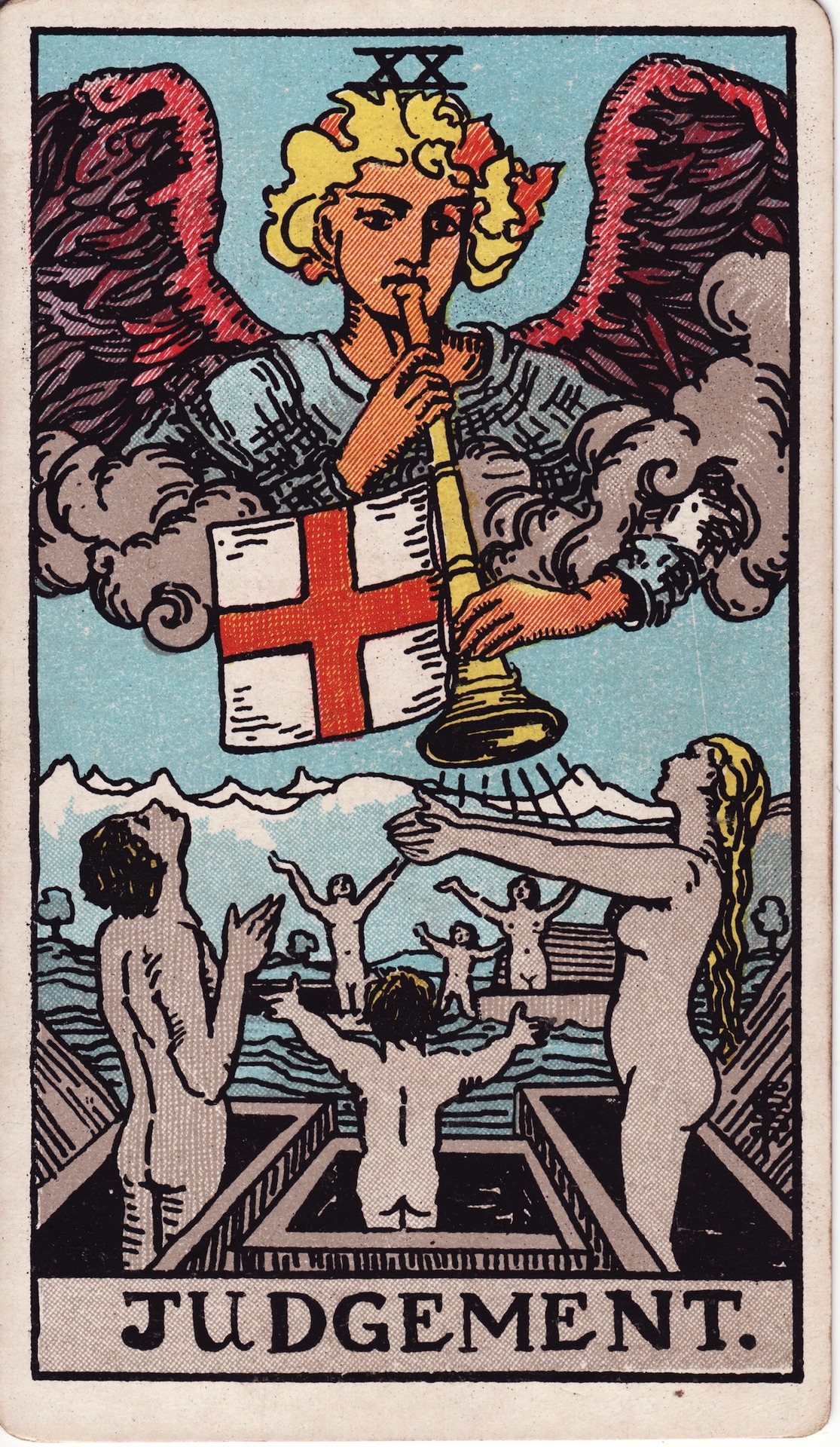
The Call of the Angel: The Sound of the Primal Logos
In the sequential journey of the Tarot's Major Arcana, the initiate traverses a path of psychological disintegration and spiritual reconstruction. Having survived the catastrophic collapse of the Tower, navigated the quiet waters of the Star, confronted the deep shadows of the Moon, and basked in the clear intelligence of the Sun, the soul arrives at Arcanum XX—Judgment. This card represents the ultimate threshold of awakening, the final preparation before the integration of the World.
At the summit of the card's composition stands a winged angel, typically identified as the Archangel Gabriel, emerging from a golden cloud. In his hands, he holds a trumpet, from which hangs a white banner bearing a red cross. The angel is not a figure of wrath or punishment; he is the personification of the hypercosmic intellect, the divine messenger who speaks the primary word of creation. The sound of the trumpet represents the Logos, the primal vibration that penetrates the dense layers of the lower chaos. It is the call that breaks the spiritual slumber of humanity, a phonic strike against the veil of matter that demands a response. For the seeker, this trumpet blast is the sudden, catastrophic disruption of daily life by the voice of the spirit, a call that cannot be ignored or rationalized away. It is the beginning of the anagoge, the active elevation of the soul from the tomb of the material world to the sanctuary of the divine mind.
The Banner of the Intersection: Spirit and Matter
The white banner with the red cross hanging from the trumpet is a key symbol in the geometry of the card. White represents the unmanifested purity of the Source, the clean slate of the spirit. The red cross represents the intersection of the vertical axis (spirit) and the horizontal axis (matter). It is the symbol of the four elements (fire, water, air, earth) and the coordinates of physical manifestation.
By placing this cross upon the banner of the trumpet, the card illustrates the mechanics of the divine call. The voice of the angel is not a distant, abstract force; it enters the physical plane at the exact intersection of our material existence. The red cross is the seal of the Logos, the promise that the material world, despite its limitations, is shot through with divine signatures. The call of the angel is not a command to escape the body, but to transmute it—to find the center of the cross within our own life and to use that coordinate as the launchpad for our return to the Pleroma. The trumpet blast aligns the four elements of the personality, turning the chaotic noise of our daily thoughts into a unified, resonant note that vibrates in harmony with the cosmic lyre.
The Resurrection from the Clay: Awakening from Amnesia
Beneath the angel, rising from grey coffins floating upon a vast, blue ocean, are three figures—a man, a woman, and a child. Their bodies are grey, reflecting the cold clay of the physical world from which they are emerging. Their hands are raised in gestures of adoration and receptivity, their eyes fixed on the angel above.
The coffins represent the physical body, the material plane, and the sleeping ego. In the Neoplatonic tradition, the descent of the soul into the body is described as a burial; the body is a tomb (soma sema) in which the spiritual spark is imprisoned. The ocean upon which the coffins float represents the flow of historical time and the watery depths of the unconscious mind. To be in the coffin is to live in a state of spiritual amnesia (Lethe), believing that the physical world is the only reality and that the ego is the true self.
The resurrection depicted in Arcanum XX is not a physical revival of dead bones, but the awakening of the consciousness. When the sound of the trumpet reaches the tomb, the lid is cast aside. The soul stands up, emerging from the watery depths of time and recognizing its own immortality. The figures are naked, representing the shedding of all material identifications, social roles, and egoic defenses. They stand before the cosmos in their true, spiritual nature, transparent and free. This resurrection is the moment the seeker steps out of the limitations of personal history, realizing that their true origin is not the family of the earth, but the eternal family of the light.
The Alchemical Triad: The Generation of the Spiritual Child
The relationship between the three figures in the foreground reveals the alchemical dynamics of the awakening. The man and the woman stand on either side, while the child stands at the center, facing away from the viewer, looking directly up at the angel.
In the language of spiritual alchemy, this triad represents the integration of opposing forces:
- The Man (Active Will): Represents the solar force, the intellect, and the active projection of consciousness.
- The Woman (Passive Receptivity): Represents the lunar force, the intuition, and the receptive containment of the spirit.
- The Child (The Rebis): Represents the newly generated spiritual self, the infant philosopher born from the union of the solar and lunar forces.
The child stands at the center of the composition, occupying the same Middle Pillar that leads from the tombs to the angel. Because the child faces away from us, we cannot see its face; it has no personal features, representing the universal, non-personal nature of the awakened spirit. The child is the true self, the spark of light that has successfully integrated the masculine will and the feminine receptivity, resolving their conflict in the unity of the center. It is the child who receives the direct influx of the angel's trumpet, acting as the bridge that connects the lower tombs to the higher heavens.
The Final Judgment: The Separation of the Real
The word "Judgment" carries heavy, moralistic connotations in the modern world, often associated with a judge pronouncing sentence on a criminal. But in the mystical tradition, judgment is an act of discernment (diakrisis). It is the alchemical process of separating the subtle from the gross, the real from the illusory.
When the angel calls, the initiate is forced to perform this judgment within themselves. They must look at their life, their thoughts, and their attachments, and decide what is eternal and what is fleeting. The tombs represent the past, the memories, and the habits that must be left behind. The resurrection is the extraction of the real essence of the soul from the dead shell of the personality. This is the final trial of the initiate: to stand naked before the cosmic mirror and to let go of everything that is not the spirit.
Once this separation is complete, the soul is no longer subject to the illusions of the material veil. It has integrated the polarities, awakened from the amnesia of the clay, and stood up in the light of the sovereign intellect. The path is clear, the trumpet has sounded, and the soul is ready to step through the final portal into the absolute unity of the World.
Related Esoteric Inquiries:
- The Visconti-Sforza Tarot: Courtly Art, Hidden Archetypes, and the Cards of Destiny
- The 56 Minor Arcana: Decoding the Four Suits, the Court Cards, and the Elemental Mastery of the Tarot
- The Tarot Arcanum of the Devil: Baphomet, the Illusion of Matter, and the Bondage of the Soul
Lux Esoterica.
2026.


Comments