Cerberus: Guardian of the Threshold of the Underworld
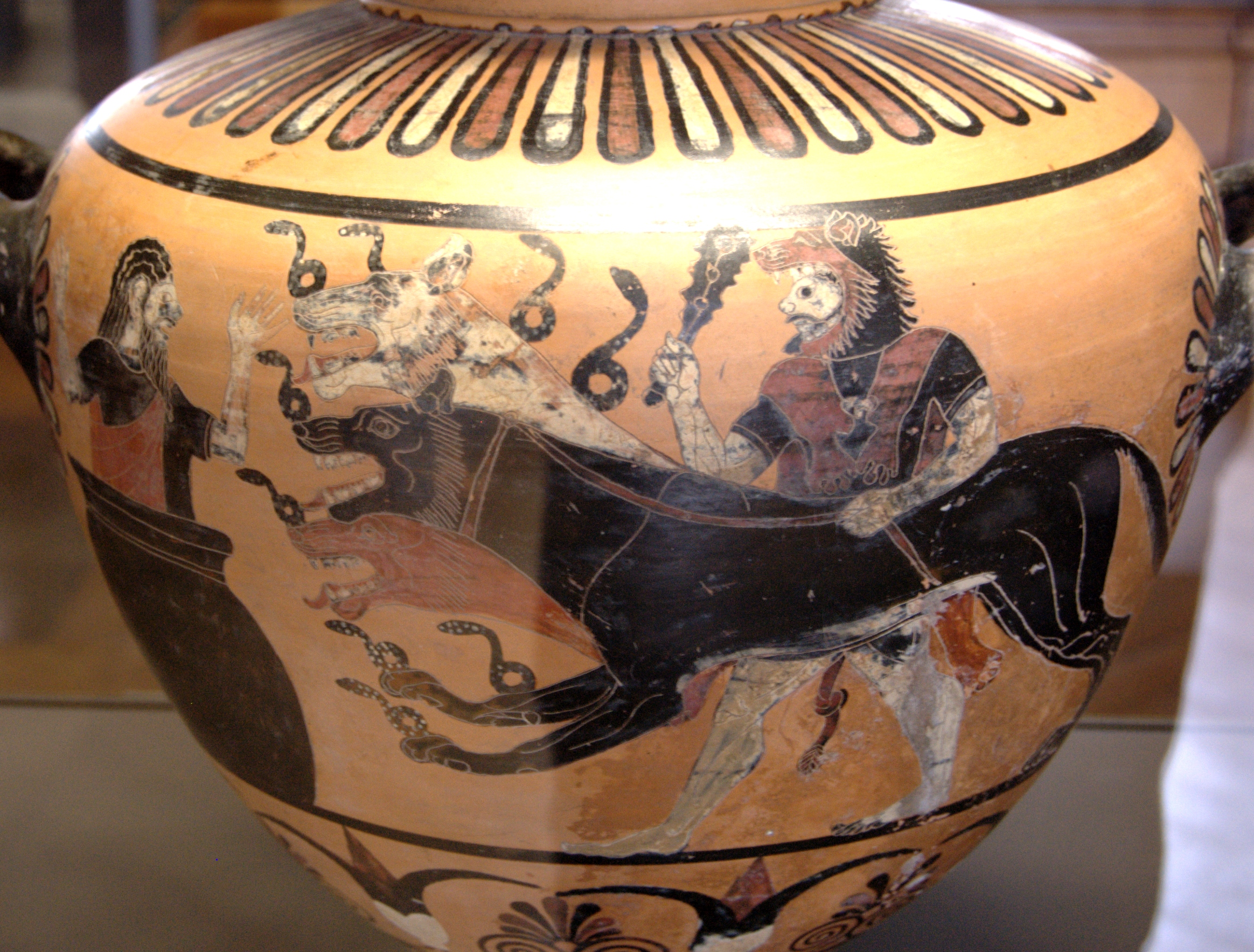
At the gate of the Greek underworld lies a dog the size of a house. It is friendly to every shade that enters, wagging its tail and fawning on the newly dead. It is merciless to any that try to leave.
This is Cerberus, in Greek Kerberos, the hound of Hades, and for nearly three thousand years he has stood in the imagination as the guard of the border between the living and the dead. His story has a hero, a musician, a prophetess and a bribe, and it explains much about how the ancients thought of the door that nobody could open twice.
Born of Monsters
The earliest full account is in Hesiod's Theogony, from around 700 BCE. There Cerberus is the child of two monsters, Typhon and Echidna, and the brother of the hydra and the chimera. Hesiod describes him as a dog with fifty heads who eats raw flesh and has a voice of bronze.
He fawns on those who enter, but he will not let them go back out, and he devours any who try.
The number of heads varied in antiquity. Later poets and artists settled on three, and often added a serpent for a tail and snakes bristling along the back. This is the form that most people know today. The dog's name has no certain origin, and ancient writers offered guesses that scholars do not accept.
The Twelfth Labor
The best-known tale of Cerberus is in the story of Heracles. As the last of his twelve labors, the hero was told by King Eurystheus to bring back the hound from the underworld. Guided by Hermes, who led souls to the land of the dead, and by Athena, Heracles descended, asked Hades for permission and was told he could take the dog if he did so without weapons.
He overcame the beast with his bare strength, dragged it into the daylight and showed it to Eurystheus. The king, terrified, hid in a large jar. The dog was then returned.
Ovid adds a gruesome detail in the Metamorphoses: where the foam of the dog's spittle fell on the earth in the light, the poisonous plant aconite, or wolfsbane, grew.
Charms for a Guard Dog
There are other ways past Cerberus than force. In myth, Orpheus, who went to the underworld to seek his dead wife Eurydice, played his lyre and put the dog to sleep. In Virgil's Aeneid, the Sibyl of Cumae throws the hound a honey cake laced with a drug, and Aeneas passes on.
Later writers also speak of honey cakes placed with the dead for the same purpose, though how widely that was done is uncertain. The English phrase "a sop to Cerberus" still means a bribe offered to quiet a dangerous obstacle.
A Dog at the Border
Dogs were natural guards, and this one's job is clear. He keeps the dead in and the living out. Other cultures knew similar figures. In the Vedic hymns of India, the god of death, Yama, has two four-eyed dogs who watch the road of the dead, and some scholars have proposed a shared Indo-European origin for such hounds, though that remains a hypothesis.
In the Middle Ages, Cerberus survived in Christian writing. Dante placed him in the third circle of Hell in the Inferno, as the guardian of the gluttons, who lie in a foul rain. The poet turned the old dog into a symbol of appetite.
What the Three Heads Mean
Many modern writers say the three heads stand for past, present and future, or for birth, life and death. These are interpretations, and the ancient sources do not say so. The Greeks simply described the dog's form, and the number varied.
Alchemical and occult authors later used Cerberus as a picture of a threshold that must be crossed with the right preparation, a fierce guardian who tests the one who would pass.
A Word of Care
Aconite, said in myth to spring from the dog's spittle, is a real and deadly poison. It should never be handled or tasted, and gardeners should wear gloves when working near it. Taking the old tales as a guide to herbal use would be dangerous.
Closing
Cerberus guards a place where nobody wants to go. Yet he is not cruel for the sake of it: he performs his office, welcoming all who come and refusing all who would leave. The old poets understood that a gate needs a keeper, and that the keeper's loyalty is as firm as the door. We still use his name for anything that stands at an entrance and will not budge.
Related Esoteric Inquiries
- The Hydra: The Symbolism of Multiplicity
- The Griffin: The Symbolism of the Solar Guard
- The Ox: The Symbolism of Stability and the Labor of the Spirit
Lux Esoterica.
2026.


Comments