The Mortar and Pestle: The Symbolism of Trituration
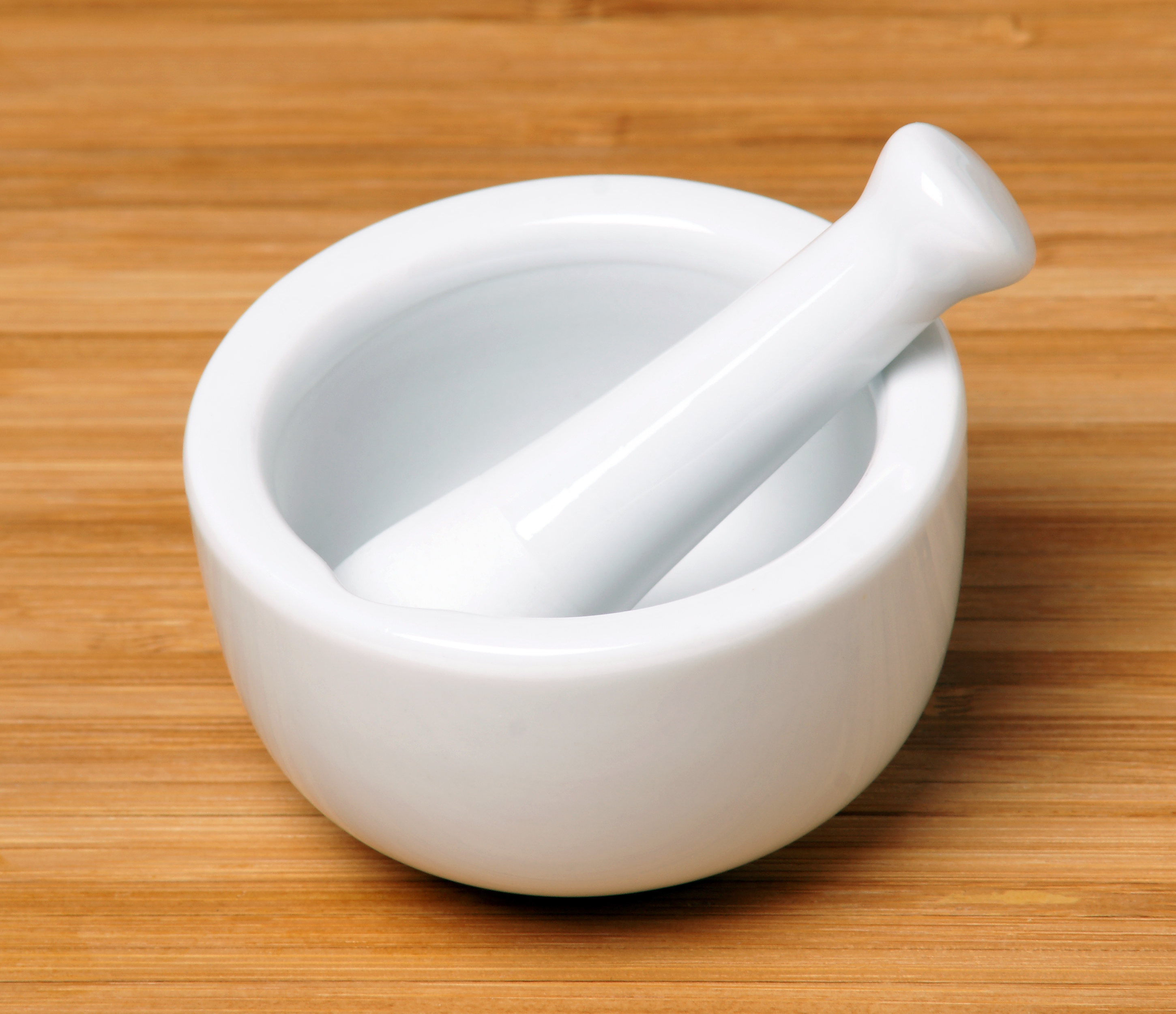
Look at the sign over any old pharmacy in Europe, or at the green cross-and-bowl logos that stand in for it, and you will often find a small stone or bronze cup with a short club resting in it. The mortar and pestle is one of the oldest tools of all, and it has been in constant use for more than ten thousand years.
People used it to crush grain and spice, to make paint and medicine, and, in the workshops of the alchemists, to grind the first matter of the Work. It is a tool of patience, and its symbolism has grown out of that.
Stone Cups of the Earliest Farmers
The first mortars were hollowed stones. Archaeologists have found them among the Natufian people of the Levant, who lived in the region of modern Israel, Lebanon and Syria before the rise of farming, more than ten thousand years ago. Grinding wild cereals into meal was among the first steps toward bread and, in time, toward agriculture.
Across the world, similar tools appeared: the metate and molcajete of Mesoamerica, wooden mortars in West Africa and Southeast Asia, and the stone mortars of ancient Egypt and Greece. The shape changed little because the job did not change. A hollow holds the material, and a heavy rod crushes it against the sides.
The Apothecary's Tool
The mortar entered medicine early. The Ebers Papyrus, an Egyptian medical scroll from around 1550 BCE, gives many recipes that call for grinding herbs, resins and minerals, and it assumes the use of a mortar. Greek and Roman physicians did the same, and the Latin name mortarium gave us the English word.
In the Middle Ages, the apothecary's shop took shape around it. Mortars of bronze, marble and wood stood on the counter, often with the name of the apothecary or the shop cast into the side. Bronze ones were prized for strength, but they could react with acidic ingredients. The mortar became so much the sign of the druggist's trade that it still appears as the emblem of pharmacy today.
The Alchemist's Bowl
In the alchemical workshop, grinding came first. Before any substance could be dissolved, heated or sublimed, it usually had to be reduced to a fine powder. The Latin word trituratio, "grinding" or "threshing," names the operation. Texts of the Middle Ages and the Renaissance advise grinding for hours or days, sometimes while adding a drop of water or vinegar.
It also gave the alchemists a vocabulary of the inner life. To crush something down to its finest form was to take it back toward its first state, and many writers likened this to the humbling of the proud heart. These readings come from the symbolic side of the tradition and not from laboratory instruction, and they were set in poetic language, not in precise recipes.
Some esoteric writers go further. They see the mortar as the receptive vessel and the pestle as the active rod, and they speak of a "luminous powder" that appears when the passions are ground down and the spirit is left clear.
This is an idea of the tradition. It cannot be confirmed, and no laboratory text proves it, but it is the reason why the mortar and pestle became a symbol of inner work as well as of the pharmacy.
Cinnabar and the Rabbit in the Moon
In China, Taoist adepts worked with cinnabar, a red mineral made of mercury and sulfur, which they ground and heated in the search for elixirs of long life. Many died of mercury poisoning, a grim lesson that records of the Tang dynasty mention. It is worth remembering when one hears about "elixirs of immortality."
East Asian folklore also gives us the Moon Rabbit. In China, the rabbit is said to pound the elixir of immortality in a mortar on the Moon. In Japan, the same markings on the Moon are read as a rabbit pounding rice cake. The shape of the dark patches on the full moon, seen from the northern hemisphere, does look like a figure with a rod and a bowl.
Baba Yaga's Mortar
Another famous mortar belongs to Baba Yaga, the old woman of Slavic fairy tales who lives in a hut on chicken legs. She travels through the forest in a great mortar, steering it with the pestle and sweeping away her tracks with a broom.
In some tellings she is a fearsome witch, in others a wise and difficult helper who sets tests for those who come to her. Her mortar turns the humble tool into a vehicle of magic.
A Word of Care
Grinding fine powders raises dust, and dust can be harmful to breathe. Some traditional materials, such as cinnabar, arsenic minerals and lead compounds, are poisonous. Never use a kitchen mortar for them, and never taste or handle such substances casually. For ordinary herbs and spices, wash the mortar well, and wear a mask when grinding irritating plants.
Closing
A hollow stone and a heavy rod have turned grain to flour and herbs to medicine for ten thousand years. In symbol, they stand for a lesson everyone learns eventually: that what is worth making needs patience, and that breaking something down is sometimes the way to find its best form. The alchemists knew this, and so did the old women who ground meal at dawn.
Related Esoteric Inquiries
- The Funnel: The Symbolism of Influx and Concentration
- The Crucible: The Symbolism of the Fire
- The Minotaur: The Labyrinth and the Dissolution of the Ego
Lux Esoterica.
2026.


Comments