The Spiritual Hierarchy of Jane Leade: Divine Sophia, the Philadelphian Vision, and the Alchemical Restoration of Souls
The Visionary of the English Civil War Era
In the turbulent intellectual and political aftermath of the English Civil War, a remarkable visionary woman articulated a mystical system that would captivate seekers across Europe. Jane Leade (1623 – 1704) was the primary spiritual force behind the Philadelphian Society, an association of mystics dedicated to the cultivation of the inner life and the preparation of humanity for a new, spiritualized age of the world. Born into a wealthy Anglican family in Norfolk, Leade experienced early religious anxieties that culminated in a life of intense, solitary prayer. Following the death of her husband in 1670, she entered a state of spiritual widowhood that opened the floodgates of her inner vision, leading to a series of extraordinary, nocturnal revelations that she recorded in her spiritual diaries, published under titles such as A Fountain of Gardens and The Revelation of Revelations.
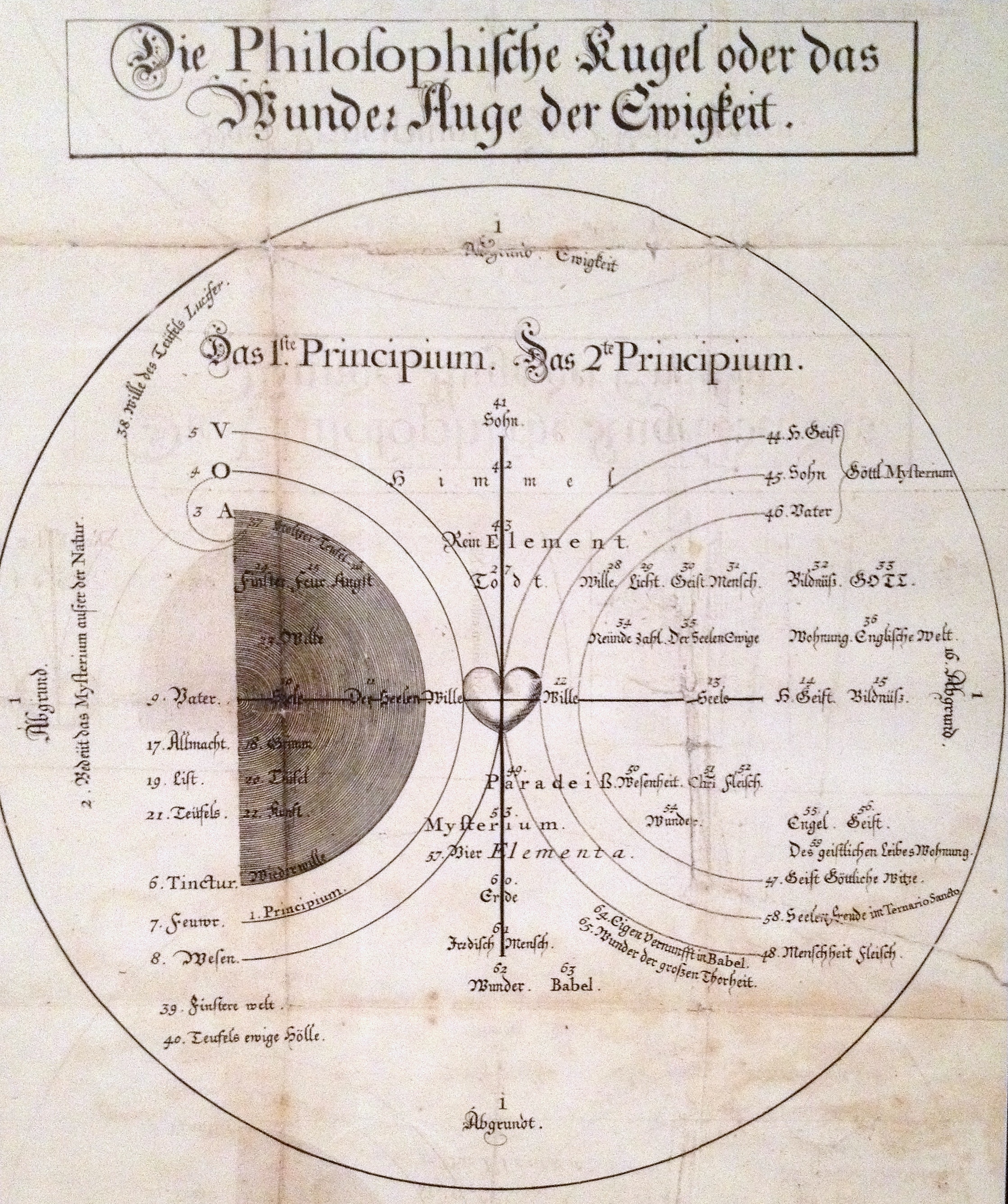
Leade's mystical system was not a simple emotional pietism; it was a highly complex, systematic theosophy that synthesized Christian scripture, Renaissance alchemy, and the profound theological speculations of the German cobbler-mystic Jakob Böhme. In an era when institutional religion was defined by rigid sectarian dogmas and rationalist theology, Leade insisted on the reality of direct, ongoing revelation. She presented the human soul as an exiled citizen of a higher, spiritual realm, destined to undergo a series of initiatory transmutations to reclaim its divine inheritance. Her writings established a unique, English branch of theosophy that prioritized the feminine dimension of the Divine, offering a comprehensive map of the spiritual hierarchy of the soul's ascent to God.
The Boehmean Legacy and the Divine Sophia
The central cornerstone of Jane Leade's visionary experience was her encounter with the Divine Sophia—the feminine manifestation of the wisdom of God. While physical theology had long treated Sophia as a mere metaphor or attribute of the deity, Leade described her as a living, distinct spiritual entity, the "Virgin of Wisdom," who acts as the primary mediator, mother, and bride of the seeking soul. This concept was heavily indebted to the work of Jakob Böhme, who had written of Sophia as the mirror of the Godhead, the passive container of the active divine fire.
In Leade's visions, Sophia appeared to her in forms of blinding light, instructing her in the secrets of the creation and the laws of the spiritual world. Sophia is the agent of regeneration; she is the one who enters the dark, cold tomb of the human heart, warming it with the divine love and initiating the process of spiritual rebirth. The relationship between the soul and Sophia is described using the vocabulary of erotic mysticism and alchemical marriage. The seeker must surrender their will to the divine virgin, becoming her spiritual bridegroom, so that their intellect may be fertilized by her light. This union produces the "spiritual birth"—the generation of a new, celestial body within the shell of the physical flesh, transforming the mortal seeker into a child of the divine wisdom.
The Philadelphian Society: The Kingdom of Love
In the 1690s, Leade, along with the Cambridge-educated physician and scholar John Pordage and the nonconformist minister Richard Roach, founded the Philadelphian Society for the Promotion of Brotherly Love. The society took its name from the church of Philadelphia mentioned in the Book of Revelation, which was celebrated as the church of love and fidelity that would survive the corruptions of the final days.
The Philadelphian Society was not intended to be a new religious sect; indeed, Leade and her followers discouraged their members from leaving their existing churches. Instead, they sought to establish a global, spiritual network of initiates who had achieved the internal rebirth, transcending all outward divisions of dogma, ritual, and national identity. The society published tracts, held quiet, meditative meetings, and established active correspondences with mystics in Germany, Holland, and North America. They taught that the outward, institutional churches were in a state of decay (which they referred to as "Babel"), and that the true church was an invisible, spiritual body coordinated by the love of the Holy Spirit. Through this global fellowship, the Philadelphians sought to prepare the earth for the millenarian reign of Christ—an era when the physical structures of the world would be spiritualized and the divine harmony would be restored to the entire creation.
The Spiritual Hierarchy of the Soul's Ascent
In her treatises, especially The Heavenly Cloud Now Breaking (1681), Leade mapped out the systematic stages of the soul's return to the divine center, describing a structured spiritual hierarchy of ascension. The journey of the soul is framed as a passage through seven progressive states or "heavens," each representing a specific level of purification and consciousness.
The ascent begins in the sublunary, material state, where the soul must undergo the death of the self—the mortification of the planetary desires. The seeker must pass through the fiery gate of the divine wrath, which burns away the dross of the ego, before they can enter the intermediate heavens of peace, light, and intellectual contemplation. Each level of the hierarchy is governed by specific spiritual laws and angelic guardians. As the soul ascends, it receives new spiritual organs, represented by the "seven seals" that are opened within the heart. The final destination of the journey is the "innermost sanctuary" of the Godhead—the eighth sphere of absolute unity—where the soul is completely integrated into the divine essence, losing its separate, egoic existence to become an active channel of the divine will. This structured map of the invisible world served as a practical guide for the Philadelphian initiates, helping them to locate their progress and understand the challenges of the contemplative life.
The Doctrine of Apokatastasis: Universal Restoration
The most controversial and radical aspect of Jane Leade's theology was her defense of the doctrine of Apokatastasis—the ultimate, universal restoration of all things. In her treatise The Wonders of God's Creation, Leade argued that the divine love is an all-consuming, purifying fire that cannot tolerate the existence of eternal damnation.
Leade asserted that at the end of the cosmic cycle, after the physical world has been dissolved and refined, all created souls—including the most wicked sinners, the damned in hell, and even Lucifer and the fallen angels—will be purified and restored to their original, glorious state in the divine essence. She argued that the concept of an eternal hell was a misunderstanding of the divine justice, which seeks to heal and perfect rather than to punish endlessly. The suffering of the underworld was interpreted as a temporary, therapeutic purgation, a severe alchemy that breaks down the stubborn wills of the rebels so that they may receive the tincture of the divine grace. This doctrine of universal salvation brought upon the Philadelphians the wrath of the orthodox churches, but for Leade it was the logical necessity of her Sophia-mysticism: the infinite, maternal love of the Creator could never rest until the entire creation was redeemed and integrated back into the divine harmony.
Esoteric and Alchemical Metaphors
Throughout her writings, Jane Leade demonstrated a deep familiarity with the language of Renaissance alchemy, utilizing its concepts to describe the internal experiences of the mystical life. She did not practice physical metallurgy in a laboratory, but she viewed chemical operations as a precise, divinely ordained vocabulary for the transformation of consciousness.
Leade spoke of the tincture—the highly concentrated spiritual agent that has the power to instantly transmute base metals into gold—as a symbol of the blood of Christ or the light of Sophia. The human soul is the prima materia, the dark, sulfurous ore that must be dissolved in the acidic waters of repentance. The furnace is the fire of the divine love, and the vessel is the quiet, hermetically sealed heart of the contemplative. The preparation of the Philosopher's Stone was explained as the creation of the glorified, resurrection body of the believer. By applying these alchemical metaphors to the internal life, Leade bridged the gulf between the natural sciences of the cosmos and the internal experiences of the soul, asserting that the same laws of transmutation govern the evolution of both the mineral kingdom and the human spirit.
Related Esoteric Inquiries:
- The Divine Mysticism of Jan van Ruusbroec: The Spiritual Espousals, the Contemplative Ascent, and the Union without Distinction
- The Pistis Sophia: The Repentance and Ascent of the Divine Wisdom
- Valentinus and the Gnostic Pleroma: The Divine Fullness and the Drama of Sophia
Lux Esoterica.
2026.


Comments