D. B. Cooper: The Man Who Leapt Into the Storm and Disappeared Forever
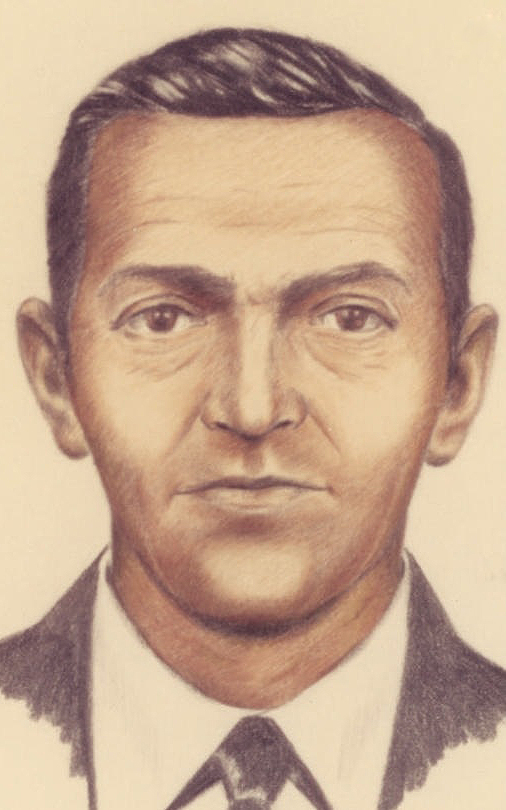
On the evening before Thanksgiving in 1971, a quiet, well-dressed man in a dark suit and tie stepped aboard an airplane in Portland, Oregon, bound for Seattle. He gave his name as Dan Cooper. He was polite, unremarkable, the sort of passenger no one would remember. By the end of that night he would become the central figure in the only unsolved air piracy case in the history of the United States, and one of the most enduring mysteries of the modern age. For after taking control of the aircraft, collecting a fortune in ransom, and ordering the plane back into the sky, this calm and courteous stranger opened the rear door in the middle of a storm, stepped out into the freezing darkness thousands of feet above the forests of the Pacific Northwest, and vanished. He was never found. No confirmed trace of him, alive or dead, has ever been recovered. More than half a century later, no one knows who he was or what became of him.
A Quiet Man With a Briefcase
The man who called himself Dan Cooper — later transformed by a reporter's error into the D. B. Cooper by which he is forever known — took his seat near the back of the aircraft, ordered a drink, and behaved like any other traveler. Then, shortly after takeoff, he handed a note to a flight attendant. When she set it aside unread, assuming it was the number of a lonely businessman, he leaned toward her and said quietly that she had better look at it, because he had a bomb. He opened his briefcase just enough to reveal a tangle of wires and what appeared to be red cylinders. His demands were precise and businesslike: a large sum of money in cash, and several parachutes, to be delivered when the plane landed in Seattle.
Throughout the ordeal, witnesses would remember, Cooper was strikingly composed and even considerate. He was not wild-eyed or frantic; he was calm, articulate, and in complete control. When the plane landed in Seattle, his terms were met — the ransom, a substantial fortune in twenty-dollar bills, and the parachutes were brought aboard. Cooper released the passengers and most of the crew, keeping only a few people to fly the plane. Then he issued his final instructions: the aircraft was to take off again and fly south, low and slow, toward Mexico, with the landing gear down and the cabin unpressurized. He had, it was clear, thought carefully about exactly how he meant to escape.
Into the Night
Once the plane was airborne again and droning southward through the dark and stormy night, Cooper sent the remaining crew forward into the cockpit and told them to stay there. Alone in the back of the cabin, he lowered the aircraft's rear stairway, which on that type of plane could be opened in flight. Somewhere over the vast, rain-lashed wilderness of the Pacific Northwest — a black expanse of mountains and dense forest and cold rivers — with the ransom strapped to his body, he walked down those stairs into the freezing slipstream and jumped. It was night. It was storming. The temperature outside was brutally cold, and the terrain below was some of the most rugged and unforgiving in the country. When the plane landed, the rear stairs were down and the man was gone.
The response was one of the largest manhunts the nation had ever seen. Investigators combed the enormous area where Cooper was thought to have come down, searching the forests and mountains on foot and from the air. They interviewed thousands of people. They chased down countless suspects over the years — men who resembled the sketch, men who boasted or confessed, men whose lives seemed to fit the profile of a person capable of such a daring and meticulous crime. And every lead, in the end, dissolved. No body was ever found. No parachute, no briefcase, no confirmed personal effect of the man ever turned up in the wilderness. It was as if he had stepped out of the airplane and out of the world.
The Money in the Sand
For years the only physical trace of the entire affair was the money — or rather, its absence, for the ransom bills, whose serial numbers had all been recorded, never appeared. Not one of them was ever spent and detected in circulation, anywhere, in all the years that followed. This deepened the mystery on both sides: if Cooper had survived, why did he never seem to spend a cent of his fortune; and if he had died, where was his body and his loot?
Then, most of a decade after the jump, came the single most famous clue in the case. A boy digging in the sand along the bank of a river turned up several bundles of decaying twenty-dollar bills — and their serial numbers matched the ransom exactly. Here at last was a real, physical fragment of the mystery, a small piece of Cooper's fortune returned from the wild. But rather than solving anything, the discovery only sharpened the riddle. The bills were found far from where investigators had long believed Cooper landed, and their condition and position raised as many questions as they answered. Had they washed down the river from where he came to earth? Had he buried them, or dropped them, or died nearby? Did their presence mean he had perished in the wilderness, his body long since lost to the elements and the animals, or had he survived and lost or hidden a portion of the cash? The few thousand dollars in the sand were the only part of the ransom ever found, and the rest, like the man, has never surfaced.
So the case stands today exactly where it has stood for decades: open, unsolved, and inexhaustibly fascinating. Every theory about D. B. Cooper's fate collides with some stubborn fact. If he died in the jump, where is he? If he lived, who was he, and how did a man vanish so completely, leaving no ripple in the world, spending none of his money, never boasting to the wrong person, never slipping up in all the years that followed? He remains a figure sketched only in a composite drawing and a handful of memories — a calm man in a dark suit who fell out of an airplane into a storm and became, in that instant, a permanent ghost.
An Esoteric Reading
To the contemplative, the abiding power of the Cooper legend has little to do with the crime and everything to do with the leap — for here is one of the purest images our modern age has produced of the soul's plunge into the unknown, the deliberate step off the edge of the ordered world into the dark and the storm. Every mystical tradition preserves the figure of the leap of faith, the moment when the seeker, having gone as far as the known will carry him, must step out over the abyss with no ground beneath and no certainty of what lies below. Cooper's descent renders that archetype in stark and literal form: a man alone at the open threshold, the wind and the blackness roaring beyond it, who gathers what he values to himself and steps out into empty air above a wilderness he cannot see. Whether he lived or died in that plunge is, to the symbolic eye, almost beside the point. What endures is the act itself — the willing passage from the lit and enclosed world into the storm-filled dark.
Consider that he was never seen again, and that this is precisely the source of his mythic stature. Had Cooper been caught, or his body recovered, he would be a mere criminal, filed and forgotten. It is the absence, the tracelessness, the clean vanishing that has made him immortal in the imagination — and the traditions understand exactly why. The one who disappears without remainder, who steps beyond the edge and leaves no corpse and no explanation, escapes the ordinary category of ending altogether and enters the realm of the mystery. He is neither confirmed among the living nor confirmed among the dead; he hangs forever suspended in the instant of the leap, and in that suspension he becomes a figure onto which the age projects its deepest questions about what lies on the far side of the threshold. The mystic has always known that the most potent departures are the ones that leave no body to bury, for they refuse the mind the comfort of an ending and hold open the door to the beyond.
And there is the matter of the money that was never spent — the fortune he seized and then, so far as the world can tell, never used. This is the strangest and most suggestive detail of all, and to the esoteric eye it transforms the whole tale. A man risks everything to obtain a treasure, and then carries it with him over the edge into the dark, and it is never seen to enrich him; a few rotting bills surface from the sand of a riverbank, and the rest is gone with the man into silence. The mystic reads in this a parable of what we truly carry across the great threshold, and what becomes of it there. The treasure that seemed the point of the whole endeavor proves, on the far side of the leap, to be worthless in the ordinary sense — not spent, not enjoyed, simply gone, dissolved into the wilderness along with the one who bore it. What Cooper actually took with him into the storm was not the fortune but the leap, and it is the leap alone that has lasted. Perhaps that is the final teaching of this most modern of mysteries: that we spend our lives grasping after the ransom and imagining it to be the goal, when the only thing that truly crosses over with us is the courage or the folly of the step we take into the dark — and that the one who vanishes into the unknown becomes, precisely by vanishing, a question the living can never stop asking, a permanent open door onto the mystery of where the fallen go.
Related Esoteric Inquiries:
- The Sodder Children: The Five Who Vanished in the Fire That Left No Bones
- The Lost Franklin Expedition: The Doomed Voyage Into the Ice From Which No One Returned
- The Vanishing of Amelia Earhart: The Aviator Who Flew Into the Blue and Was Never Found
Lux Esoterica.
2026.


Comments