Koschei the Deathless: The Hidden Soul in the Needle, the Egg, and the Duck
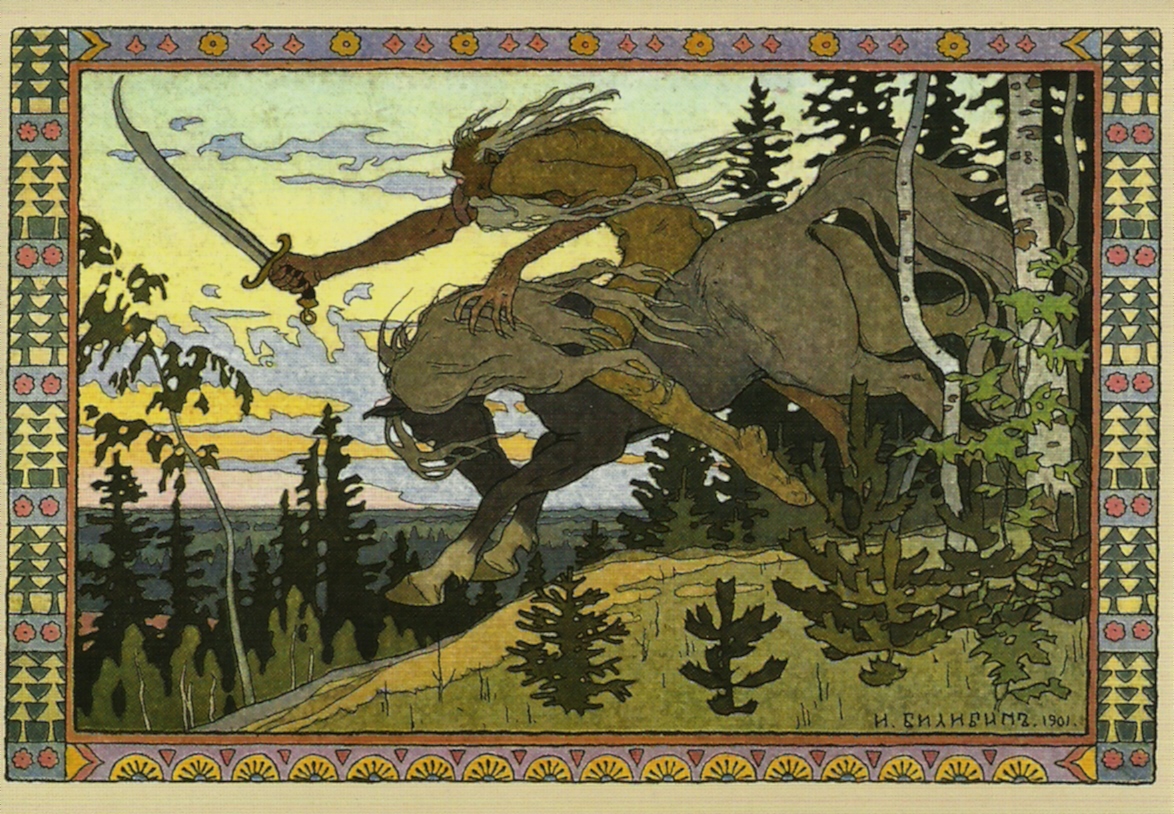
There is a figure who gallops through the Russian wonder tales like a rumor of winter: gaunt as famine, old as grievance, mounted on a steed that outruns the wind, forever carrying off the bride of some luckless prince. Swords do not bite him. Fire does not hold him. Bury him and he climbs out; drown him and he walks ashore. The tales name him with a shudder of respect: Koschei Bessmertny, Koschei the Deathless. And yet the whole engine of his legend runs on a paradox the peasant storytellers polished for centuries—the Deathless One can die, and he knows precisely how, because he has hidden his death away himself. His death lies at the point of a needle; the needle is in an egg; the egg is in a duck; the duck is in a hare; the hare is in an iron chest; the chest is buried under a green oak; and the oak stands on the island of Buyan, in the middle of the ocean-sea. Whoever recites that address has already begun the spell that kills him.
The Prisoner in the Iron Chamber
The most complete of his tales, The Death of Koschei the Deathless, begins with a door that must not be opened—for the Russian tale, like the Greek and the Hebrew, knows that all catastrophe is a hinge. Prince Ivan marries the warrior-queen Marya Morevna, a woman so formidable that the tale introduces her by the heap of a defeated army she has left on the steppe. Called away to war, she leaves her husband the keys of the house and one prohibition: do not look into the closet at the end of the hall. Ivan, naturally, looks. Inside hangs an old man, mere bones in chains, twelve iron hoops about him, who begs in a voice of dust for water. Ivan, being kind—and kindness in these tales is always double-edged—brings him a bucket. Then another. Then a third. With the third bucket the prisoner's strength returns like a river breaking ice: the chains burst, the hoops snap, and Koschei the Deathless goes out through the window like a whirlwind, pausing only to seize Marya Morevna as he goes.
The detail deserves its own meditation. Koschei is not summoned from hell; he is watered back to power by mercy without discernment. The tale-tellers understood something the moralists often miss: that evil in its dormant state solicits compassion, and that there is a species of pity which is really disobedience wearing a halo. Marya Morevna had conquered the unconquerable and kept him chained and dry—starved of the one element, living water, that feeds his kind of life. One well-meaning bucket at a time, Ivan undoes the labor of a war.
Three times Ivan steals his wife back; three times Koschei's marvelous horse overtakes them at leisure—the steed itself warns its master, and Koschei, unhurried, remarks that there is time to sow wheat, harvest it, brew beer, and drink it before the fugitives need be caught. Twice he spares Ivan for the water's sake. The third time he chops the prince into pieces and barrels him into the sea. Only after Ivan's brothers-in-law—falcon, eagle, and raven, the shape-shifting husbands of his three sisters—gather the pieces and revive him with the waters of death and life does the prince learn the single useful truth: Koschei cannot be fought. He can only be out-horsed. And the only mare fleeter than Koschei's stallion grazes in the herd of Baba Yaga, beyond the river of fire—that iron-toothed mistress of thresholds whose deeper offices we have examined in her own chapter of the forest mysteries.
Ivan serves the witch three days as herdsman, aided by the grateful beasts he refrained from harming on the road—a bird, a bee, a lioness—and escapes across the fiery river with a mangy colt that becomes a steed of wonder. The chase reverses; Koschei's horse stumbles; and depending on the telling, the sorcerer is brained by a hoof, burned on a pyre, and his ashes scattered to the wind. In other tales—The Frog Princess chief among them—the hero must go the longer way: to Buyan, to the oak, through chest and hare and duck to the egg, which in the best versions he does not even crush himself. He carries it to the confrontation, and as he tosses it from hand to hand, Koschei is flung from wall to wall; he breaks the egg, or snaps the needle's point, and the Deathless One collapses like an emptied garment.
The External Soul and the Arithmetic of Fear
Koschei is world folklore's supreme case of what the comparative mythologists call the external soul: the life kept outside the body so the body cannot be slain. The pattern is ancient beyond reckoning—the Egyptian tale of the Two Brothers hid a heart in the blossom of an acacia; the giant of the Norse tales kept no heart in his breast; a sorcerer of the Hebrides confessed his life lay in an egg in a sheep's belly. But the Russian tales give the device its most precise anatomy, and every layer of the nesting reads like a clause in a metaphysical contract. The ocean is the unconscious deep; Buyan, the paradisal island of the old Slavic incantations, upon which every charm sited its power ("On the sea, on the ocean, on the island Buyan..."); the oak, the world-tree of Perun; the chest, iron will; the hare and duck, the animal souls of earth and air that flee and dive when disturbed; the egg, the primordial germ of life itself; and at the last, the needle—the thinnest possible thread-bearer, the point upon which a whole existence balances.
What has Koschei actually purchased with this arrangement? Not immortality. Insulation. He has removed his life from his living, and the tales are unanimous about the price: he is a skeleton. Kost', the bone, echoes in his very name; the folk also heard in it koshchei, an old word for a captive slave—the Deathless One is etymologically a prisoner. He hoards gold he cannot spend ("he wastes away over his gold," says the proverb the tales attach to him), abducts brides he cannot win—the maidens never love him, and their rescuers always come—and commands a magnificence that brings him nothing but the next siege. He is the portrait of a soul that, in terror of loss, has deposited itself where experience cannot reach it, and therefore cannot be nourished by anything at all. The alchemists would call him a fixation without a solution: matter locked at the stage of dry bone, refusing the bath of dissolution wherein alone renewal begins. Even his revival by water is diagnostic—life must be carried to him in buckets, for nothing flows where he lives.
The Needle's Point
The Christian centuries, inheriting him, made Koschei a figure of the Adversary, and the egg-breaking a little Easter: life hidden in the egg, death defeated by its opening. But the older reading cuts closer to the bone. The tales insist that the hero almost never locates the death by cleverness. The chest is found because a bear uproots the oak; the hare that leaps out is torn by another hare, or run down by hounds the hero spared; the duck is struck from the sky by a drake or a falcon he once fed; the egg falls into the sea and is returned by a pike he threw back into the water. The hidden death of the tyrant is delivered into the hero's hand by every small mercy he ever practiced. Where Ivan's undiscerning pity watered Koschei back to life at the tale's opening, his discerning kindnesses—each one a restraint, a sparing, a feeding—assemble, creature by creature, the instrument of the sorcerer's end. The Russian tale is not sentimental about compassion; it is forensic. Mercy misapplied resurrects the demon; mercy rightly sown recruits the whole animate world against him.
And the needle: why a needle? Because the needle is the instrument of joining, of mending, of the thread—and Koschei's entire being is a refusal of the thread that binds life to life. His death is the point of connection he amputated and buried. To snap the needle is not to stab him; it is to break the last, inverted link by which he still touched the world. There is a fearful symmetry here that the esoteric reader should carry away whole: whatever we sever from ourselves and bury on a far island does not cease to be ours. It becomes the one address at which we can be destroyed—and the tale promises, with the calm of long experience, that the address is always found. The bear always fells the oak. The pike always brings the egg.
The wonder tales end as they must: the wedding, the feast, the honey-beer running down mustaches. But Koschei is never quite gone from the Russian imagination—he returns in Stravinsky's firebird ballet, where his soul-egg is danced to its breaking, in lacquered miniatures, in the lean shadow of every hoarding tyrant of the age. The peasants who told of him through the long snowbound evenings were not warning each other about sorcerers. They were warning each other about a temptation that visits every human being who has been badly hurt: to take the trembling egg of one's life, wrap it in iron and animal cunning, and bury it beyond the sea where nothing can ever touch it again. It works. Nothing touches it. And in the chair by the stove sits the remainder—deathless, boneful, thirsty, waiting for some kind fool with a bucket.
Lux Esoterica.
2026.


Comments