The Quimbaya Artifacts: The Golden Jets of Colombia
Place a small gold pendant on a table, flat side down. It measures only a few centimeters, with a triangular body, two swept-back wings and a single upright fin at the tail. To many eyes, it looks like a toy jet fighter.
In the second half of the twentieth century, this resemblance gave rise to one of the best-known puzzles of popular archaeology: the so-called "golden jets" of Colombia. The pieces are real and beautiful, and they were made by skilled hands. The question is what those hands were making.
What the Pieces Are
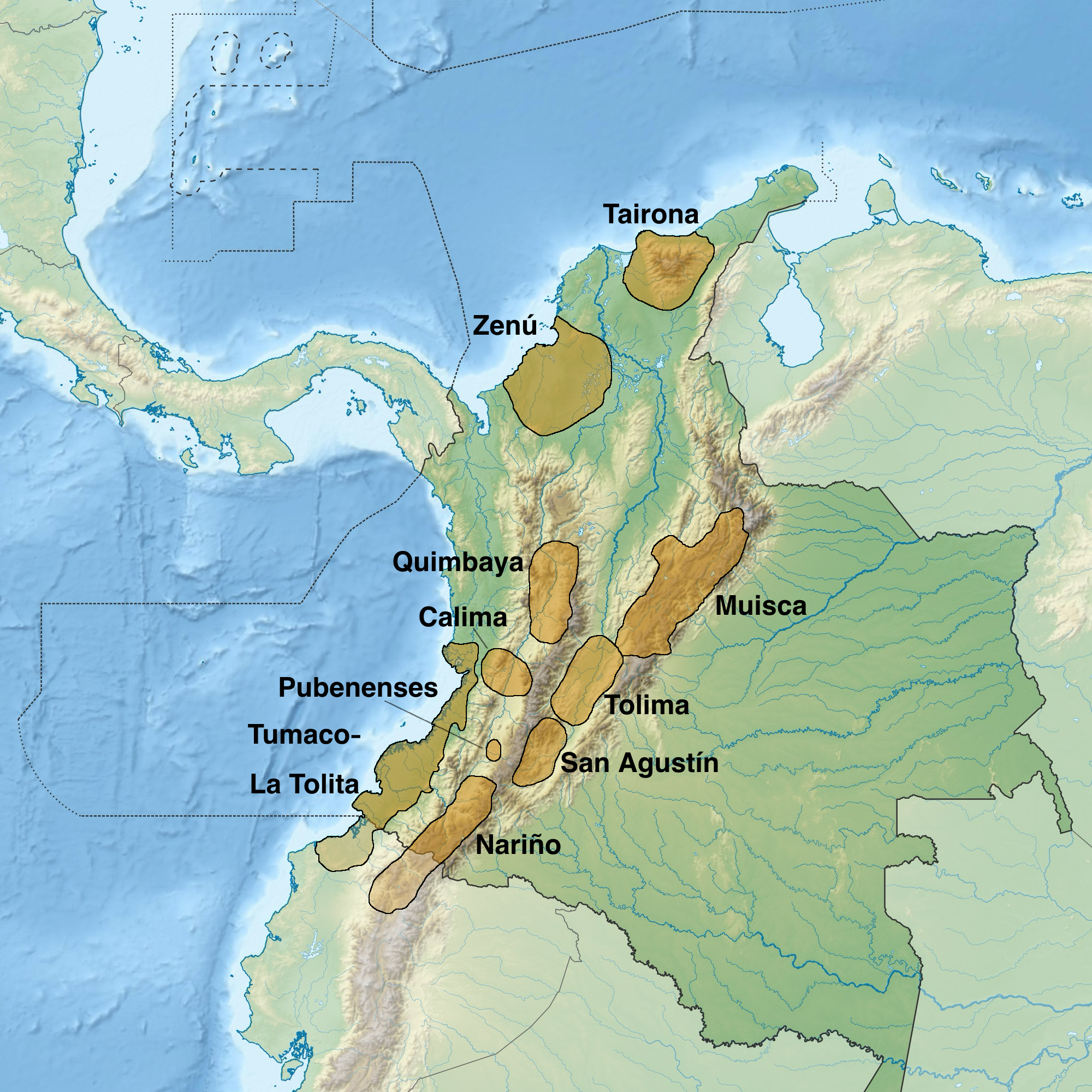
The little gold objects come from Colombia and are often credited to the Quimbaya culture, which flourished in the middle valley of the Cauca River roughly in the first millennium of our era. Similar winged pieces are also credited to neighboring peoples, such as the Tolima and the Zenu, and some resemble works from Costa Rica and Panama. Many of them are kept in the Gold Museum, the Museo del Oro, in Bogota.
They are small, usually no more than a few centimeters, and were made as pendants. Most were buried with their owners or offered in ceremonies. The best-known object of the Quimbaya style is not a jet but a treasure of more than a hundred gold vessels, ornaments and lime flasks found in the 1890s and given by Colombia to Spain, where it is now in Madrid.
The Jet Idea
The idea that the winged pendants represent aircraft became popular in the 1960s and later. The writer Ivan T. Sanderson helped spread it, and the theme appeared in the "ancient astronaut" books of the age, such as Erich von Daniken's Chariots of the Gods? (1968). In the 1990s, a German engineer named Algund Eenboom built scale models, some of them powered and radio-controlled, and reported that they flew well.
That may sound like proof, but it is not. Any model with swept wings and a tail fin can be made to glide if its proportions are adjusted, and a successful flight tells us only that the engineer did a good job.
It does not tell us what the ancient goldsmith had in mind. And the argument goes round in a circle: the pieces look like aircraft because we know aircraft.
What the Evidence Suggests
Museum specialists see animals. Some of the winged pendants have features that point to living creatures: eyes, a mouth, gills, or the patterns of scales and feathers. The upright "tail fin" matches the dorsal fin of a fish, and the "wings" match fish with large pectoral fins, such as flying fish.
Others look like birds, bats or insects. Pre-Columbian Colombian goldwork is full of such creatures, and it often mixes them: a figure may have the head of a bird and the body of a man.
There is also a wider setting. Many of these cultures believed that shamans could take the form of animals in trance. A bat, an eagle or a jaguar was a spirit-helper, and a gold figure of such a creature could be worn as a sign of that power.
Seen in this light, a winged pendant is more likely a charm for travel between worlds than a drawing of a machine.
What the Goldsmiths Knew
The real marvel is the craft. The metalworkers of ancient Colombia cast their pieces by the lost-wax method: a model was shaped in wax, covered in clay, heated so the wax ran out, and then filled with molten metal. Many pieces were made of tumbaga, an alloy of gold and copper.
By treating the surface with plant acids, the smiths could remove some of the copper and leave a skin of pure gold, so that a cheaper alloy shone like the real metal. This was a sophisticated technique, and it was developed by trial and error over centuries.
To such people, gold was more than a precious metal. Many cultures of the Andes and Colombia linked it to the sun. In the old stories of the Muisca, gold was thrown into Lake Guatavita in an offering, and this practice gave rise to the legend of El Dorado.
The alchemists of Europe had a similar view of gold as the metal of the sun, incorruptible and perfect. This shared feeling is worth noticing, though there is no sign that the two traditions influenced each other.
Why the Idea Lasts
The theory is attractive for a simple reason: it tells a story of lost greatness. It is often linked to the vimanas, flying chariots in Sanskrit epics, but those belong to ancient Indian poetry and have no known link to Colombia.
A well-known modern text on vimanas was written in the early twentieth century. The idea also carries an unspoken suggestion that the peoples of the Americas could not have built such fine things on their own. That suggestion is not only false but unfair. The gold of Colombia needs no outside help.
Closing
The gold "jets" teach a good lesson about looking. When we see a shape that reminds us of something modern, we should ask what the makers saw, not what we see. If we do, the pendants become more wonderful, not less.
They show a people who watched fish leaping over the river and birds crossing the sky, and who captured that motion in a metal that never tarnishes. That is a message from the past that does not need an airplane to be remarkable.
Related Esoteric Inquiries
- The Alchemy of the Nebra Sky Disk: The Bronze Age Cosmos
- The Black Pullet: The Golden Hen and the Alchemy of Material Mastery
- The Secret of the Golden Flower: Daoist Internal Alchemy and the Birth of the Immortal Self
Lux Esoterica.
2026.


Comments