The Elongated Skulls of Paracas: The Cone-Headed Dead of the Peruvian Desert
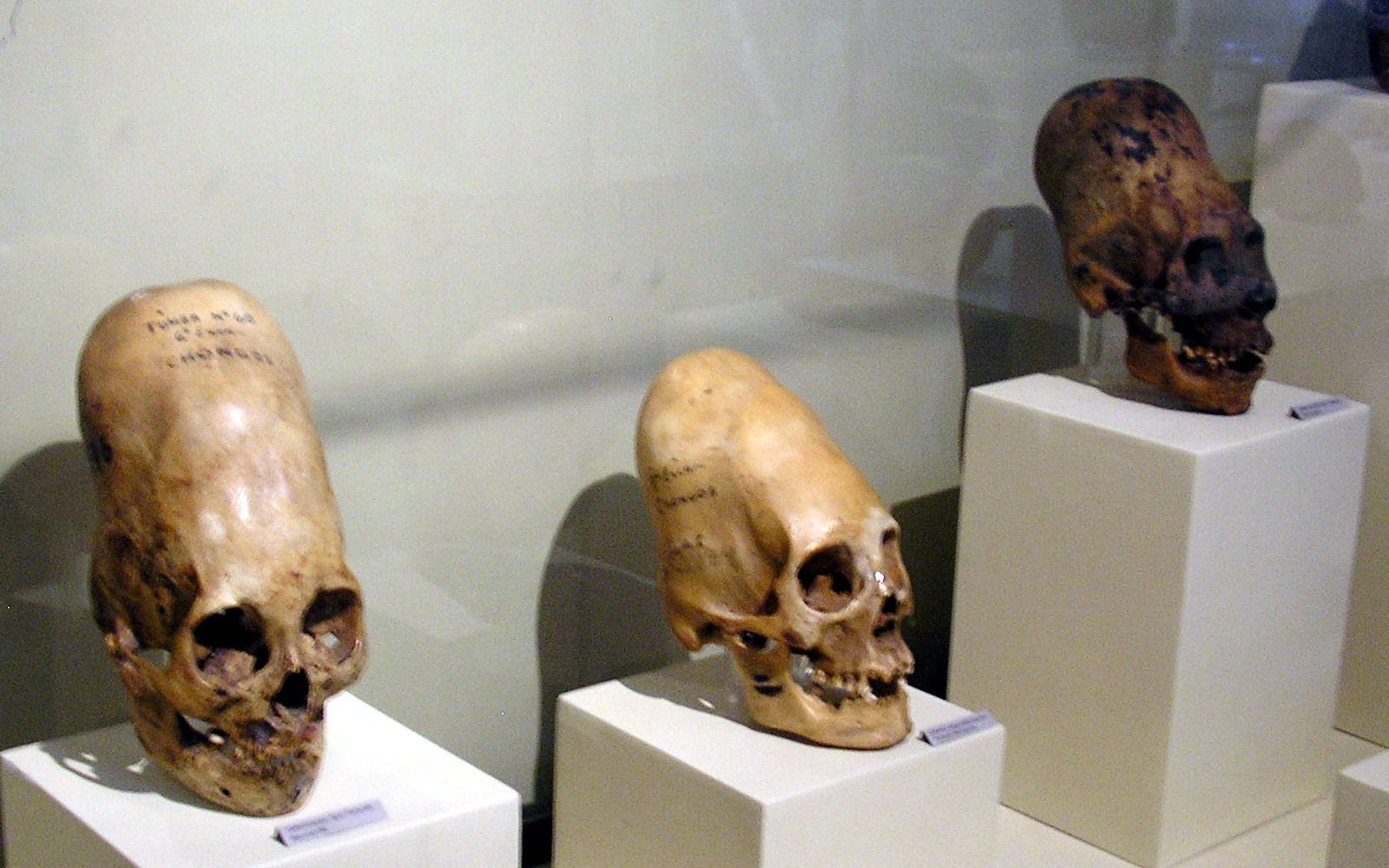
On the arid Paracas peninsula of southern Peru, where the desert runs down to meet the cold Pacific, a Peruvian archaeologist named Julio Tello made an astonishing discovery in the 1920s. Beneath the parched ground he uncovered a great necropolis, an ancient cemetery holding hundreds of mummified bodies wrapped in some of the most magnificent woven textiles the ancient world ever produced. But it was not the burials or even the exquisite cloth that has kept the name of Paracas alive in the imagination of the world. It was the skulls. Among the dead were individuals whose heads were shaped like nothing in ordinary human experience — long, narrow, and swept dramatically backward into a great tapering cone, as though the skull itself had been drawn out and stretched toward the sky. These are the famous elongated skulls of Paracas, and for a century they have provoked wonder, argument, and a persistent whisper that they might be something other than entirely human.
A People of the Desert Coast
The Paracas culture flourished on this coast for many centuries before the rise of the more famous civilizations of the Andes, in the long stretch of time before the common era. They were a sophisticated people, master weavers whose burial cloths, embroidered with gods, animals, and geometric visions in brilliant surviving colors, are counted among the treasures of pre-Columbian art. They fished the rich waters, farmed the river valleys that cut through the desert, and buried their dead with extraordinary care in the dry sand that preserved them across the ages. And a portion of these dead — particularly, it seems, those of high status — bore the strange, elongated heads that have made their name.
The skulls are genuinely arresting to behold. In the most extreme examples the cranium is stretched far back and upward, giving the head an almost otherworldly silhouette, longer and narrower than any natural human skull. Displayed together in the museums of Peru, rows of these tapering craniums with their large, deep eye sockets present a sight that unsettles the modern viewer and seems to belong more to a vision of another world than to the ordinary history of humankind. It is little wonder that they have become a magnet for every kind of speculation about lost races, forgotten visitors, and hidden truths.
The Shaping of the Head
The mainstream explanation for the elongated skulls is well established, and it is remarkable enough in itself. The Paracas people, like a number of cultures across the ancient world, practiced deliberate cranial modification. When an infant was born, its skull was still soft and pliable, its bones not yet fused, and by binding the head tightly with cloth or pressing it between boards over the first months and years of life, the growing skull could be gradually and permanently reshaped. Applied with patience, this practice could produce exactly the long, backward-sweeping form seen in the Paracas dead. The custom is known from many peoples in different parts of the world, who used it to mark beauty, rank, tribal identity, or membership in an elite. On this understanding, the elongated skulls are the product of a widespread human tradition of shaping the body to express status and belonging — a testament not to strange origins but to the lengths to which people will go to make the human form carry meaning.
This explanation accounts for a great deal. Head-binding demonstrably changes the shape of the skull, and the presence of the practice among many cultures makes it entirely plausible that the Paracas elite bound the heads of their children in the same way. For most scholars, the case is essentially closed: the cone-headed dead of Paracas were ordinary human beings whose skulls were molded in infancy by an ancient custom, and the aura of the uncanny that surrounds them is a trick of unfamiliarity.
The Questions That Will Not Settle
And yet the mystery has refused to lie down quietly, for a stubborn set of observations keeps the argument alive. Cranial binding, its critics point out, can change the shape of a skull, but it cannot change the amount of bone or the volume of the braincase; it only redistributes what is there. Some researchers examining the Paracas skulls have claimed that certain specimens possess features that binding alone should not produce — a greater cranial volume than ordinary skulls, differences in weight, or peculiarities in the structure of the bone, such as the arrangement of the sutures where the plates of the skull meet, and small openings in unusual places. These claims are hotly disputed, and much of the sensational commentary around them has been unreliable, tangled up with dubious testing and outright fantasy. But the disputes themselves keep a genuine question open: whether every one of the Paracas skulls can be fully explained by binding, or whether at least some of them reflect something not yet understood.
Into this uncertainty has poured a flood of extraordinary speculation. To the more imaginative interpreters, the elongated skulls are evidence of a lost race of long-headed beings who once walked the earth, or of contact between the ancient Peruvians and visitors from beyond the world, whose forms the Paracas people either belonged to or sought to imitate. Attempts to extract and analyze genetic material from the skulls have been announced from time to time with dramatic claims of anomalous or unidentifiable ancestry, but these have generally come from unreliable sources and have not survived careful scrutiny, and the serious study of the remains continues to point toward a fully human people. Still, the sheer strangeness of the skulls, combined with the disputed anomalies and the incomplete state of rigorous testing, means the topic has never reached a resolution that satisfies everyone. The Paracas skulls sit at the exact boundary where established archaeology meets unanswered questions, and that is precisely why they will not release their hold on the imagination.
An Esoteric Reading
To the student of the sacred traditions, the elongated skulls of Paracas speak not of alien blood but of something the mystic finds even more compelling: the ancient and worldwide conviction that the shape of the head is bound up with the shape of the soul, and that to reshape the crown of the body is to make a statement about the crown of the spirit. Consider what the practice truly involved. From the first days of life, in a chosen few, the head was drawn upward and backward, elongated toward the heavens, deliberately made to rise. This was reserved, it appears, for the elite, the priestly, the high-born — for those set apart. The mystic recognizes at once the language of such an act. The crown of the head is, in nearly every esoteric system, the highest point of the human being, the seat of the loftiest faculties, the place where, in the traditions of the East and the West alike, the spirit is said to ascend and the divine to descend. To lengthen the skull upward is to make visible, in the very bone, the aspiration of the soul toward the heights.
There is a profound symbolism in shaping a person from infancy toward this elevated form. It declares that the individual so marked is dedicated, from before the age of choosing, to a life oriented upward, consecrated to the sky and to the sacred. The elongated head becomes a permanent sign of a permanent vocation, a body molded to proclaim that this person belongs not to the ordinary horizontal world of appetite and labor but to the vertical axis that joins the earth to the heavens. In this the Paracas practice joins hands with the crowns and tall headdresses and shaven or bound heads of priesthoods across the world, all of which use the summit of the body to mark the summit of the spiritual order. The head is made into a living crown, and the crown, in the mysteries, is always the emblem of attained sovereignty over oneself and of nearness to the divine.
And here the deepest teaching emerges, in the very tension that keeps the mystery alive. The skeptic says the skulls are merely bound bone, wholly explained, nothing but custom; the dreamer says they are the relics of another kind of being altogether. The mystic stands between and reads a third meaning that reconciles them: that these people took the ordinary human material they were given and, through discipline applied with unwavering patience across the whole of a life, transformed it into something that now appears, to all who behold it, to belong to a higher and stranger order. Is that not the very definition of the spiritual work? The alchemists did not claim to be made of finer stuff than other men; they claimed that the base material, worked upon with art and perseverance, could be raised into gold. The Paracas dead are a figure of exactly this, wrought in the flesh: ordinary human beings shaped, from the cradle, into an image of the transcendent, until the boundary between what was born and what was made can no longer be clearly drawn. Perhaps that is the final secret the cone-headed sleepers of the desert keep — not that they came from another world, but that human hands, working with vision and devotion upon the humblest clay of the self, can shape a being that seems to have come from one. The elongated skulls are a monument to the oldest hope of the mysteries: that we are not fixed in the form we are given, and that the crown of the human head may yet be lifted, by patient art, toward the sky.
Related Esoteric Inquiries:
- The Tarim Mummies: The Fair-Haired Dead of the Desert Who Came From Nowhere
- Nabta Playa: The Desert Star-Circle Older Than Stonehenge
- Roopkund, the Skeleton Lake: Five Hundred Dead in the Himalayas Who Died a Thousand Years Apart
Lux Esoterica.
2026.


Comments