The Gnostic Demiurge: The Archons and the Prison of Matter
In December 1945, two brothers digging for fertilizer near the town of Nag Hammadi in Upper Egypt broke open a sealed jar. Inside were thirteen books of papyrus bound in leather, written in Coptic and buried some sixteen centuries earlier.
Among them were texts that had been lost since late antiquity, works of Christian and Jewish thinkers whom the Church had condemned. One of them, the Apocryphon of John, tells a story that has haunted readers ever since: that the world was made not by the true God but by a blind and arrogant lesser power, and that human beings carry within them a spark of something older and better.
The Find at Nag Hammadi
The jar was uncovered by a farmer named Muhammad Ali al-Samman, according to his own later account. The codices passed through many hands, and some pages were nearly burned by his mother, who used papyrus as kindling, by his own telling. They reached scholars slowly, and a complete English edition appeared only in 1977.
The collection holds some fifty-two treatises, including the Gospel of Thomas, the Gospel of Philip and the Apocryphon of John. This last one survives in several copies: three at Nag Hammadi and one in a codex kept in Berlin. That so many copies exist suggests that it was widely read.
Sophia and the Lion-Faced One
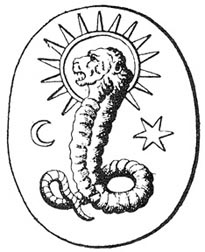
In the Apocryphon, the highest reality is an unknowable source from which emanate the divine powers, together called the Pleroma, a Greek word meaning "fullness." The lowest of these powers is Sophia, "Wisdom." She wished to bring forth something on her own, without her partner, and what she bore was imperfect: a misshapen being, a serpent with the face of a lion.
She named him Yaldabaoth. The word's origin is debated, and one old suggestion is that it means "child of chaos." He is also called Samael, "the blind god," and Saklas, "the fool." Sophia hid him in a cloud, but he stole power from her and set about making a world of his own.
The Archons
Yaldabaoth created rulers beneath him, the archons, from the Greek word for "rulers" or "magistrates." In the text they number twelve, and a group of seven is tied to the planets, the old seven wandering lights. Each has a name and an animal face. Together they shape the body of the first human, Adam, in imitation of a vision of the divine image they glimpsed in the waters.
Yaldabaoth's boast is the heart of the story. He declares, "I am God, and there is no other god beside me," echoing words from the Hebrew Bible. A voice from above answers that he is mistaken. For the author, the lesser god's pride shows his ignorance: he does not know that there is anything above him.
A Spark Within
The archons' creature lay lifeless until Yaldabaoth was tricked into breathing into it, and with his breath went the power he had taken from Sophia. So the human being carries a spark of the higher light, hidden within a body made by lesser rulers. Gnostic teachers called such knowledge gnosis, a direct knowing of one's origin, and they held that it, not obedience or faith alone, brought freedom.
It is important not to read this as simple hatred of the world. The authors were arguing with a puzzle that many ancient thinkers faced: if the source is good, why is there suffering? Their answer placed the flaw in the maker, not in the source.
Echoes and Rivals
The idea of a "demiurge," a craftsman of the world, comes from Plato. In his dialogue the Timaeus, the demiurge is a kindly artisan who shapes the cosmos by looking to eternal patterns. The Gnostics took the word and inverted it, making the craftsman ignorant or cruel.
Around the same time, Marcion of Sinope taught that the God of the Hebrew scriptures was a lesser, harsher deity than the Father of Jesus, and he was condemned in Rome in the year 144.
The philosopher Plotinus, in the third century, wrote a treatise against the Gnostics. He objected that they scorned the beauty of the world and slandered its maker. The bishop Irenaeus of Lyons also described and attacked such teachings in his Against Heresies, which is why we know much about them from their critics as well as their own books.
A Word of Care
These are ancient myths, and they are best read as such. Some modern teachers present them as proof that a hostile hidden power rules the world and that ordinary people are its prisoners. Such claims go far beyond the evidence, and they can feed fear, isolation and suspicion of family and friends.
Be wary of anyone who sells "liberation" for a fee or asks you to break with the people around you. Scholarly translations, such as the Nag Hammadi Library edited by James M. Robinson, let the texts speak in their own voice.
Closing
A farmer's jar gave back a voice that had been silent for centuries, and it spoke of a lion-faced maker who thought himself alone in the heavens. Whatever one makes of the myth, it is a powerful picture of pride without wisdom, and of a hidden spark waiting to be recognized.
That question, why a good source would allow a flawed world, did not die with the Gnostics. It still sits with us at the edge of the dark.
Related Esoteric Inquiries
- The Gnostic Compendium: An Esoteric Index of the Nag Hammadi Codices and Archontic Cosmology
- The Gnostic Valentinus: The Pleroma and the Fall of Sophia
- The Gnostic Basilides: Abraxas and the Seed of the Cosmos
Lux Esoterica.
2026.


Comments