The MV Joyita: The Unsinkable Ship Found Adrift With Twenty-Five Souls Gone
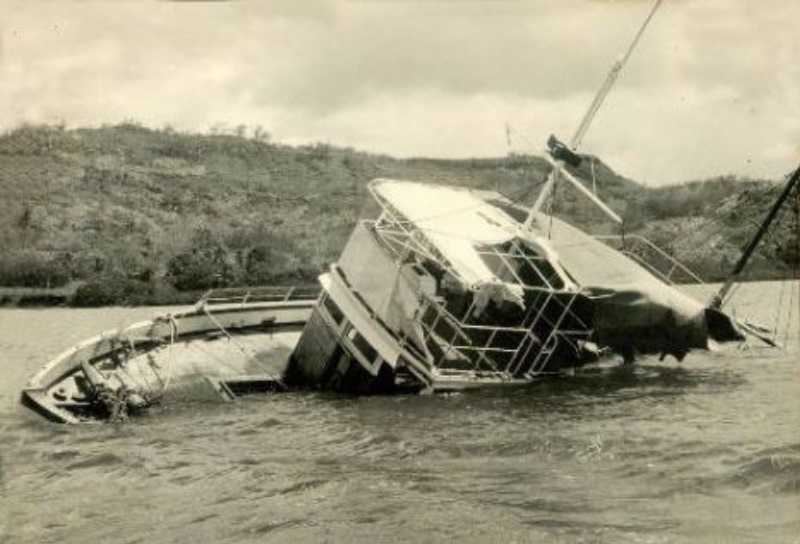
In October of 1955, a small merchant ship named the Joyita set out across the South Pacific from the islands of Samoa, bound for the distant atolls of the Tokelau group, carrying twenty-five people — sixteen crew and nine passengers, among them a doctor, a government official, and children. She never reached her destination. Five weeks later, hundreds of miles off her intended course, another vessel came upon her drifting alone across the empty ocean, listing heavily to one side, half-swamped with water, and utterly deserted. Not one of the twenty-five people who had sailed aboard her was ever seen again. No bodies were recovered. No lifeboats were found. The ship herself, though damaged and waterlogged, was still afloat — and there lay the heart of the mystery, for the Joyita was, by her very construction, a vessel that should have been almost impossible to sink. Why the people aboard a virtually unsinkable ship would abandon her into the open sea, and what became of them all, has never been explained.
A Ship That Could Not Sink
The Joyita was not an ordinary hull. Built decades before as a luxury yacht and later converted to other uses, she had a feature that set her apart from most vessels of her size: her hull was lined with cork and fitted in such a way that she possessed enormous natural buoyancy. Even with her hull breached and her interior flooded, the great quantity of cork and the sealed spaces within her were expected to keep her afloat. In the judgment of those who knew her, the Joyita was practically unsinkable; short of some catastrophe that tore her apart entirely, she would ride the waves even when swamped. This is the single fact that transforms her story from an ordinary tragedy of the sea into an enduring enigma. The people aboard her were, in a sense, safest if they stayed with the ship — for the ship itself was the best life raft they had. And yet they left her.
When she was found, five weeks after her departure, the Joyita was in a sorry state. She lay heeled far over on her side, low in the water, one of her decks awash. Her port engine was found with a mattress jammed against a corroded pipe, as though someone had tried to stem a leak. Her superstructure showed damage. Water had flooded parts of her. But she had not sunk, and she would not sink; she was still there, drifting, waterlogged but afloat, exactly as her buoyant construction had promised. Everything about her condition confirmed that the ship had betrayed no one. Whatever had driven her people over the side, it was not the imminent loss of the vessel beneath them — because the vessel had refused to be lost.
The Empty Deck
Those who boarded the derelict found a scene that raised far more questions than it answered. The twenty-five people were gone, and so were all of the ship's life rafts — three or four of them, depending on the account — which had apparently been launched or taken. This suggested a deliberate, if desperate, evacuation: the people had, for some reason, chosen or been forced to leave the ship in her rafts. But it made no sense. To abandon an unsinkable ship, still afloat in open water, for small rafts on the vast and hungry Pacific, was to trade the safest place for the most dangerous. No experienced mariner would do such a thing without a compelling and terrible reason, and the ship's captain was a seasoned seaman who surely knew his vessel's buoyant nature better than anyone.
Other details deepened the strangeness. A doctor's bag was found on deck, open, containing bloodstained bandages and surgical instruments, hinting that someone aboard had been injured and treated in the final hours. The ship's clocks had stopped. Her logbook, her navigational instruments, her firearms, and a quantity of her cargo were missing. The radio was discovered tuned to the international distress frequency, as though someone had tried to call for help — and yet no distress message from the Joyita was ever clearly received by anyone. It later emerged that the ship's radio, through a fault in its wiring, had a drastically reduced range, so that any call for aid would have carried only a short distance across the water, unheard by the wider world. The people of the Joyita may have cried out into the night and been answered only by the indifferent ocean.
The Theories and the Silence
An official inquiry was held, and it reached a famously frank conclusion: that the cause of the abandonment of the Joyita was inexplicable. That verdict has stood, in essence, ever since, for none of the theories advanced in the decades since has ever been proven. Some proposed a straightforward maritime accident: that a pipe had burst and flooded the engine room, that the ship had taken on a heavy list, and that the crew, perhaps not fully trusting the vessel's buoyancy in the terror of the moment, had panicked and abandoned her, only to perish in their rafts before rescue could come. The mattress against the corroded pipe and the flooding lend this some support — yet it founders on the question of why an experienced captain who knew his unsinkable ship would give the order to leave her.
Darker theories abounded. Some suspected foul play — a mutiny among the crew, or an attack by pirates or by fishermen from some passing vessel, who might have overpowered the people aboard, seized the missing cargo, and disposed of the passengers and crew in the sea. The blood in the doctor's bag, the missing firearms, and the vanished cargo were pointed to as signs of violence. Others suspected an insurance scheme gone wrong, or a deliberate scuttling attempt, and a few reached for stranger explanations still, invoking the vague and sinister reputation that clings to disappearances in the wide Pacific. But every theory collides with the same wall of silence. No survivor ever came forward. No body was ever recovered. No pirate or mutineer ever confessed. The twenty-five people who sailed on the Joyita simply ceased to exist, leaving behind a half-drowned ship that would not sink, a doctor's bag of bloody bandages, a radio calling into a void, and a mystery that the sea has never given up.
An Esoteric Reading
To the contemplative, the Joyita presents an image of almost unbearable symbolic force, and it turns upon a single, piercing paradox: the people abandoned the one thing that would have saved them. They left the unsinkable ship — the vessel that, by its very nature, could not go down, the refuge that would have carried them through even the worst — and cast themselves instead upon the open and devouring sea. Here the mystic sees a parable of the soul's gravest error, repeated in countless spiritual teachings across the ages: that in the moment of crisis and terror, the frightened self flees the very refuge that would preserve it, abandoning the sure ground for the illusion of escape, trading the ark that cannot sink for the frail raft that cannot last. The ship, in the language of the traditions, has always been the vessel of salvation, the ark that bears the faithful safely across the flood of dissolution. To leap from the unsinkable ark into the waters is the image of a panic that mistakes safety for danger and danger for safety, and perishes by its own flight.
Consider what the ship's unsinkable nature truly represents. Its buoyancy was hidden, woven invisibly into the cork within its hull; to the eye, in the moment of flooding and listing, the ship may have appeared to be dying, even as its hidden nature guaranteed it could not die. The people aboard, if the accident theory holds, were undone precisely because they judged by the terrifying appearance — the water rushing in, the deck tilting toward the sea — rather than by the deeper, unseen truth of the vessel that bore them. The mystic recognizes this as the central drama of faith itself. The refuge of the spirit does not always look like a refuge in the hour of trial; the ark of salvation may appear, to the senses in their terror, to be sinking beneath us, and only the one who trusts the hidden buoyancy, the unseen nature of what upholds them, will remain aboard and be carried through. Those who trust only the visible, and flee what looks like death for what looks like escape, cast themselves upon the deep.
And there is the radio, calling into silence on the distress frequency, its cry carrying only a few useless miles across the darkening water — an image the mystic finds almost too poignant to bear. Here were souls in extremity, reaching out for help, sending their appeal into the night, and the very instrument of their calling was crippled, its voice unable to reach any ear that could answer. The traditions know this desolation; it is the dark night of the soul, the cry that seems to go unheard, the prayer that appears to vanish into an empty heaven. Yet the deeper teaching turns even this toward meaning. The Joyita herself, the abandoned and faithful ship, did not sink; she rode the waves for five weeks across six hundred miles of ocean and was found still afloat, exactly as her nature had promised, waiting — one is tempted to say faithfully — for the people who had lost their trust in her and left. The mystic reads in this the final and most sober lesson of the Joyita: that the refuge remains a refuge whether we trust it or not, that the ark keeps faith even when we do not, and that the true catastrophe is never the storm or the flooding but the failure of the frightened heart to remain aboard the thing that cannot sink. The ship kept her promise; it was the people who let go. And the wide Pacific keeps their secret still, twenty-five souls given to the water beside a vessel that would have borne them home.
Lux Esoterica.
2026.


Comentarios