The Mystery of Göbekli Tepe: The Oldest Temple on Earth
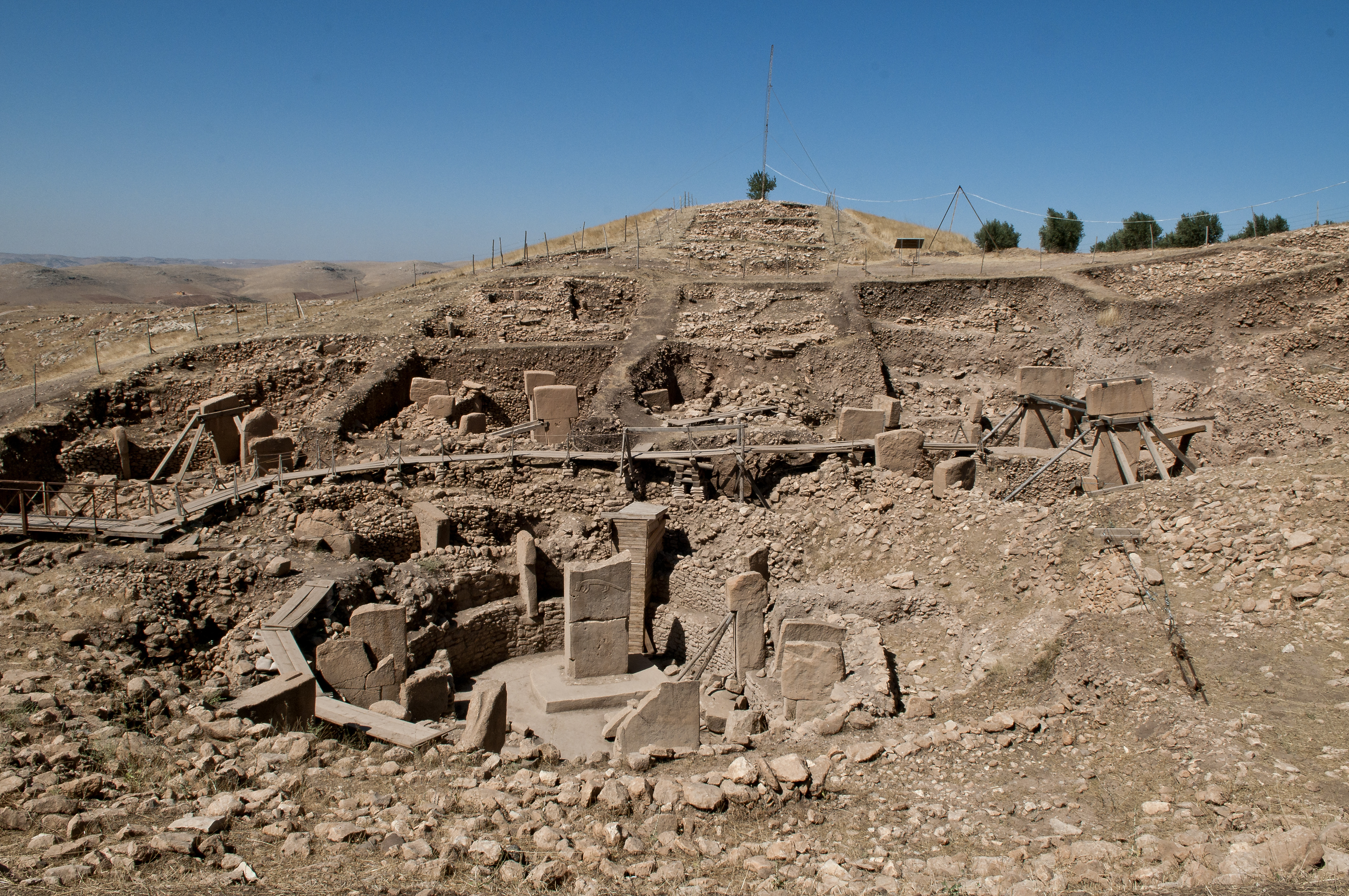
Beneath the sun-scorched plains of southeastern Turkey, where the rolling hills of Anatolia gaze southward toward the Fertile Crescent, lies a monument that quietly dismantled the foundations of modern archaeology. For generations, historians and anthropologists taught a neat, comfortable progression of human history: humanity wandered as primitive hunter-gatherers until the invention of agriculture forced permanent settlements, which then allowed cities to form, labor to specialize, and sacred temples to rise.
In 1994, that entire timeline shattered upon a rounded ridge known locally as Göbekli Tepe—the "Potbelly Hill."
Standing atop this quiet mound near the ancient city of Şanlıurfa, German archaeologist Klaus Schmidt recognized what others had dismissed decades earlier. Beneath the plow of local shepherds lay not a medieval cemetery, but colossal rings of carved limestone pillars erected around 9600 BC. This places the construction of Göbekli Tepe roughly 11,500 years ago—predating Stonehenge by six millennia, the Great Pyramid of Giza by seven thousand years, and the dawn of written history by longer than the span of recorded human civilization.
Most startling of all, Göbekli Tepe was raised before the invention of the wheel, before the domestication of beasts of burden, before pottery, before bronze, iron, or metal chisels, and before the development of organized agriculture. It stands as monumental proof of an unexpected truth: humanity did not build temples because we settled down into farming villages. Humanity gathered to build sacred temples, and in doing so, was compelled to invent civilization.
The Awakening of Potbelly Hill
When Klaus Schmidt first visited the site in the autumn of 1994, he was struck by the countless flint artifacts scattered across the hill. Thousands of finely knapped blades, scrapers, and projectile points littered the surface like fallen leaves. Schmidt noticed the unmistakable contours of carved megaliths poking through the topsoil.
"As soon as I saw it," Schmidt later remarked, "I knew I had two choices: walk away immediately and tell no one, or spend the rest of my life working here."
Schmidt chose the latter. As excavations began, team members uncovered massive circular and oval enclosures, each dominated by two giant T-shaped megaliths at the center, surrounded by a ring of slightly smaller pillars embedded within dry stone walls. Each enclosure spanned between thirty and a hundred feet across.
Geophysical surveys quickly revealed that what Schmidt had unearthed was merely the threshold. Beneath the earth lay at least twenty distinct stone circles comprising more than two hundred towering pillars. Only a tiny fraction of this sprawling megalithic sanctuary has been excavated to this day. The hill was not a natural geographic formation, but a completely artificial mound—a sacred acropolis built, rebuilt, modified, and eventually interred across centuries of devotional labor.
The Architecture of the Stone Giants
The megaliths of Göbekli Tepe are monumental masterworks of Neolithic engineering. Carved directly from the neighboring limestone plateau, single pillars reach heights of up to twenty feet and weigh between ten and twenty tons. In nearby quarries, unfinished pillars measuring nearly thirty feet long still remain fused to the bedrock, silent witnesses to quarrying operations on a scale previously thought impossible for the era.
Without draft animals, metal wedges, or wheeled carts, hundreds of individuals must have collaborated to quarry, carve, transport, and raise these colossal stones using only flint hammers, wooden levers, ropes, and raw physical devotion.
Yet the true marvel of Göbekli Tepe lies in its artistry. The pillars are shaped into stylized "T" forms, which represent anthropomorphic figures. The horizontal beam at the top serves as the head, while the vertical shaft represents the torso. Curiously, these figures possess no facial features—no eyes, mouths, or ears—rendering them enigmatic, supernatural entities that transcend individual human identity.
Along the sides of the pillars, delicate human arms and elongated fingers are carved in low relief, descending from the shoulders to clasp above the belly. Around their waists, the sculptors carved detailed belts fastened with intricate buckles, from which hang loincloths crafted from the skins of foxes. These were not mere architectural supports; they were petrified avatars of ancestral spirits, gods, or primordial mythic beings holding court in stone circles beneath the open sky.
Adorning these towering figures is a menagerie of wildlife carved in astonishing high relief. Unlike the tranquil grazing herds common in later agricultural art, the creatures of Göbekli Tepe are fierce, predatory, and alert. Menacing boars with exposed tusks, snarling lions, leaping foxes, coiled vipers, lunging scorpions, and watchful vultures emerge from the stone with three-dimensional vitality. The level of sculptural mastery demonstrates a sophisticated artistic tradition that must have developed over centuries, if not millennia, prior to the construction of the sanctuary.
The Paradigm Shift: Temple Preceded the City
For more than a century, classical archaeology operated under the paradigm of the Neolithic Revolution formulated by V. Gordon Childe. According to this model, human beings were purely subsistence-driven nomads until the climate warmed after the last Ice Age, permitting the cultivation of wild grasses like emmer and einkorn wheat. Agriculture created food surpluses, food surpluses allowed for permanent villages, villages evolved into towns and cities, and only within wealthy, settled societies did a priestly caste arise to construct monumental religious architecture.
Göbekli Tepe inverted this entire pyramid.
The builders of Göbekli Tepe lived in a world without cultivated fields. The tens of thousands of animal bones recovered from the site belong entirely to wild game: gazelles, aurochs, wild boars, red deer, and migratory birds. There are no traces of domesticated plants or animals in the earliest and most monumental layers of the site.
This means that nomadic hunter-gatherers, moving across vast territories of Upper Mesopotamia, deliberately congregated at this sacred peak. They united their bands, pooled their resources, and engaged in grand cooperative labor not to secure shelter or food, but to honor the unseen realm of the spirit.
To sustain hundreds of builders and pilgrims during monumental construction festivals, these gathering communities began to systematically manage wild cereals on the surrounding hillsides. Genetic research has traced the origin of all modern domesticated einkorn wheat to the slopes of Mount Karaca Dağ, located just sixty miles northeast of Göbekli Tepe. The spiritual impulse to gather at the holy mountain acted as the catalyst that sparked the agricultural transformation of humanity. The sanctuary gave birth to the farm.
Pillar 43: The Vulture Stone and the Sky
Among the dozens of decorated pillars uncovered at Göbekli Tepe, one monolith has captured the imagination of astronomers and mythologists worldwide: Pillar 43 in Enclosure D, commonly known as the "Vulture Stone."
Pillar 43 is an intricate tapestry of relief carvings. At its center stands a prominent vulture with outstretched wings, balancing a round orb upon its wingtip. Below and around the vulture are depictions of a scorpion, a headless human figure, a serpentine form, and several smaller birds and quadrupeds. Along the upper frieze of the pillar sit three distinct "handbags" or arched boxes, topped with animal emblems.
In recent years, researchers including Dr. Martin Sweatman of the University of Edinburgh have conducted detailed archaeoastronomical analyses of Pillar 43. Their research suggests that the animal symbols on the Vulture Stone correspond to specific constellations of the ancient night sky, functioning as an astronomical calendar and date stamp carved in rock.
According to this astronomical interpretation, the central vulture represents the constellation of Sagittarius, the scorpion corresponds to Scorpius, and the circular orb represents the sun at the summer solstice. By matching the celestial alignments depicted on the stone with the precession of the equinoxes, the researchers proposed that Pillar 43 commemorates a cataclysmic cosmic event: the Younger Dryas comet impact around 10,900 BC.
This devastating epoch, marked by global wildfires, rapid climatic cooling, and the mass extinction of Ice Age megafauna, profoundly scarred early humanity. Göbekli Tepe may have been conceived, in part, as an eternal astronomical observatory and temple of remembrance—a monumental ledger where sacred knowledge was carved into stone to warn future generations of the celestial cycles that govern earthly destinies.
Shamanic Rites, Psychopomps, and the Skull Cult
Beyond its astronomical alignments, Göbekli Tepe functioned as the supreme spiritual nexus of Neolithic Anatolia. The absence of domestic hearths, roof structures, or daily living quarters indicates that the hill was not an inhabited village, but a pure pilgrimage sanctuary reserved for sacred rites, initiations, and shamanic communion.
The dominant presence of avian iconography, particularly the vulture, speaks directly to ancient traditions of excarnation and "sky burials." In early shamanic traditions across Eurasia, the vulture was revered as a sacred psychopomp—a benign guide of souls whose role was to consume the flesh of the deceased, liberating the spiritual essence from its mortal vessel and carrying it upward into the celestial realms.
This interpretation is reinforced by archaeological discoveries at the site. Excavators have unearthed fragmented human skull bones bearing deliberate carvings, incisions, and drill holes designed for suspension. This evidence points to a sophisticated "skull cult," wherein the crania of revered ancestors, shamans, or ritual leaders were preserved and displayed within the stone circles, serving as conduits for divination and ancestral wisdom.
In these circular enclosures, illuminated by blazing fire pits beneath the unpolluted night sky, initiates likely participated in ecstatic rituals. Surrounded by the towering stone avatars and the carved forms of predatory spirits, they engaged with the unseen forces of nature, seeking equilibrium between the earthly realm and the mysteries of the cosmos.
The Great Entombment: An Intentional Time Capsule
Perhaps the most baffling enigma of Göbekli Tepe is not how it was constructed, but how it met its end.
Around 8000 BC, after more than a thousand years of continuous ceremonial use, the sanctuary was not abandoned to decay beneath the elements, nor was it destroyed by invading conquerors. Instead, the builders carefully, deliberately, and systematically buried the entire complex.
To entomb an enclosure required an astonishing expenditure of organized labor. Tens of thousands of tons of clean limestone rubble, soil, flint tools, and animal bones were brought from elsewhere to fill the enclosures to their brims, completely covering the twenty-foot pillars and burying the sacred art intact. When one circle was completely buried, a smaller, less monumental enclosure was often built atop it, only to be buried in turn.
Why did our ancestors choose to bury their most sacred temples?
Some scholars speculate that the deliberate entombment was a ritual "funeral" for the temple itself—an act of decommissioning sacred ground once its spiritual cycle had reached completion. Others propose that shifting climatic conditions or religious revolutions led the priests to conceal their ancestral knowledge from a changing world.
By burying their temples beneath mountains of earth, the architects of Göbekli Tepe accomplished something miraculous: they shielded their work from millennia of weathering, seismic destruction, and human vandalism. Intentionally or not, they preserved an immaculate time capsule of humanity's primordial dawn, awaiting the moment when distant descendants would dig into the earth and rediscover their forgotten origins.
The Enduring Mystery of the Navel
The name Göbekli Tepe translates literally to "The Hill with a Navel." In ancient cosmological traditions from Delphi to Heliopolis, the navel or omphalos marked the sacred axis mundi—the central point where heaven, earth, and the underworld intersected.
Göbekli Tepe remains our most profound window into the minds of the ancients. It stands as an enduring monument to human genius, proving that our earliest ancestors were not brutish survivors consumed solely by the struggle for bread, but visionary architects driven by an innate longing for the transcendent. Long before we built cities to govern our bodies, we carved sanctuaries in stone to elevate our souls.
Related Esoteric Inquiries:
- The Mystery of the Carnac Stones: The Breton Alignment, Earth Grid Geometry, and the Megalithic Avenues of Brittany
- Göbekli Tepe: The Temple Older Than Farming That Rewrote the Story of Humankind
- The Mystery of the Shadow Serpent of Chichén Itzá
Lux Esoterica.
2026.


Comments