The Secret of Coral Castle and Edward Leedskalnin
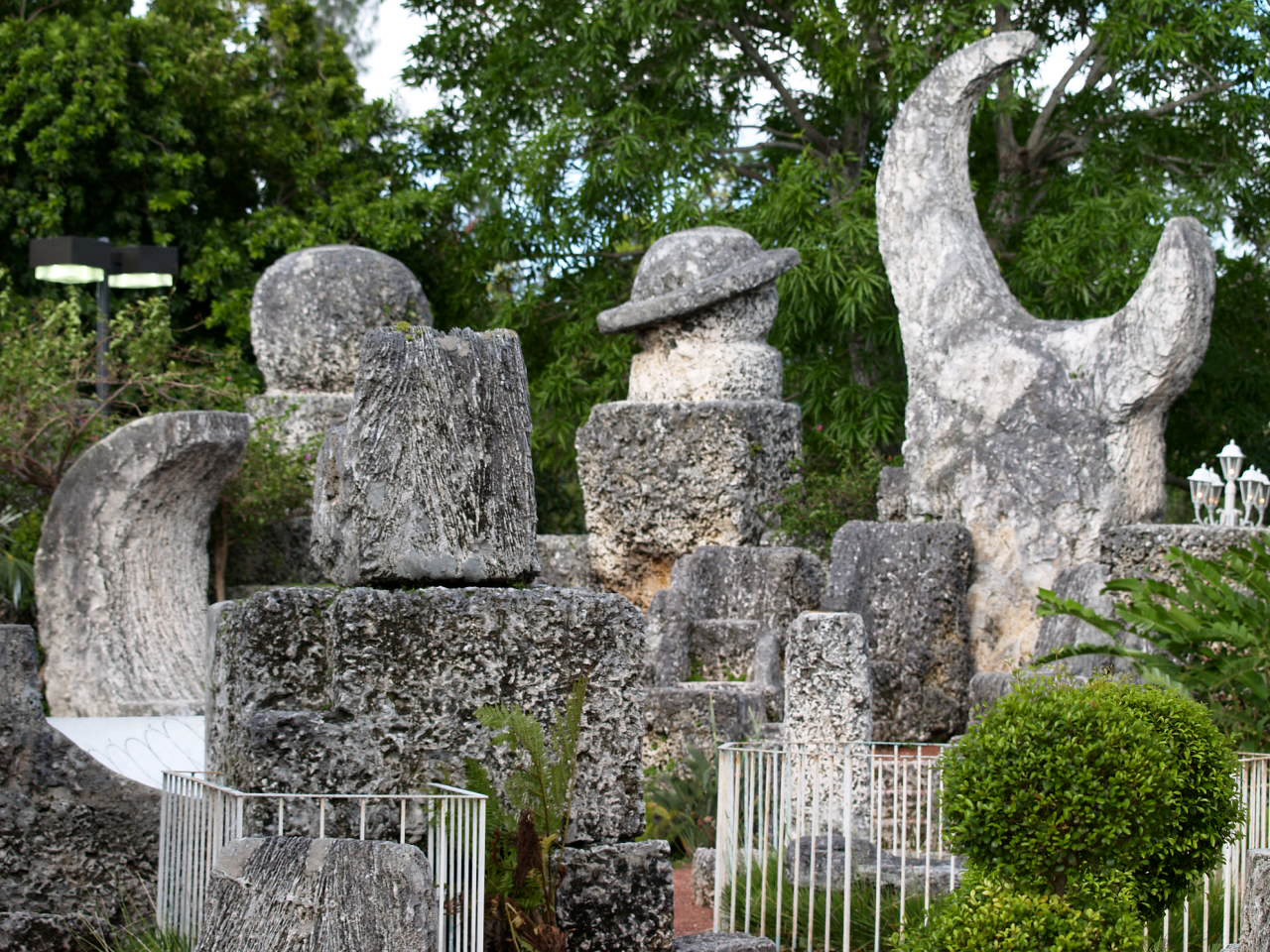
Under the humid skies of southern Florida, where the subtropical flatlands stretch toward the sawgrass of the Everglades, stands an architectural anomaly that defies the conventional canons of modern engineering. Known to the world today as Coral Castle, and dubbed by its creator as Rock Gate Park, this sprawling open-air sanctuary is composed of more than eleven hundred tons of megalithic oolite limestone. Vast monoliths, towering obelisks, celestial crescents, and gargantuan stone furniture stand assembled in silent majesty, their surfaces weathered by the maritime winds.
Yet the true marvel of Coral Castle lies not merely in its monumental aesthetic, but in the incomprehensible circumstances of its creation. Every single block of stone—some weighing upwards of thirty tons, exceeding the heft of the average building blocks of the Great Pyramid of Giza—was quarried, carved, transported, and hoisted into position by a solitary man. His name was Edward Leedskalnin: an impoverished Latvian immigrant who stood barely five feet tall, weighed scarcely one hundred pounds, possessed only a fourth-grade education, and worked without the aid of modern engines, hydraulic cranes, or electrical power.
For decades, orthodox historians and skeptical engineers have attempted to reduce Leedskalnin’s achievement to simple leverage, block-and-tackle rigging, and stubborn human labor. Yet the mathematical scale of the complex, combined with the eyewitness testimonies of those who lived near his secluded compound, points toward a far deeper reality. Edward Leedskalnin did not merely build a private retreat; he demonstrated a practical rediscovery of an ancient, forgotten science—a mastery over terrestrial magnetism, acoustic resonance, and the fundamental polarities of matter that once raised the sacred monuments of antiquity.
The Solitary Architect of Rock Gate Park
Born in Stāmeriena Parish, Latvia, in 1887, Edward Leedskalnin grew up in a family of traditional stonecutters, learning from childhood the innate temperament of quarry stone and timber. His life, however, was fundamentally altered on the eve of his marriage in 1913. His sixteen-year-old fiancée, Agnes Scuffs—whom Ed would forever refer to with reverent longing as his "Sweet Sixteen"—abruptly cancelled the wedding just one day before the ceremony, declaring him too old and too poor.
Devastated by the betrayal, Leedskalnin left his homeland and embarked on a wandering pilgrimage across Western Europe, Canada, and the United States. He worked in logging camps in the Pacific Northwest, laboured in cattle yards in Texas, and gradually moved southeast after contracting a severe case of pulmonary tuberculosis. Believing that a warm climate would halt the progress of his illness, he arrived in Florida City around 1918, purchasing a small parcel of undeveloped land blanketed in wild palmettos and porous coral rock.
It was there, in complete isolation, that Ed began his life’s singular opus. Driven by a blend of romantic devotion and obsessive esoteric inquiry, he resolved to construct a colossal stone castle dedicated to his lost beloved. For over twenty-eight years, spanning his initial work in Florida City and his subsequent relocation to Homestead in 1936, Leedskalnin toiled entirely alone. He possessed no heavy industrial equipment, no steam tractors, and no access to the municipal electric grid. His tools consisted almost entirely of repurposed scrap metal: old automobile leaf springs, discarded iron pipes, hand-forged chisels, and primitive pulleys salvaged from abandoned rail yards.
Despite these severe physical constraints, the frail stonecutter quarried hundreds of thousands of cubic feet of solid limestone from the bedrock of his property, shaping the jagged stone into precise geometric forms and elevating them into towering ramparts that enclosed his solitary world.
Megaliths of the Florida Bedrock
To comprehend the sheer impossibility of Coral Castle, one must examine the physical reality of the stone itself. The material chosen by Leedskalnin is oolitic limestone, formed millennia ago beneath shallow tropical seas from the fossilized remains of marine invertebrates, coral reefs, and microscopic calcium carbonate spheres. It is a dense, abrasive, and extraordinarily heavy stone, weighing approximately one hundred and twenty-five pounds per cubic foot.
The scale of the finished fortress is staggering:
- The outer defensive wall is comprised of massive limestone blocks, each weighing between twelve and fifteen tons, fitted together with interlocking joints that require no mortar to maintain their structural integrity.
- Within the inner courtyard stands a colossal obelisk weighing twenty-eight tons, rising twenty-eight feet into the air—a monolithic pillar that dwarfs the celebrated stones of Stonehenge and required flawless vertical alignment.
- Beside the obelisk stands the Great Polaris Telescope: a twenty-ton monolith towering twenty-five feet high, bored with a slender, perfectly straight aperture containing crossed copper wires that sight directly upon Polaris, the North Star.
- A single monumental megalith—known as the East Wall cornerstone—weighs approximately thirty tons, surpassing the weight of the lintels at Karnak or the heaviest stones of the Temple of the Sun in Ollantaytambo.
- The castle interior features fully functioning stone rocking chairs weighing over a thousand pounds each, balanced so delicately upon their curved bases that a gentle touch sets them rocking smoothly upon the limestone flagstones.
- A stone banquet table, carved in the precise geographical contour of the state of Florida, is accompanied by a water basin filled with fresh rainwater representing Lake Okeechobee, flanked by towering stone thrones carved for Sweet Sixteen, their imaginary child, and an uncomfortable stone "punishment chair" for misbehaving guests.
In total, over eleven hundred tons of solid stone were excavated, sculpted, and positioned without leaving behind the crushed soil, deep wheel ruts, or fractured stone edges that inevitably accompany heavy mechanical hauling.
The Miracle of the Nine-Ton Gate
Perhaps the most celebrated testament to Leedskalnin’s mastery of physics is the legendary Nine-Ton Gate that once served as the primary entrance to the castle grounds. Carved from a single rectangular slab of oolite coral, the gate measures approximately eight feet tall, six feet wide, and nearly two feet thick.
When closed, the gate fits into the surrounding stone wall with a clearance of less than a quarter of an inch on either side—a tolerance so tight that it prevents the passage of a knife blade. Yet despite weighing eighteen thousand pounds, the gate was hung with such supernatural equilibrium that a five-year-old child could push it open with the gentle pressure of an index finger.
For decades, visitors and physicists marveled at the effortless motion of the massive stone, which turned smoothly along its central vertical axis without catching or scraping. The secret of its movement remained hidden within the stone itself until 1986, long after Ed’s death, when the gate finally ceased rotating due to decades of internal wear.
To repair the mechanism, a specialized team of mechanical engineers and restoration experts was assembled. The restoration crew required a twenty-ton hydraulic crane, heavy steel hoisting rigs, and a team of twelve skilled workmen just to extract the gate from its frame. Upon removing the monolithic slab, the engineers uncovered Ed’s ingenious, minimalist design: he had bored a perfectly vertical hole through the entire eight-foot height of the nine-ton stone, inserting a discarded iron shaft salvaged from a Model T Ford axle. The shaft rested upon a subterranean automotive wheel bearing seated within a hollowed flint stone, with no grease or lubrication other than the natural balance of gravity and friction.
Modern engineers replaced the rusted bearing and reinstalled the stone using state-of-the-art laser levels and digital measuring instruments. Yet, to their profound embarrassment, once reinstalled, the gate never rotated with the same frictionless, whisper-soft grace that Ed had achieved half a century earlier with nothing more than hand tools and an unyielding intuition for the centre of mass.
The Nocturnal Mystic and the Singing Stones
Throughout his three decades of construction, Edward Leedskalnin adhered to an unshakeable protocol of absolute secrecy. He worked almost exclusively under the cloak of night, labouring by the flickering light of kerosene lanterns when the rest of the world was asleep.
Ed possessed an uncanny sixth sense for observation. Whenever curious neighbors, wandering tourists, or local children attempted to spy on him over the wooden palisade he had erected around his workshop, he would instantly sense their gaze. Without turning around, he would cease all activity, fold his thin arms across his chest, and stand perfectly motionless like a stone sentinel until the onlookers became uncomfortable and retreated into the darkness.
The few individuals who managed to catch fleeting glimpses of his nightly labors reported phenomena that defied all conventional understanding:
Several local boys, climbing an avocado tree adjacent to the property line, claimed they saw massive coral monoliths hovering horizontally through the air "like hydrogen balloons," floating into position as though gravity had ceased to exert its downward dominion.
Other neighbors living along the rural outskirts of Homestead reported hearing strange, melodic sounds emanating from the castle grounds at two or three in the morning. They described hearing Ed singing or chanting strange, repetitive melodies in low, guttural tones, accompanied by high-pitched metallic humming and acoustic whistling that vibrated through the limestone bedrock.
Whenever Ed was observed moving his colossal blocks across the grounds, he made use of a massive tripod constructed from forty-foot telephone poles and heavy fir timbers, lashed together at the apex with thick manila rope. Suspended from the very peak of this tripod hung a mysterious, enclosed wooden box—a container Ed guarded with ferocious jealousy and referred to as his "sweet sixteen apparatus." He never allowed a living soul to look inside the box, and whenever he climbed the rigging to adjust its contents, he did so with the utmost care, manipulating concealed levers and copper coils before descending to the earth.
The Lost Secret of the Ancients
Leedskalnin was neither modest nor cryptic regarding the origin of his abilities. When asked directly by visitors, reporters, and skeptical academics how a frail, solitary man could quarry, lift, and carve megalithic blocks that baffled modern civil engineers, Ed offered a simple, audacious answer that sent shockwaves through orthodox circles:
"I have discovered the secrets of the pyramids, and have found out how the Egyptians and the ancient builders in Peru, Yucatan, and Asia, with only primitive tools, raised and set in place blocks of stone weighing many tons!"
Ed did not attribute his accomplishment to mythological deities, celestial visitors, or occult sorcery. Instead, he insisted that the monumental builders of antiquity—the architects of the Great Pyramid of Khufu, the cyclopean masons of Sacsayhuamán, the builders of the temple platforms at Baalbek, and the sculptors of Easter Island—were masters of a practical, physical science that modern civilization had fundamentally misunderstood.
In Ed’s view, the conventional academic narrative of human history was fatally flawed. Modern historians envisioned thousands of enslaved laborers dragging multi-ton stones across wooden sledges, pulling ropes over mud ramps, and exhausting themselves with brute mechanical force. Ed knew from direct personal experience that such methods were not only inefficient, but mathematically and practically unfeasible for the precision seen in cyclopean architecture. The ancients, he maintained, did not fight gravity through violent kinetic resistance; they neutralized it by mastering the universal circulation of terrestrial currents.
The Doctrine of Magnetic Current
To understand Leedskalnin’s worldview, one must study his self-published treatises, most notably Magnetic Current, printed in 1945, alongside his shorter essays Mineral, Vegetable and Animal Life and Magnetic Base. Written in terse, crystalline English, these texts outline an esoteric physics that directly challenges the orthodox atomic model established by twentieth-century academia.
Leedskalnin rejected the notion of electrons, protons, and static atomic structures. Instead, he posited that the entire material cosmos is composed of two primary, dynamic forces: North and South individual magnetic poles. In Ed’s cosmology:
- Magnetic Monopoles: Magnetism does not consist of static fields, but of microscopic, indivisible particles that exist in two polar forms—North-seeking and South-seeking magnets. These particles are smaller than light waves and possess an innate, perpetual orbital motion.
- The Dual Spiral: These North and South magnetic particles circulate continuously throughout all matter, metals, atmosphere, and the planet itself. They do not travel in straight trajectories, but in opposing, interlocking helical vortices, spiraling against one another like the serpents of the ancient caduceus.
- The True Nature of Gravity: Gravity is not an independent fundamental force, nor is it the curvature of space-time. Rather, terrestrial gravity is the net equilibrium produced by the continuous, downward percolation of cosmic magnetic currents toward the iron core of the Earth, counterbalanced by the upward ascent of opposing terrestrial currents.
- The Principle of Magnetic Neutralization: By establishing a localized, sympathetic magnetic field within a dense body of matter, an adept can alter the flow of the internal North and South poles within the crystalline lattice of the stone. When the internal circulation of the stone is brought into harmonious phase-opposition with the ambient terrestrial magnetic field, the stone's gravitational affinity is momentarily severed. Weight is transformed into buoyancy; the dense megalith becomes as light as cork upon water.
Ed constructed homemade magnetic flywheels, direct-current generators wound with miles of copper wire, and tuned magnetic accumulators inside his secluded workshop. By combining high-amperage, pulsed direct currents with acoustic harmonic frequencies—vibrating the quartz crystals and calcite minerals within the oolite limestone through humming and sound resonance—he was able to temporarily disengage the stone from the gravitational matrix of the Earth.
The Grand Relocation to Homestead
In 1936, a dramatic event provided ultimate proof that Leedskalnin’s techniques were systematic, reliable, and entirely repeatable. Learning that a major highway expansion and a new residential subdivision were planned near his Florida City property, Ed resolved to relocate his entire megalithic compound ten miles north to the rural town of Homestead.
To accomplish this monumental migration, Ed contracted a local truck driver who owned a heavy-duty flatbed chassis. The logistics of the move were conducted under the same strict conditions of secrecy that characterized all of Ed’s endeavors.
Each morning, the driver would back his empty flatbed truck into the Florida City courtyard and depart, having been instructed by Ed to return in several hours. When the driver returned, a massive, thirty-ton coral block was sitting perfectly centered upon the chassis, without the truck’s wooden frame exhibiting any marks of crushing impact, drag friction, or mechanical winching. The driver would then haul the load ten miles north to the Homestead parcel, park the truck, and leave once more. Upon returning an hour later, the megalith would be completely unloaded, resting effortlessly in its new assigned location within the growing fortress walls.
Over the course of three years, Ed moved more than eleven hundred tons of megalithic stone across the Florida countryside. Not a single stone was cracked, chipped, or dropped. The entire fortress of Rock Gate Park was reassembled in Homestead with flawless geometric alignment, incorporating new astronomical observatories, larger living quarters, and monumental carved stone courts.
The Undying Legacy of a Modern Master
In December 1951, feeling his health deteriorating rapidly from advanced stomach cancer, Edward Leedskalnin closed the heavy gates of his castle, hung a simple sign reading "Going to the Hospital," and took a local bus to Jackson Memorial Hospital in Miami. A few days later, on December 7, 1951, he passed away peacefully in his sleep at the age of sixty-four.
He died as he had lived: modest, penniless, and entirely self-contained. He left behind no heirs, no formal blueprints, and no surviving apprentices. When investigators entered his private living quarters—a modest second-story wooden cabin perched atop the monolithic stone tool room—they found only a simple canvas cot, a few hand-forged tools, several notebooks filled with cryptic calculations on magnetic polarity, and thirty-five hundred dollars in cash representing the accumulated ten-cent admission fees he had collected from curious tourists over thirty years.
The mysterious wooden box atop his forty-foot derrick was nowhere to be found, having been dismantled or concealed by Ed prior to his departure.
Today, Coral Castle remains an unyielding challenge to the limitations of modern materialism. It stands as living, undeniable proof that the monumental architecture of the ancient world was not the byproduct of mechanical brutality, but the triumphant realization of an elegant, forgotten science. Through the harmonious marriage of geometry, polarity, acoustic vibration, and human willpower, a solitary, frail man unlocked the ancient harmonic frequencies of the Earth, demonstrating that human consciousness, when aligned with the living currents of the cosmos, possesses the power to command the very stones beneath our feet.
Related Esoteric Inquiries:
- The Mystery of the Coral Castle: Edward Leedskalnin's Magnetic Generator
- The Enigma of Coral Castle: Edward Leedskalnin's Anti-Gravity Secrets
- The Mystery of the Coral Castle: Edward Leedskalnin and the Magnetic Current
Lux Esoterica.
2026.


Comments