The Secret of the Mithraic Mysteries and the Sacred Bull
During the height of the Roman Empire, from the first through the fourth centuries AD, a secret and powerful brotherhood spread across the ancient world. From the sun-baked sands of Syria and the bustling ports of Ostia to the remote, rain-swept garrisons along Hadrian’s Wall in northern Britain, Roman legionnaires, imperial administrators, and aristocratic initiates gathered under the cover of night.
They did not assemble in sunlit public temples or opulent basilicas. Instead, they descended into the subterranean dark of windowless underground chambers known as Mithraea (singular: Mithraeum).
Inside these artificial caves, lit only by flickering oil lamps and surrounded by vaulted stone ceilings painted with stars and constellations, they practiced the Mithraic Mysteries—a secret initiatory religion centered on the worship of the invincible solar deity Mithras (Sol Invictus Mithras).
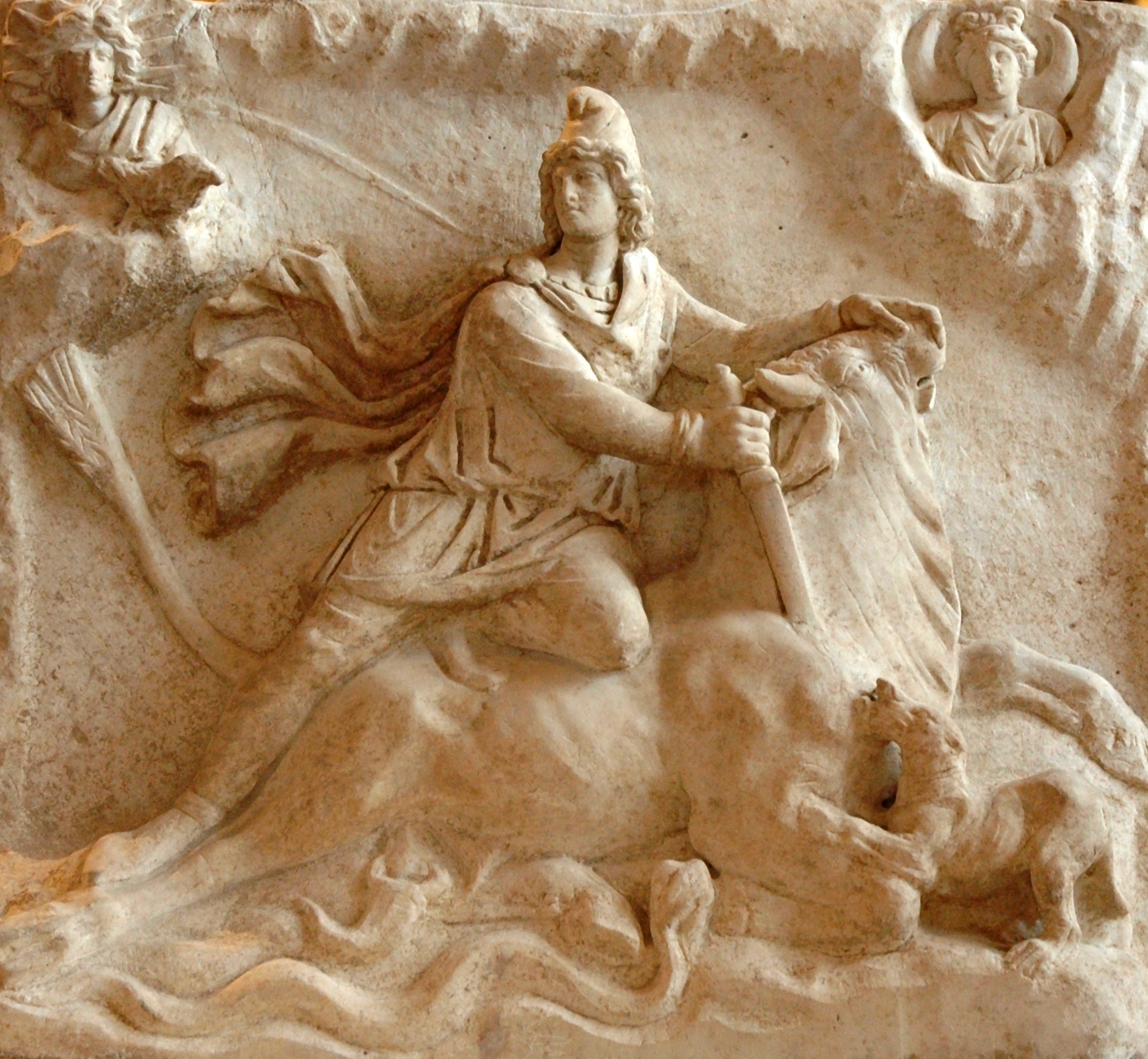
At the focal point of every single Mithraeum stood a powerful, recurring stone relief that has fascinated historians and occultists for centuries: the Tauroctony, the dramatic scene of Mithras slaying a great celestial bull.
What was the hidden meaning of this ritual sacrifice? Why did Roman soldiers swear binding oaths of silence in subterranean caves, and how did modern astronomical research unlock the cosmic secret coded into the stone carvings? To uncover the truth, we must descend into the underground sanctuaries of Rome.
The Architecture of the Cosmic Cave
Unlike classical Greco-Roman temples designed to impress external crowds with towering marble columns, a Mithraeum was deliberately concealed from the outside world. It was designed from the ground up as a physical model of the universe—a miniature, self-contained cosmos (Cosmic Cave):
- Subterranean Seclusion: Shrines were either excavated directly into natural caverns, built into the basements of private villas, or constructed half-underground without windows.
- The Central Nave: A sunken central aisle flanked by raised stone or masonry benches running along the side walls, where initiates reclined during sacred banquets.
- The Vaulted Ceiling: The arched roof was painted deep blue and decorated with gold leaf to represent the night sky, embedded with niches holding lamps to mimic the seven planets and the twelve signs of the zodiac.
- The Altar of the East: At the far end of the sanctuary stood the high altar, illuminated by lamps, showcasing the central icon of the cult: the Tauroctony.
The fourth-century philosopher Porphyry, in his treatise On the Cave of the Nymphs, explained that the cave represented the physical universe created by Mithras, the cosmic father and maker of all things, who placed the planets and stars in their proper harmonic order.
Anatomy of the Tauroctony: A Celestial Star Map
The central relief of the Tauroctony depicts a scene charged with dynamic, violent, and symbolic energy:
- The God and the Bull: Mithras, depicted as a vigorous young man wearing a flowing cape and a conical Phrygian cap, kneels on the back of a massive white bull. He pulls back the bull’s head by its nostrils with his left hand while plunging a dagger deep into its shoulder with his right.
- The Turned Gaze: Notably, Mithras does not look at the animal he is slaying. Instead, he turns his head away, looking over his shoulder toward the Sun god, Sol, who shines in the upper left corner of the relief.
- The Cosmic Companions: A dog and a snake leap upward to drink the life-giving blood flowing from the bull's wound. A scorpion attacks the bull's genitals from below. A raven—the divine messenger of Sol—perches upon the edge of Mithras's billowing cloak.
- The Wheat of Life: Emerging directly from the tip of the dying bull’s tail is a cluster of ripe ears of wheat, symbolizing that from the sacrificial death of the bull springs the physical sustenance of all life on Earth.
For decades, conventional historians interpreted the scene as a primitive fertility ritual. However, in the late twentieth century, the classical scholar and astronomer David Ulansey published a groundbreaking scientific analysis that completely revolutionized our understanding of the cult.
Ulansey demonstrated that every single figure in the Tauroctony corresponds with mathematical precision to an astronomical constellation along the celestial equator:
- The Bull: The constellation Taurus.
- The Dog: Canis Minor or Canis Major.
- The Snake: Hydra, the great water serpent.
- The Raven: Corvus, the celestial crow.
- The Scorpion: Scorpius.
- The Wheat: The bright star Spica in the constellation Virgo.
The Secret of Precession: The God Who Moves the Heavens
Why would a Roman mystery cult dedicate its central religious icon to a map of the constellations?
Around 128 BC, the great Greek astronomer Hipparchus of Rhodes made a discovery that shattered the ancient understanding of the cosmos: the Precession of the Equinoxes. Hipparchus discovered that the entire sphere of fixed stars is not completely static; rather, due to a slow, wobbling motion of the Earth's axis, the position of the equinoxes shifts backwards through the zodiac over a massive cycle of approximately 25,920 years (a "Great Year").
To the ancients, this discovery was terrifying. If the fixed stars could move, it meant that an immense, unimaginable cosmic force existed beyond the sphere of the stars, powerful enough to move the entire cosmic vault itself.
In the astronomical framework of the time:
- During the ancient Golden Age (circa 4000–2000 BC), the spring equinox occurred in the constellation of Taurus the Bull.
- Due to precession, the celestial spring equinox shifted out of Taurus and entered Aries the Ram.
The Mithraic initiates identified Mithras as the supreme hyper-cosmic divinity—the Kosmokrator (Ruler of the Universe)—whose divine power was so immense that he physically moved the celestial equator, ending the Age of the Bull and initiating a new cosmic aeon. By "slaying the bull," Mithras did not kill an animal; he demonstrated his absolute sovereignty over the astronomical architecture of the cosmos itself.
The Twin Torchbearers: Cautes and Cautopates
Flanking the central Tauroctony scene in every Mithraeum were two smaller figures dressed identically to Mithras, known as the torchbearers:
- Cautes: Stands with his legs crossed, holding a lit torch pointed upward toward the sky. He represents the rising sun, the morning light, the vernal (spring) equinox, heat, life, and the ascent of the soul into the celestial spheres.
- Cautopates: Stands with his legs crossed, holding a lit torch pointed downward toward the earth. He represents the setting sun, the evening twilight, the autumnal equinox, cold, physical death, and the descent of the soul into earthly incarnation.
Together with Mithras (who represents the radiant midday sun at the equilibrium point), they form a cosmic trinity symbolizing the eternal cycle of time, light and shadow, and the soul's journey through the material universe.
The Seven Grades of Initiation
Initiation into the Mithraic Mysteries was a rigorous, step-by-step process of spiritual and psychological transformation. The cult was strictly hierarchical, divided into Seven Grades, each under the direct tutelage of one of the seven classical planetary spheres:
- Corax (The Raven - Mercury): The entry grade. The initiate wore a raven mask, serving food during the ritual feasts and learning the foundational laws of the sanctuary.
- Nymphus (The Bridegroom - Venus): The initiate wore a veil and carried a lamp, symbolizing the mystical marriage of the soul to divine wisdom.
- Miles (The Soldier - Mars): The warrior grade. The initiate was offered a crown on the point of a sword, which he was required to push away, declaring: "Mithras alone is my crown!" From that moment on, he was consecrated to selfless duty and spiritual combat.
- Leo (The Lion - Jupiter): The grade of fire. The initiate’s hands and tongue were purified not with water, but with sacred honey, symbolizing the sweetness of divine truth and the burning fire of the spirit.
- Perses (The Persian - Moon): The initiate carried a scythe or sickle, symbolizing his role as a harvester of sacred knowledge.
- Heliodromus (The Sun-Runner - Sun): The initiate wore a radiant halo or solar crown, acting as the living earthly representative of the Invincible Sun.
- Pater (The Father - Saturn): The supreme spiritual authority of the Mithraeum. The Pater wore red robes, carried a pastoral staff (crozier), and wore a ring of authority, overseeing the initiation and spiritual development of the entire brotherhood.
Through these seven grades, the initiate systematically cleansed his soul of the astrological vices associated with each planetary sphere, achieving spiritual liberation (Apotheosis) and freeing himself from the fatalistic grip of earthly destiny (Heimarmene).
The Lion-Headed God and the Keys of Eternity
In the deepest, most secluded niches of certain Mithraea stood another chilling and enigmatic statue: the Leontocephaline (the Lion-Headed Deity, often associated with Aion or Arimanius).
This terrifying figure possessed the body of a muscular man and the head of a roaring lion. A great serpent was coiled six times around his torso, its head resting over the lion's crown. The figure possessed four wings representing the four seasons, held two heavy keys in his hands, and stood atop a celestial globe marked with the signs of the zodiac.
In esoteric doctrine, this figure represented Infinite, Eternal Time (Aion) and the cosmic gatekeeper of the planetary spheres. The keys in his hands unlocked the gates of heaven and hell, reminding the initiate that only those who had mastered their animal passions could pass through the serpent-coiled rings of time into the timeless eternity of the divine.
The Sacred Banquet and the Solar Legacy
The culminating rite of the Mithraic brotherhood was the Sacred Banquet. Initiates reclined on the cushioned benches along the sides of the cave to share a consecrated meal of bread and wine (or water), commemorating the legendary feast that Mithras shared with the Sun god Sol atop the hide of the slain bull before ascending to heaven in a flaming chariot.
By sharing this consecrated meal in the subterranean dark, the brothers affirmed their unbreakable bond of loyalty, mutual protection, and spiritual equality, united under the eternal banner of Sol Invictus.
The Eternal Flame of the Sun
When Christianity became the official state religion of the Roman Empire in the late fourth century, the Mithraic sanctuaries were systematically targeted, destroyed, or buried beneath newly constructed churches. Under the Basilica of San Clemente in Rome, the original third-century Mithraeum still lies preserved in the subterranean dark, its stone altar and benches intact beneath layers of Christian history.
Yet the archetypes of Mithraism—the eternal victory of light over darkness, the celebration of the rebirth of the Invincible Sun on December 25th (the winter solstice), and the journey of the soul through the celestial spheres—became permanent pillars of the Western esoteric tradition.
Mithras remains an immortal symbol of the human will: the spiritual warrior who descends into the darkest caverns of existence, takes hold of the cosmic forces of nature, and turns the wheel of the universe toward the light.
Lux Esoterica.
2026.


Comentarios