Angkor Wat: The Cosmic Temple of the Khmer Empire
Angkor Wat — built between approximately 1113 and 1150 CE by the Khmer king Suryavarman II — is the largest religious monument ever constructed, covering an area of approximately 400 acres. It was built as a state temple dedicated to Vishnu and simultaneously as a funerary monument for Suryavarman himself — the king as divine mediator between heaven and earth, his temple the axis mundi of the Khmer universe. Its five towers represent the five peaks of Mount Meru, the cosmic mountain at the center of the Hindu and Buddhist universe; its surrounding moat represents the ocean at the world's edge; its galleries, covered in the most extensive bas-relief program in the history of art, depict the cosmic battles of Hindu mythology and the king's own military victories — the two made equivalent. When the French naturalist Henri Mouhot described Angkor in 1860, he struggled to find an adequate comparison: greater than anything left by Greece or Rome, he wrote, a monument to which nothing in the known world corresponds.
 [Unavailable: ❌ https://upload.wikimedia.org/wikipedia/commons/thumb/2/25/Angkor_Wat_with_its_reflection_%28cropped%29.jpg/250px-Angkor_Wat_with_its_reflection_%28cropped%29.jpg ❌]
Angkor Wat and its reflection in the western moat — the 190-meter-wide moat that surrounds the entire complex represents the cosmic ocean; at dawn, the temple's five towers are reflected in still water that mirrors the sky, creating an image of the cosmos contemplating itself
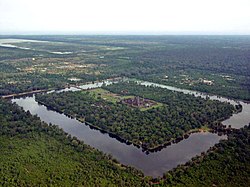 [Unavailable: ❌ https://upload.wikimedia.org/wikipedia/commons/thumb/5/5d/Angkor-Wat-from-the-air.JPG/250px-Angkor-Wat-from-the-air.JPG ❌]
Angkor Wat from the air — the complete cosmological plan is visible only from above: the rectangular moat, the processional causeway approaching from the west, the three concentric galleries representing the mountain ranges of the cosmic universe, and the five towers at the center representing Mount Meru's peaks
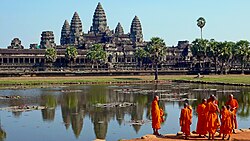 [Unavailable: ❌ https://upload.wikimedia.org/wikipedia/commons/thumb/f/f5/Buddhist_monks_in_front_of_the_Angkor_Wat.jpg/250px-Buddhist_monks_in_front_of_the_Angkor_Wat.jpg ❌]
Buddhist monks at Angkor Wat — the temple was originally Hindu (Vaishnavite), then converted to Theravada Buddhism in the 14th century; it is today the only Angkor monument still actively used as a working Buddhist temple; the orange robes of the monks against the grey sandstone is a living demonstration of the continuity between the original builders' intentions and the present
 [Unavailable: ❌ https://upload.wikimedia.org/wikipedia/commons/thumb/2/28/View_of_the_West_Entrance_of_Angkor_Wat_by_Delaporte_1873.jpg/250px-View_of_the_West_Entrance_of_Angkor_Wat_by_Delaporte_1873.jpg ❌]
The western entrance by Louis Delaporte (1873) — French explorers of the 19th century documented Angkor in drawings and photographs before the vegetation could be cleared; the romantic image of the jungle reclaiming the sacred — tree roots threading through carved stone — became one of the defining images of archaeological exploration
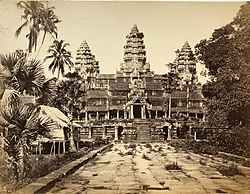 [Unavailable: ❌ https://upload.wikimedia.org/wikipedia/commons/thumb/9/93/Angkor1866.jpg/250px-Angkor1866.jpg ❌]
Angkor Wat, 1866 photograph — among the earliest photographs of the temple, taken during the French colonial survey; the scale and complexity of Angkor defeated the initial capacity of European scholarship to date or explain it; early estimates placed it at 2,000 years old; it is in fact approximately 900 years old — still extraordinary, but a different kind of extraordinary
 [Unavailable: ❌ https://upload.wikimedia.org/wikipedia/commons/thumb/d/d0/AngkorWat_Delaporte1880.jpg/250px-AngkorWat_Delaporte1880.jpg ❌]
Interior gallery by Delaporte (1880) — the 800-meter continuous bas-relief of the third gallery is the longest in the world; it depicts scenes from Hindu mythology (the Churning of the Ocean of Milk, the Battle of Lanka) and from the historical reality of Suryavarman's court and campaigns; myth and history occupy the same visual register
 [Unavailable: ❌ https://upload.wikimedia.org/wikipedia/commons/thumb/3/3f/Angkor_Wat_naga_and_guardian_lion.JPG/250px-Angkor_Wat_naga_and_guardian_lion.JPG ❌]
Naga and guardian lion, Angkor Wat — the seven-headed serpent (naga) that lines the processional causeway represents the rainbow bridge between the human world and the divine; the naga is simultaneously a protective entity and a cosmological statement: the path to the sacred center passes through the serpent's domain
 [Unavailable: ❌ https://upload.wikimedia.org/wikipedia/commons/thumb/d/d2/Statue_in_Cambodia.jpg/250px-Statue_in_Cambodia.jpg ❌]
Guardian statue, Angkor Wat — the dvarapala (door guardian) figures that protect every threshold of the temple complex; in Hindu-Buddhist cosmology, sacred space requires protection at every transition point between ordinary and sacred; the guardian is not merely a sentinel but a theological statement about what kind of space lies beyond
 [Unavailable: ❌ https://upload.wikimedia.org/wikipedia/commons/thumb/8/82/Angkor_Vat_%286931599619%29.jpg/250px-Angkor_Vat_%286931599619%29.jpg ❌]
The towers at dawn — the five towers of Angkor Wat align with the five brightest stars of the Pleiades at spring equinox; Eleanor Mannikka's astronomical analysis demonstrated that the temple's entire architectural program encodes astronomical cycles in its measurements, making it simultaneously a monument, a calendar, and an observatory
Related Esoteric Inquiries:
- Garuda: The Divine Eagle, Mount of Vishnu and Destroyer of Illusion
- Sacred Architecture: How Cathedrals, Temples, and Pyramids Encode the Divine
- Hindu Deities: The Great Pantheon of the Eternal Religion
Lux Esoterica.
2026.


Comments