Hindu Deities: The Great Pantheon of the Eternal Religion
Hinduism is not a religion with one God. It is a religion with one Reality — Brahman, the infinite, attributeless ground of all existence — expressed through an inexhaustible multiplicity of divine forms, each one a specific face of the Absolute, each accessible to particular temperaments, situations, and spiritual needs. The 33 principal devas of the Vedic tradition have expanded, through three thousand years of living theology, into a pantheon of extraordinary richness: creator and destroyer, mother and warrior, wisdom and abundance, the cosmic dancer and the still witness. To worship Ganesha is not to worship a different god than the devotee of Kali — both are worshipping Brahman, through the form that speaks most directly to their heart. The diversity is not polytheism in the Western sense. It is the recognition that the Infinite cannot be confined to a single face.

The Sri Yantra — the geometric form of the Goddess herself; nine interlocking triangles (five pointing down for Shakti, four pointing up for Shiva) generating 43 smaller triangles; the visual representation of the cosmos as the union of divine masculine and feminine
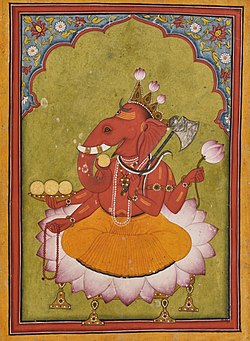
Ganesha — Basohli miniature, c. 1730; the elephant-headed son of Shiva and Parvati, remover of obstacles and lord of beginnings; no undertaking in Hindu practice begins without invoking Ganesha, the deity who clears the path

Vishnu — from the Gita Govinda manuscript; the preserver of the cosmos, blue-skinned, bearing the conch (sound of creation), discus (cosmic wheel), lotus (purity), and mace (authority); he descends as an avatar in every age when dharma is threatened

Shiva — the great ascetic and cosmic dancer; simultaneously destroyer and regenerator, the most paradoxical of the Hindu deities: lord of yoga and of ecstasy, of time and of the timeless, of creation through destruction

Durga Mahisasuramardini — the Goddess slaying the buffalo demon Mahishasura; Durga is the supreme power (shakti) of the divine, summoned when the gods themselves cannot defeat the forces of chaos; her ten arms bear the weapons given by every god

Parvati with Ganesha — the mountain goddess, consort of Shiva and mother of Ganesha; Parvati represents the benign, accessible face of the divine feminine — the goddess as mother, lover, and partner in the cosmic dance

Lakshmi — by Raja Ravi Varma, 1896; the goddess of wealth, fortune, and beauty, consort of Vishnu; she stands on a lotus, golden coins flowing from her hands, flanked by elephants — abundance as a divine quality, not merely a material one

Saraswati — the goddess of learning, music, art, and wisdom; she carries the veena (lute), the Vedas, a mala (rosary), and a lotus; her vehicle is the swan, symbol of discernment — the ability to separate the real from the unreal, milk from water


Comentarios