Aromatherapy and Essential Oils: The Ancient Science of Healing Through Scent
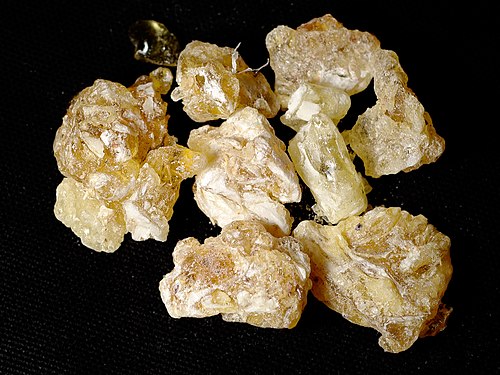
Frankincense resin from Boswellia sacra — one of the most sacred aromatic substances in human history, burned in temples from ancient Egypt to medieval cathedrals, traded along the Incense Route for millennia, and now confirmed by modern research to carry genuine anti-inflammatory and psychoactive properties
The oldest pharmacy in the world is a forest. Before chemistry extracted and synthesized the active compounds in plants, before modern medicine catalogued their molecular mechanisms, human beings learned through millennia of intimate contact that certain plants — burned, infused, extracted, applied to the skin — could alter states of body and consciousness. The resin of the frankincense tree, burned in the temple, opened the mind to the sacred. The lavender growing wild on the hillside, crushed between the fingers, calmed the nervous system. The peppermint leaf, distilled in the ancient alembic, cleared the head and eased the gut.
Aromatherapy — the therapeutic use of essential oils extracted from plants — is in its modern form a relatively young discipline. The word itself was coined by the French chemist René-Maurice Gattefossé in 1937, following a laboratory accident in which he plunged a burned hand into a nearby vat of lavender oil and found that the burn healed with unusual speed and without infection. His subsequent research established the first systematic Western scientific framework for the therapeutic properties of aromatic plant extracts.
But Gattefossé was not discovering something new. He was rediscovering, in the language of modern chemistry, a tradition that human civilization had never entirely abandoned — one that reaches back to the earliest records of medicine, religion, and daily life, and that carries at its center a philosophical understanding of the relationship between plant, human being, and the living world that goes far beyond what can be captured in a clinical trial.
Ancient Roots: Egypt, Mesopotamia, and the Sacred Smoke
The use of aromatic plants in healing and ritual is documented in the earliest written records of civilizations that kept records. The Ebers Papyrus (c. 1550 BCE), one of the oldest surviving medical texts from ancient Egypt, contains hundreds of prescriptions using aromatic plants — frankincense, myrrh, cassia, juniper — for conditions ranging from skin disease to digestive complaints to emotional disturbances.
For the Egyptians, the aromatic was inseparable from the sacred. The word kyphi (κῦφι in Greek) referred to a complex ritual incense blend — up to sixteen ingredients, including frankincense, myrrh, cinnamon, juniper, and wine — burned in the temples of Ra and Osiris at sunset. Plutarch, writing about Egyptian religious practice, noted that kyphi was believed to ease anxiety, induce pleasant dreams, and open the mind to the divine. It was both medicine and prayer, simultaneously addressing body and soul because, in Egyptian understanding, these were not separate.
Myrrh — the resin of Commiphora myrrha — was among the most sacred substances in the ancient world. It was used in the mummification process, burned as incense in temple rites, and carried as medicine throughout the ancient Mediterranean trade networks. Together with frankincense, it was one of the gifts carried by the Magi to the child Jesus — not simply luxury items but bearers of specific symbolic and practical meaning: frankincense for the divine, myrrh for mortality and healing.
In Mesopotamia, aromatic plants were used in the medicine of the asipu (physicians who worked at the intersection of the physical and the spiritual). Clay tablets from the Royal Library of Nineveh document the use of aromatic cedar, cypress, myrtle, and juniper in medical practice that understood illness as simultaneously physical and spiritual — a disruption of the patient's relationship to the divine order, requiring remedies that addressed both levels.
Avicenna and the Birth of Distillation
The modern essential oil — the highly concentrated aromatic extract obtained by steam distillation — is largely the creation of Ibn Sina (known in the West as Avicenna, 980–1037 CE), the great Persian polymath whose Canon of Medicine (Al-Qanun fi al-Tibb) became the standard medical text in Europe and the Islamic world for six centuries.
Ibn Sina refined and systematized the distillation process that would make essential oils possible: the passage of steam through plant material, which volatilizes the aromatic compounds and carries them into a condensing coil where they separate from the steam as a concentrated oil floating on hydrosol (aromatic water). The first oil he is credited with distilling was rose — an achievement that allowed the precise capture of the rose's volatile aromatic compounds at a concentration impossible through any previous method.
Before distillation, aromatic preparations were primarily infused oils (aromatic plants macerated in vegetable carrier oils), resins burned directly, and hydrosols (aromatic waters). Distillation fundamentally changed the therapeutic and commercial landscape of aromatics: it allowed an extraordinary concentration of active compounds, created products with far greater stability and transportability than plant material, and opened the door to the systematic investigation of each plant's distinctive aromatic signature.
Ibn Sina's contribution to aromatherapy, in the tradition's own telling, was not merely technical. As a physician who worked within a cosmology in which body and spirit were understood as aspects of a unified being, his approach to aromatic medicine was holistic in the original sense: addressing the patient as a whole person, in relationship to the natural world, within a framework in which the healing properties of plants were understood as expressing qualities that mirrored and could rebalance corresponding qualities in the human constitution.
The Alchemical and Esoteric Dimension

Lavender — Lavandula angustifolia — the most studied and most widely used essential oil in modern aromatherapy: its calming, analgesic, and antimicrobial properties are among the best-documented in the clinical literature, and its connection to the seventh chakra (crown) and to spiritual purification runs through the medieval European herbal tradition
Paracelsus (1493–1541), the Swiss-German physician-alchemist who established the foundational principles of chemical medicine, understood the aromatic as carrying what he called the quintessence — the fifth element, the subtle spirit within each plant that was responsible for its specific healing action. To extract the quintessence of a plant through distillation was, in his framework, to perform an alchemical operation: to separate the subtle from the gross, to liberate the healing intelligence of the plant from its material substrate.
This is the spagyric tradition: the application of alchemical principles to plant medicine. Where conventional herbal medicine works with the physical plant, spagyric medicine aims to capture the plant's energetic signature — its sulfur (aromatic volatile compounds), its mercury (the watery, hydrosol element), and its salt (the mineral ash remaining after combustion) — and to reunite them in a preparation that works on all three levels of the human constitution: body, soul, and spirit.
Whether or not one accepts the literal cosmological framework, the practical insight embedded in the spagyric approach is genuinely sophisticated: that a plant's healing action is not reducible to any single class of compounds, but emerges from the interaction of multiple constituents across multiple levels of organization. Modern phytochemistry increasingly confirms this — that whole plant extracts often produce effects that isolated compounds do not, precisely because the plant's full chemical complexity is part of its medicinal intelligence.
The doctrine of signatures — the Renaissance-era belief that a plant's outward form reveals its inner medicinal purpose — is another dimension of the esoteric plant tradition relevant to aromatherapy. The walnut, resembling the brain, was used for headaches. The blood-red juice of the rosehip was considered useful for blood conditions. Yellow-flowered plants like St. John's Wort were associated with the Sun and with conditions requiring its qualities (warmth, cheerfulness, expansiveness). While the doctrine is not literal botanical science, it preserves a kind of analogical intelligence about the relationship between form and function that predates and coexists with modern phytochemical analysis.
Key Essential Oils: Properties and Correspondences
The following oils represent a foundational vocabulary of aromatherapy, spanning both modern clinical evidence and traditional esoteric correspondences.
Frankincense (Boswellia sacra, B. carterii, B. frereana): Distilled from the tree's resin, frankincense is among the most sacred aromatic substances in the world. Research has identified boswellic acids in frankincense resin as genuine anti-inflammatory agents; incensole acetate (found in the smoke of burned frankincense) has been shown in animal studies to reduce anxiety and produce antidepressant effects through action on ion channels in the brain — a possible mechanism for the traditional association between temple incense and altered states favorable to contemplation. Esoteric correspondence: the Sun, divine consciousness, the crown chakra, elevation of prayer.
Lavender (Lavandula angustifolia): The most widely studied essential oil in modern research. Clinical evidence supports its use for anxiety, insomnia, and mild pain relief; the compound linalool appears to be responsible for much of its sedative effect. Traditional correspondence: the Moon, peace, purification, protection, love. Chakra: crown and third eye.
Rose (Rosa damascena): Among the most precious and costly of all essential oils (it takes approximately four tons of rose petals to produce one kilogram of rose otto). Traditionally associated with the heart — both as a cardiac tonic in traditional medicine and as a symbol of the opening of the emotional center. Modern research supports mild antidepressant and anxiolytic effects. Chakra: heart. Esoteric correspondence: Venus, love, the sacred feminine, the alchemical Rosarium.
Myrrh (Commiphora myrrha): Deeply resinous, earthy, bitter. Used in Egyptian embalming, in traditional Chinese and Ayurvedic medicine, and as a ritual incense in Mediterranean cultures since antiquity. Modern research identifies it as anti-inflammatory, antimicrobial, and potentially antifungal. Esoteric correspondence: Saturn, contemplation of mortality, depth, protection. Chakra: root and sacral.
Peppermint (Mentha piperita): Strongly cooling and stimulating. Clinical evidence supports its use for tension headaches (applied topically to the temples), digestive discomfort, and mental alertness. Esoteric correspondence: Mercury, clarity of thought, communication, movement. Chakra: throat and solar plexus.
Sandalwood (Santalum album, S. spicatum): Deeply grounding, warm, woody. Used for millennia in Hindu and Buddhist ritual contexts as incense and as an anointing oil, particularly in meditation and prayer. Modern research suggests mild anxiolytic and anti-inflammatory effects. Esoteric correspondence: the Moon and Saturn together, grounding of spiritual practice, depth, contemplation. Chakra: root and sacral.

Sandalwood essential oil — distilled from the heartwood of Santalum album, one of the most expensive and most deeply revered aromatic woods in the world. Used for millennia in Indian temple rituals, Buddhist practice, and Ayurvedic medicine, it remains among the most grounding and spiritually resonant of all aromatic substances
Aromatherapy and the Chakra System
The integration of essential oils with the chakra system is a contemporary development that draws on both Tantric Yoga tradition and Western esoteric correspondence systems. While classical Ayurveda does not map essential oils directly onto chakras in the way contemporary aromatherapy has developed, the underlying principles — that aromatic substances carry specific qualitative energies that can interact with corresponding energetic centers in the human body — are consistent with the framework of both traditions.
A simplified correspondence:
Root Chakra (Muladhara — security, grounding): myrrh, vetiver, patchouli, cedarwood.
Sacral Chakra (Svadhisthana — creativity, pleasure, sexuality): sandalwood, ylang-ylang, jasmine, clary sage.
Solar Plexus Chakra (Manipura — personal power, will): lemon, grapefruit, juniper, black pepper.
Heart Chakra (Anahata — love, compassion): rose, geranium, bergamot, neroli.
Throat Chakra (Vishuddha — communication, truth): peppermint, eucalyptus, chamomile.
Third Eye Chakra (Ajna — intuition, insight): frankincense, clary sage, juniper.
Crown Chakra (Sahasrara — spiritual connection, transcendence): frankincense, lavender, sandalwood.
This correspondence system is not to be treated as literal physiology. It is a language — a way of using the qualitative intelligence of aromatic plants to support specific dimensions of inner work. The person who wishes to open their heart may find that rose or bergamot creates a specific quality of emotional availability. The person seeking clarity in meditation may find that frankincense literally shifts something in the quality of their contemplation.
Safe and Conscious Practice
A few principles for working with essential oils with both effectiveness and care:
Dilute before applying to skin: most essential oils are too concentrated for direct skin application and can cause sensitization or irritation. A standard dilution of 2-3% in a carrier oil (jojoba, sweet almond, fractionated coconut) is appropriate for most adult applications.
Less is more: a drop or two of essential oil in a diffuser is typically sufficient. The aromatic compounds are volatile — they work at very small concentrations. The belief that more oil means more effect is among the most common errors in aromatherapy practice.
Attend to quality: the quality of essential oils varies enormously. True essential oils (steam-distilled or cold-pressed, from the correct botanical species) are categorically different from synthetic fragrance oils (which carry no therapeutic properties). Look for oils that specify the botanical species, the country of origin, and the extraction method.
Contraindications exist: certain oils are contraindicated in pregnancy, with certain medications, or for people with specific health conditions. Peppermint oil should be kept away from young children's faces. Photosensitizing oils (bergamot, lemon, lime) should not be applied to skin before sun exposure. Research each oil before therapeutic use.
The ancient temple smoke rising toward the divine, the herbalist's still bubbling through the night, the modern diffuser releasing molecules that reach the limbic system within seconds of inhalation — all of these are expressions of the same fundamental understanding: that the world of plants carries within it a healing intelligence, encoded in volatile aromatic molecules that the human nervous system has co-evolved with for hundreds of thousands of years. To use aromatic plants consciously is to enter into a conversation that began before history, in a language that the body has never forgotten how to speak.
— Lux Esoterica


Comentarios