The Egyptian Mysteries: Osiris, Isis, and the Ancient Science of Immortality
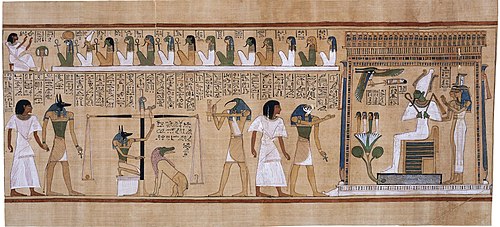
The Judgement of the Dead in the presence of Osiris — one of the most iconic scenes from the Egyptian Book of the Dead, showing the weighing of the heart against the feather of Ma'at before the assembled gods of the Duat.
Three thousand years before Plato wrote about the immortality of the soul, before the Buddha taught about the cycle of rebirth, before the Gnostics spoke of divine sparks trapped in matter — the priests of Egypt had already developed one of the most sophisticated understandings of death, consciousness, and spiritual transformation that human civilization has ever produced. They encoded it in hymns, painted it on tomb walls, sealed it in papyrus scrolls placed beside the dead, and built entire cities of stone on the west bank of the Nile — the side where the sun sets — to house the eternal bodies of their sacred dead.
Ancient Egypt was, at its deepest level, a civilization organized around the mystery of death and resurrection. Its greatest buildings — the pyramids of Giza — are not monuments to royal ego but temples of stellar alignment, designed to ensure the pharaoh's soul would join the circumpolar stars and return eternally. Its greatest literary work — what we call the Book of the Dead but which the Egyptians called Pert em Hru, "The Book of Coming Forth by Day" — is a manual for navigating the afterlife, filled with spells, passwords, and declarations of moral integrity designed to guide the soul to the ultimate prize: immortality in the presence of Osiris.
The Ennead: A Cosmological Family
Egyptian theology was not a single system but a constellation of local traditions — each city with its patron deity and creation myth — that were gradually synthesized into broader national narratives. The most influential synthesis was the Heliopolitan Ennead (nine gods), centered at Heliopolis (the City of the Sun), which told the story of creation as a family drama of cosmic proportions.
In the beginning was Nun — the primordial waters, the undifferentiated cosmic ocean from which everything emerged. From Nun rose the first mound — the benben — and upon it appeared Atum (or Ra-Atum), the self-created, the first god, who generated the first divine pair from himself: Shu (air/dryness) and Tefnut (moisture). From Shu and Tefnut came Geb (the earth) and Nut (the sky). And from Geb and Nut were born the four children whose story is the central drama of Egyptian religious life: Osiris, Isis, Set, and Nephthys.
This is the divine family at the heart of the Egyptian mystery — the Osirian cycle that would, over three millennia, absorb virtually every other Egyptian religious narrative and become the template through which every Egyptian understood their own death and transformation.
Osiris: The God Who Died and Rose
Osiris (Egyptian: Wsir) was, in the myth, the first king of Egypt — a benevolent ruler who taught humanity the arts of civilization: agriculture, law, the worship of the gods. His brother Set (god of chaos, storms, and the desert) murdered him out of envy — in the most common version, tricking him into lying in a beautifully decorated chest, then sealing it and throwing it into the Nile. The chest floated to Byblos, where it became embedded in a tree. Isis — Osiris's devoted wife and sister — searched the world for her husband, recovered the chest, and brought it back to Egypt.
Set was not finished: he found the body, dismembered it into 14 pieces, and scattered them across Egypt. Isis, joined by her sister Nephthys, searched again — gathering the pieces, reassembling them, and wrapping them in linen (the origin of mummification). The only piece never found was the phallus, eaten by a Nile fish; Isis fashioned a golden replacement.
By her magical skill — she was the greatest sorceress among the gods, the mistress of words of power — Isis breathed life back into Osiris long enough to conceive a child: Horus, the falcon-headed sky god, avenger of his father and heir to the throne of Egypt.
Osiris, having tasted death and been reconstituted by love and magic, became the king of the dead — the ruler of the Duat (the Egyptian underworld/afterlife realm) and the judge of the dead who weighed each soul's heart against the feather of Ma'at (cosmic truth and justice).
This myth is not mere folklore — it is a complete theological statement about the nature of death and transformation. Osiris is the prototype of resurrection: the one who died, was dismembered, was reassembled through love, and was reborn in a new form with new sovereignty. Every Egyptian hoped to become "an Osiris" after death — to undergo the same transformation, to be declared "true of voice" (justified) before the divine court, and to exist eternally in the Field of Reeds.

Osiris — depicted in his characteristic mummiform posture, holding the crook and flail of royal authority, wearing the Atef crown of eternal sovereignty. As the first god to die and be resurrected, he became the model and guarantor of every Egyptian's hope for eternal life.
Isis: The Great Magician
If Osiris represents the divine mystery of death and resurrection, Isis (Aset in Egyptian) represents the power that makes resurrection possible: love expressed as magical skill, grief transformed into creative force, feminine wisdom that nothing can defeat.
Isis was the greatest goddess of Egypt — and eventually of the entire ancient Mediterranean. Her cult spread from Egypt to Rome, to Greece, to the frontiers of the empire, absorbing and identifying with every local goddess she encountered. The Roman poet Apuleius, in his Golden Ass (2nd century CE), wrote what remains one of the most moving accounts of an initiation into a mystery religion ever composed — the initiation of Lucius into the Mysteries of Isis, in which the goddess reveals herself as the universal divine feminine, the source of all life, worshipped under many names but ultimately one.
Her identification as the divine mother — nursing the infant Horus on her throne — directly influenced the iconography of the Virgin Mary and Child that became central to Christian art. The image of the seated queen nursing the divine child, her throne-crown (the hieroglyph of her name is a throne) identifying her as the divine seat of power — this image traveled from Egypt to Alexandria, from Alexandria to Rome, and from Rome to every corner of the Christian world.
Esoterically, Isis represents the principle of wisdom as love — the understanding that the highest knowledge is not abstract philosophical reasoning but the passionate, searching intelligence of one who loves what they seek to understand. She recovers the scattered pieces of Osiris through the depth of her longing — a metaphor for the spiritual seeker's recovery of the scattered fragments of the divine self.
Thoth: Lord of Knowledge and the Sacred Word
Thoth (Djehuti) — the ibis-headed god of writing, knowledge, magic, measurement, and the moon — is the divine scribe and the god of all wisdom in the Egyptian pantheon. He was the inventor of hieroglyphs, the keeper of the divine records, the mediator between the gods, and the measurer of the hearts of the dead in the Hall of Two Truths.
In the Osirian myth, Thoth plays a crucial role: he is the physician who heals Horus's eye (the Wedjat, the Eye of Horus) after Set plucks it out in battle. He is also the advocate who argues for Horus's right to the throne of Egypt in the divine court. He is the god who magically reconstitutes Osiris's body and teaches Isis the spells needed to revive her husband.
Thoth is identified by the Hermetic tradition with Hermes Trismegistus — the "Thrice-Great Hermes" whose attributed writings (the Hermetica, Corpus Hermeticum) form the foundation of Western esotericism. This identification — made by Hellenistic Greeks who recognized in the Egyptian Thoth the same divine principle they attributed to Hermes — created a bridge between Egyptian and Greek wisdom traditions that would be enormously fruitful for the subsequent development of mystical philosophy.
The wisdom tradition attributed to Thoth — and transmitted under the name Hermes Trismegistus — claimed to preserve the original wisdom of Egyptian civilization: a knowledge of the cosmos, the soul, and the divine that predated any particular religious form and could be directly apprehended by the prepared mind.

Isis — wearing her throne-crown (the hieroglyph of her name), her wings spread in the protective gesture that sheltered Osiris in death and Horus in life. As the mistress of magic and divine wisdom, her cult spread from Egypt across the entire Mediterranean world.
The Egyptian Soul: Ba, Ka, Akh, and Their Companions
One of Egypt's most remarkable contributions to spiritual philosophy is its understanding of the human being as a complex of multiple subtle bodies — not a simple soul/body dualism but a rich ecology of different soul-aspects, each with its own role and destiny.
Ka — the vital double or life force, created simultaneously with the physical body and sustaining it throughout life. The Ka was represented by two upraised arms and was associated with nourishment, sexuality, and the fundamental life force. After death, the Ka remained in the tomb, fed by offerings.
Ba — the personality soul, the unique character of the individual, depicted as a human-headed bird that could move freely between the land of the living and the Duat. The Ba visited the body at night and could travel to the divine realm, returning each morning like the rising sun. The Ba needed the preserved body to return to — which explains the theological centrality of mummification.
Akh — the luminous, transfigured soul: what the Ba and Ka became after successful transformation through the afterlife judgment. The Akh was a being of light, a "shining one," who joined the imperishable stars (the circumpolar stars that never set in the Egyptian sky) and existed eternally in the divine realm. Becoming an Akh was the goal of the entire Egyptian funerary tradition.
Ren — the name: one of the most sacred of a person's soul-aspects, because the name sustained existence. To speak someone's name was to sustain them; to erase a name was to destroy a person from existence entirely.
Sheut — the shadow: a protective soul-aspect, the person's shadow as a living spiritual entity. The shadow also had to survive the afterlife journey.
Ib — the heart: the seat of intelligence, will, memory, and moral character. In the Hall of Two Truths, the heart was weighed against the feather of Ma'at — and if it was heavier (burdened by wrongdoing), the soul was devoured by Ammit, the crocodile-headed beast. If balanced, the soul was declared "true of voice" and admitted to eternity.
The Hall of Two Truths: The Weighing of the Heart
The climactic moment of the Egyptian afterlife journey — depicted on virtually every papyrus of the Book of the Dead and in countless tomb paintings — is the Weighing of the Heart before Osiris and the 42 Assessors of the Dead.
In this judgment, the deceased must first recite the Negative Confession — a declaration of innocence before each of the 42 Assessors, each governing a specific moral domain: "I have not robbed the poor. I have not killed. I have not lied. I have not stolen offerings from the gods..." This is not a confession of sin but a declaration that the soul has lived in alignment with Ma'at — cosmic truth, justice, and harmony.
Then the heart is placed on the scale against the feather of Ma'at, while Thoth records the result and Anubis (the jackal-headed god of embalming and the psychopomp) adjusts the scales. If the heart is light — free of the weight of wrongdoing — the soul is declared justified and welcomed by Osiris into eternal life. If it is heavy, the beast Ammit (part crocodile, part lion, part hippopotamus) devours it, and the person ceases to exist.
The theological sophistication of this judgment is remarkable: it is not about faith or ritual participation but about moral character — how one actually lived, whether one's actions were in alignment with the cosmic order. Three thousand years before the Last Judgment of Christian eschatology, the Egyptians had already developed a detailed moral accounting of the soul — one that emphasized ethical behavior in daily life as the foundation of spiritual salvation.
The Egyptian Legacy in Western Esotericism
The influence of Egyptian religion on the subsequent development of Western mystical and esoteric thought cannot be overstated. Through the Hellenistic synthesis at Alexandria — where Egyptian, Greek, Jewish, and later Christian wisdom traditions met and cross-pollinated — Egyptian ideas about the soul, the cosmos, and the divine permeated the entire subsequent history of Western spirituality:
The Hermetic tradition (attributed to Thoth-Hermes Trismegistus) directly transmitted Egyptian cosmological and soul-philosophical ideas into the Renaissance esoteric revival that gave birth to Rosicrucianism, Freemasonry, and the Golden Dawn. The Hermetic principle of "as above, so below" is a Greek philosophical formulation of Egyptian cosmic correspondence thinking.
Neoplatonism — the most influential philosophical current of late antiquity — drew directly on Egyptian priestly wisdom, particularly through the figure of Plotinus (who studied in Alexandria) and Iamblichus (who explicitly incorporated Egyptian theurgy into his system).
The Egyptian concept of the Akh — the luminous, transfigured soul that joins the imperishable stars — resonates with every mystical tradition's ultimate aspiration: the return of the individual consciousness to its divine source, transformed and glorified by the journey through earthly existence.
And the myth of Osiris — dead, dismembered, reconstituted, and resurrected — remains one of the deepest templates in human spiritual imagination for what spiritual transformation means: not mere improvement but death and rebirth, the dissolution of what was into something unrecognizably more luminous.
— Lux Esoterica


Comentarios