Ancient Egyptian Gods: The Divine Pantheon of the Nile
The gods of ancient Egypt were not distant abstract forces. They were immanent — present in the flooding of the Nile, in the rising of the sun, in the face of the pharaoh, in the sacred animals that moved through the land as their living embodiments. For three thousand years, through dynasty after dynasty, through conquest and conversion and the slow transformation of language and culture, the Egyptian pantheon maintained its essential character: a system of cosmic principles expressed as beings with animal heads and human bodies, whose relationships with each other encoded the fundamental dynamics of the universe. Ra sailed his solar barque across the sky; Osiris died and was resurrected; Horus fought Set and won; Isis gathered the scattered pieces of what had been broken. These were not myths in the diminished modern sense — they were descriptions of what actually happens, told in the only language adequate to their subject.

Tomb of Horemheb — Pharaoh Horemheb before the gods in the Valley of the Kings; the formal presentation of offerings to the divine was not merely ritual but a cosmological act maintaining the order (Ma'at) of the universe

Amun-Ra Kamutef — the great syncretism of the New Kingdom; Amun, the hidden god of Thebes, merged with Ra, the solar god, to become the supreme deity of the Egyptian pantheon from approximately 1550 BCE onward

Ramesses II with Ptah and Sekhmet — Ptah, the craftsman-god of Memphis (whose name may be the origin of 'Egypt'), and Sekhmet, the lion-headed goddess of war and healing, flanking the Great Pharaoh

Hathor — the cow-goddess of love, beauty, music, and the sky; her name means 'House of Horus'; she was simultaneously the mother of the pharaoh, the goddess of the western horizon, and the patroness of the dead

Mut nursing Pharaoh Seti I — the vulture goddess Mut, consort of Amun, nursing the pharaoh in a scene that legitimizes royal power by establishing its divine origin; the pharaoh was understood as the living Horus

Nut — the sky goddess arching over the earth (Geb, her consort); each evening she swallowed the sun, and each morning gave birth to it; the deceased pharaoh was also swallowed by Nut and reborn as a star

Temple relief at Abydos — the great cult center of Osiris, where the sacred drama of his death and resurrection was performed annually; Abydos was the most important pilgrimage site in ancient Egypt for over two thousand years

The Temple of Horus at Edfu — the best-preserved ancient Egyptian temple, built between 237 and 57 BCE; its walls encode the Edfu Building Texts, which describe the reconstruction of the primordial sacred sites after the great flood of Zep Tepi

Sokar-Osiris — the syncretized form of the underworld deity and the god of resurrection; the Book of the Dead illustration shows the deceased navigating the Duat (underworld) toward the Hall of Two Truths
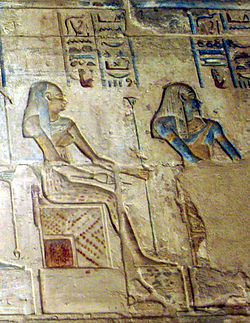
Nun and Naunet — the primordial pair of the Ogdoad of Hermopolis, representing the infinite dark waters of the pre-creation void; before all things, there was only Nun — the undifferentiated potential from which all existence emerged

The Eye of Horus (Wadjet) — one of the most potent protective symbols in Egyptian religion, representing the eye that Set tore from Horus and Thoth restored; it encodes a mathematical fraction system based on the parts of the eye

Bes — the dwarf lion-god of the household, childbirth, sexuality, and protection against evil spirits; one of the most beloved and widely depicted deities in Egyptian popular religion, distinct from the great temple gods

Early dynastic amulet — from the period of Narmer (c. 3100 BCE), the unifier of Upper and Lower Egypt; Egyptian religious iconography maintained its essential character from this moment through the Ptolemaic period — three thousand years of continuity


Comentarios