Día de los Muertos: Mexico's Sacred Conversation with the Dead
On the night of November 1st and through November 2nd, the cemeteries of Mexico come alive. Families arrive with marigolds, candles, food, photographs, and the favorite objects of their dead relatives and construct, around the graves, elaborate altars (ofrendas) that invite the souls of the deceased to return for one night to the world of the living. The air is thick with the scent of marigold (cempasúchil), whose color and smell are believed to guide the souls home along the path from the land of the dead. This is not a morbid ritual. It is a joyful reunion — a night of music, food, and conversation with the absent, in which death is not denied or hidden but integrated into the fabric of ordinary life. The Día de los Muertos tradition synthesizes two streams: the pre-Columbian Aztec festival of the dead (the month of Miccailhuitontli, dedicated to the goddess Mictecacihuatl, lady of the dead), and the Catholic feasts of All Saints and All Souls introduced by Spanish missionaries — a mestizo synthesis as characteristically Mexican as the culture itself. Its most iconic figure, La Catrina — the elegant skeleton woman in a wide-brimmed hat, created by the printmaker José Guadalupe Posada and popularized by the muralist Diego Rivera — is not a symbol of death's power over life but of death as the great equalizer: the aristocrat and the peasant, the skull beneath the hat the same for both.
 [Unavailable: ❌ https://upload.wikimedia.org/wikipedia/commons/thumb/6/68/Catrina_3.jpg/250px-Catrina_3.jpg ❌]
La Catrina — the skeleton woman in her elaborate hat, the most iconic figure of the Día de los Muertos; created as a political cartoon by José Guadalupe Posada (c. 1910) to mock upper-class Mexicans who adopted European fashions and denied their indigenous heritage; Diego Rivera incorporated her into his famous mural 'Dream of a Sunday Afternoon in Alameda Park' (1947), giving her a body and a name
 [Unavailable: ❌ https://upload.wikimedia.org/wikipedia/commons/thumb/a/ac/Posada2.Catrina.jpeg/250px-Posada2.Catrina.jpeg ❌]
La Calavera Catrina by José Guadalupe Posada (c. 1910) — the original zinc etching; Posada's skeleton figures (calaveras) were published in Mexican popular broadsheets as political and social satire; the skeleton as the democratic equalizer — everyone's skull looks the same — was a pre-existing Mexican tradition that Posada elevated into high political art; 'Death is democratic,' the image says, 'because in the end, she takes everyone'
 [Unavailable: ❌ https://upload.wikimedia.org/wikipedia/commons/thumb/1/1e/Altardediademuertos.jpg/250px-Altardediademuertos.jpg ❌]
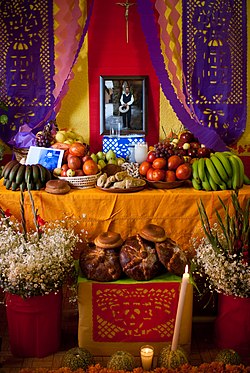
Ofrenda (altar) for Día de los Muertos — the altar is built in layers, each level with its own significance; photographs of the deceased, marigolds (to guide the soul home by scent and color), candles (to light the path), food and drink (the deceased's favorites), and sometimes personal objects; the altar is an act of love and memory, its construction as important as its contents
 [Unavailable: ❌ https://upload.wikimedia.org/wikipedia/commons/thumb/a/a6/Oaxaca_Mexico-_personal_family_shrine_for_Day_of_the_Dead.jpg/250px-Oaxaca_Mexico-_personal_family_shrine_for_Day_of_the_Dead.jpg ❌]
Family ofrenda, Oaxaca — the state of Oaxaca is considered the heart of the Día de los Muertos tradition, its celebrations among the most elaborate in Mexico; the Oaxacan tradition includes the construction of elaborate sand tapestries (tapetes de arena) depicting sacred imagery on the streets leading to the cemeteries, so that the souls walk in beauty on their return
 [Unavailable: ❌ https://upload.wikimedia.org/wikipedia/commons/thumb/4/48/Flower_of_the_Dead_%C3%A1nima_%28memorial%29.jpg/250px-Flower_of_the_Dead_%C3%A1nima_%28memorial%29.jpg ❌]
Cempasúchil (marigold) memorial — the marigold's vivid orange-yellow color and strong scent were believed by the Aztecs to have the power to attract the souls of the dead; the path from the grave to the family home is strewn with marigold petals, a fragrant road of the living extending into the domain of the dead; the flower's name in Nahuatl means 'twenty flowers'
 [Unavailable: ❌ https://upload.wikimedia.org/wikipedia/commons/thumb/d/de/CemetarioAlmoloyaRio1995.jpg/250px-CemetarioAlmoloyaRio1995.jpg ❌]
Cemetery celebration, Almoloya del Río, 1995 — families spending the night in the cemetery with their dead; candles illuminate the graves, marigolds cover every surface, food is arranged on the graves for the returned souls; this is not mourning — it is a reunion; the dead are present, the living are with them, and the boundary between the two states is, for this one night, permeable
 [Unavailable: ❌ https://upload.wikimedia.org/wikipedia/commons/thumb/6/6f/Dia_de_los_Muertos_Celebration_in_Mission_District_of_San_Francisco%2C_CA.jpg/250px-Dia_de_los_Muertos_Celebration_in_Mission_District_of_San_Francisco%2C_CA.jpg ❌]
Día de los Muertos celebration, Mission District, San Francisco — the tradition has spread beyond Mexico to Mexican-American communities throughout the United States; the face-painting (calavera makeup) that has become the most visible symbol of the holiday in its global form originated in theatrical and community celebration rather than in the traditional domestic ritual; the tradition adapts without losing its essential logic: the dead are not forgotten
 [Unavailable: ❌ https://upload.wikimedia.org/wikipedia/commons/thumb/1/1a/FilAm_Ofrenda.jpg/250px-FilAm_Ofrenda.jpg ❌]
Community ofrenda — the collective altar in a public space extends the domestic tradition to the broader community; in its public form, the ofrenda becomes a memorial to all the dead of a neighborhood, city, or cause — a statement that the community's relationship with its ancestors is collective as well as personal; the Día de los Muertos in its public form has become a vehicle for political memorialization, including for victims of violence and injustice
Related Esoteric Inquiries:
- Dziady: The Slavic Feast of the Forefathers and the Food Left for the Dead
- Chinese Ritual Bronzes: The Sacred Vessels of the Shang and Zhou
- Pacific Sacred Art: Easter Island, Maori, and the Oceanic Imagination
Lux Esoterica.
2026.


Comments